Learn Music: Tradition, Technology and the Human Voice
Doctorate in World Music, University of Oxford · teaching since 1992. More about the teacher.
Learning music in 2026 is no longer about information. Lessons, tutorials, apps and teachers abound. The task is learning to choose: how to keep the discipline of tradition, how to use AI and online tools without letting them do the listening for you, and how to train the human voice — at a time when a machine can produce a finished-sounding song in seconds. This guide explains that triangle, whether you study singing, piano, guitar, harmonium, flute or ukulele in Jalandhar or through online music classes worldwide.
Why does tradition still decide whether you sound musical?
A tuner can tell you you are flat. It cannot tell you why that note mattered. That judgement comes from tradition — not nostalgia, but tested method.
What fundamentals never change?
Breath control, pitch discipline, listening sensitivity and bodily awareness still form the skeleton of musical skill. A raga is still learned through patient immersion; Western counterpoint still rewards those who wrestle with its logic. Technology does not erase these skills. It exposes habits that never learned them.
Daily riyaz is the laboratory. Singers who practise alankars and paltas at a steady pulse, pianists who give ten quiet minutes to scales with a metronome, and guitarists who drill clean chord changes before songs all build the same thing: a body that remembers accurately. No app replaces that repetition.
If you are choosing where to begin, start with the instrument you will touch daily. Many beginners start with singing classes in Jalandhar or piano and keyboard classes for immediate feedback, while others begin with guitar classes in Jalandhar for the quick reward of a complete song.
How does lineage give you musical judgement?
Tradition is intellectual inheritance. The guru–shishya parampara and the sequential rigour of a Western conservatoire carry methods pressure-tested for generations. They teach what to prefer: which ornament is tasteful, which tempo respects the bandish, when silence is better.
Learn the grammar first from a teacher you trust, then add the device. For vocabulary across traditions, see Western and Hindustani terms and Indian classical for beginners.
How should you use AI and technology without losing musicianship?
AI is the most polite disruptor of our era. It offers help, stays quiet, and never insists. That politeness is the risk.
Is AI a teacher or a mirror?
Artificial intelligence now analyses pitch stability, timbre and rhythmic accuracy with striking precision. Used well it becomes a diagnostic mirror — a microscope that reveals detail without prescribing meaning. A pitch map can show your held Sa wavers after four seconds; it cannot teach you to mean that Sa.
Treat AI as feedback, not curriculum. Use a tuner or rhythm app for a short block, then close the screen and sing or play the same material acoustically. If the improvement survives without the display, you own it. The wider picture is explored in AI in Music Education: Revolution, Threat or Mirage? and in Incorporating Technology Tools into Modern Music Education.
How do online classrooms change access and responsibility?
High-fidelity microphones have dissolved geography. A student in Punjab can study harmony with a teacher in London while continuing riyaz with a teacher in Mumbai the same evening. Access has improved; guidance remains human.
The change transfers responsibility to the learner. You must curate: choose credible sources, resist instant gratification, keep a simple practice log, and protect attendance. Learners who follow the habits in How Long Does It Take to Learn Music? Practice, Lessons and Progress and avoid the errors in 7 Beginner Mistakes at Music Classes (and Fixes) adapt fastest. Every online plan at Dr Banerjee Music still begins with a live intro session — devices, camera angles and syllabus agreed first — so technology serves the lesson. See online music classes worldwide and Best Music Classes for Kids in Jalandhar.
Why is the human voice still the one instrument technology cannot replace?
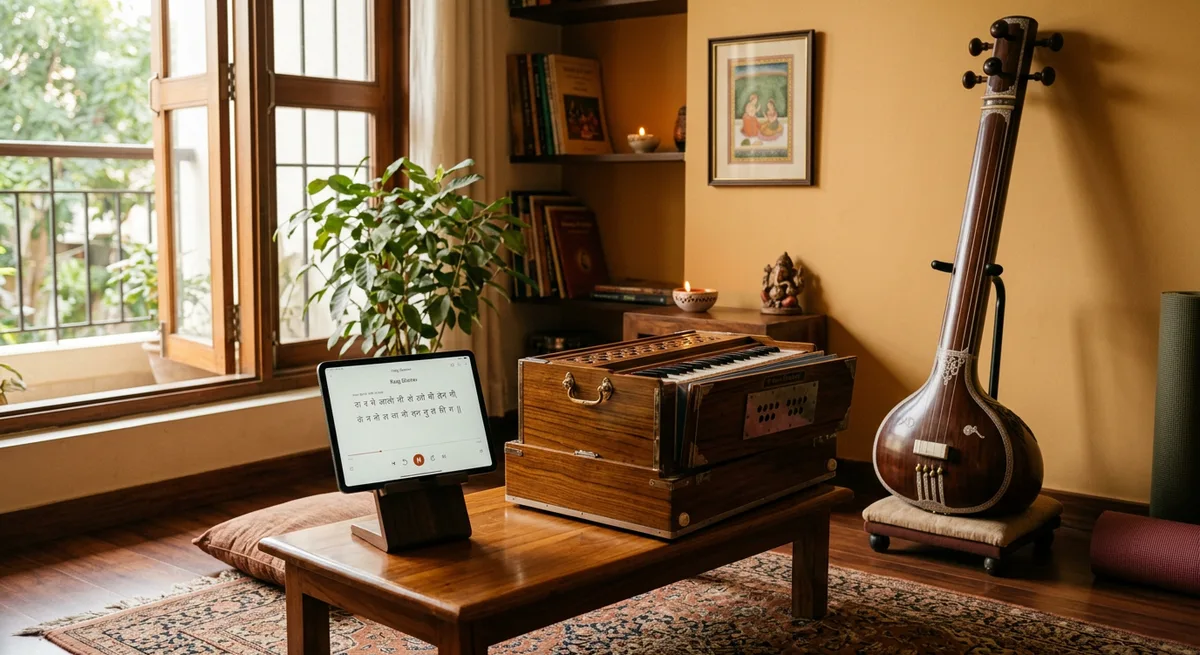
The voice is resistant to shortcuts. It is fragile, intimate and honest. You can edit a keyboard part after the take; the voice reveals discipline in real time.
Tone lives in breath, pitch in listening, and expression in restraint. Traditional riyaz builds strength — sustained vowels, meends between swaras, controlled dynamics — while acoustic analysis can refine clarity after the work. The body and the screen collaborate rather than compete.
Singers, even modest ones, often learn faster on other instruments because their ears are already calibrated. Training that includes voice culture and diction, such as singing classes in Jalandhar and Indian classical music classes in Jalandhar, develops listening that transfers to flute and bansuri and ukulele.
Watch, from the studio channel, how a bandish is taught as a complete lesson — words, sargam and phrasing together. Each player below loads only when you tap play:
More lessons are on the official channel at Dr Banerjee Music on YouTube — direct links if embeds do not load: Ae Ri Aali · Jaago Mohan Pyare.
What changed between 2025 and 2026 — and what did not?
What has changed is distribution. What has not is development.
AI-made music went mainstream, and licensed. In late 2025 Warner Music settled its lawsuits with the AI song generators Suno and Udio, and Universal Music settled with Udio, with licensed models following through 2026; Sony's claims are still open. For a learner the practical result is simple: you will hear more machine-made music, some of it polished. That makes a trained ear more valuable, not less, because the ear is what tells you whether a phrase breathes, whether a meend is sung or stitched, and whether a song means anything.
Streaming now separates tools from impersonation. In September 2025 Spotify said it had removed more than 75 million spam tracks in the previous twelve months, brought in a filter against mass uploads, banned unauthorised voice clones and committed to showing AI use in song credits. The useful line for a student: using software to check your pitch is practice; using software to sound like a singer you are not is not musicianship, and cloning a real artist's voice without permission is now against the platforms' own rules.
Graded exams became more recorded. ABRSM's Performance Grades and Trinity's Digital Grades are assessed from a video recorded at home, and since December 2025 Trinity digital submissions go through its MyTrinity site. A recorded exam rewards the same habit as good riyaz: playing a piece through, once, without stopping to fix it — so it is worth recording full run-throughs well before exam day, whether you will sit the exam in a hall or on camera.
What did not change is the body. It still learns between sessions, not during them. Today's learners battle saturation; the students who progress limit sources and repeat a small set daily. A simple log after each session — what you played, what broke, what to repeat tomorrow — makes skipping visible. This literacy — respect for heritage, selective use of tools, daily attention to the voice — keeps you musical when platforms change, as they did again this year.
How can you practise this triangle in a normal week?
| Axis | What tradition gives you | What technology gives you well | What to test without the screen |
|---|---|---|---|
| Tradition | Raga grammar, tala structure, paltas and bandish; Western scales and harmony sequence | Notation software for clean parts; metronome for steady tala | Sing the bandish or play from memory, at tempo, without visual aid |
| Technology | A mirror, not a master — tuner, pitch map, DAW for listening back | Immediate feedback on isolated skills; recording to hear yourself honestly | Close the app and repeat: if accuracy survives, you own it |
| Voice | Riyaz for breath, placement and listening; diction that carries meaning | Acoustic analysis for clarity; quality mic and room for online lessons | Record once a week and compare this month with last month |
A practical shape for most beginners:
- Maintain two classes a week where possible, so corrections stay frequent.
- Between classes, keep five or six short sessions of twenty to thirty minutes.
- Begin every session with two minutes of breath and tuning, then the teacher’s single priority for the week, then repertory as reward.
- End each session with the three-line log. Over a month the log becomes your teacher between teachers.
- Once a month, record one full run-through on your phone without stopping, and listen back the next day.
For device and sound checks before the first online lesson see Online Music Lesson Setup: 5-Minute Checklist and the essays Learning Music in the Age of Distraction and Why Reels and Shorts Cannot Teach Music.
Frequently Asked Questions
Can AI replace a music teacher?
AI can analyse pitch, timing and tone with impressive accuracy, and it can now generate whole songs, but it cannot teach musical judgement, cultural context or expressive choice. Use it as a diagnostic mirror between lessons — check an isolated skill, note the correction, then close the screen and reproduce the improvement acoustically with guidance from a teacher who knows your voice or hands.
How long does it take to learn music properly?
You stabilise different capacities at different rates. The ear develops first, then bodily coordination, then musical thinking over years. Under regular twice-weekly classes and short daily riyaz, beginners usually hear clear steadiness within months, and repertoire ease over one to two years of consistent practice rather than by calendar alone.
What is the best way to practise music as a beginner today?
Keep it short and regular, protect attendance, and limit sources. Agree one priority per week with your teacher, practise it for twenty to thirty minutes on five or six days, log what broke and what to repeat tomorrow, and record once a month to compare with yourself. That simple cycle beats any collection of disconnected tutorials.
Questions about anything in this article? WhatsApp +91-62800-75157 or email drbnrj@gmail.com.