AI in Music Education: Revolution, Threat, or Mirage?
Doctorate in World Music, University of Oxford · teaching since 1992. More about the teacher.
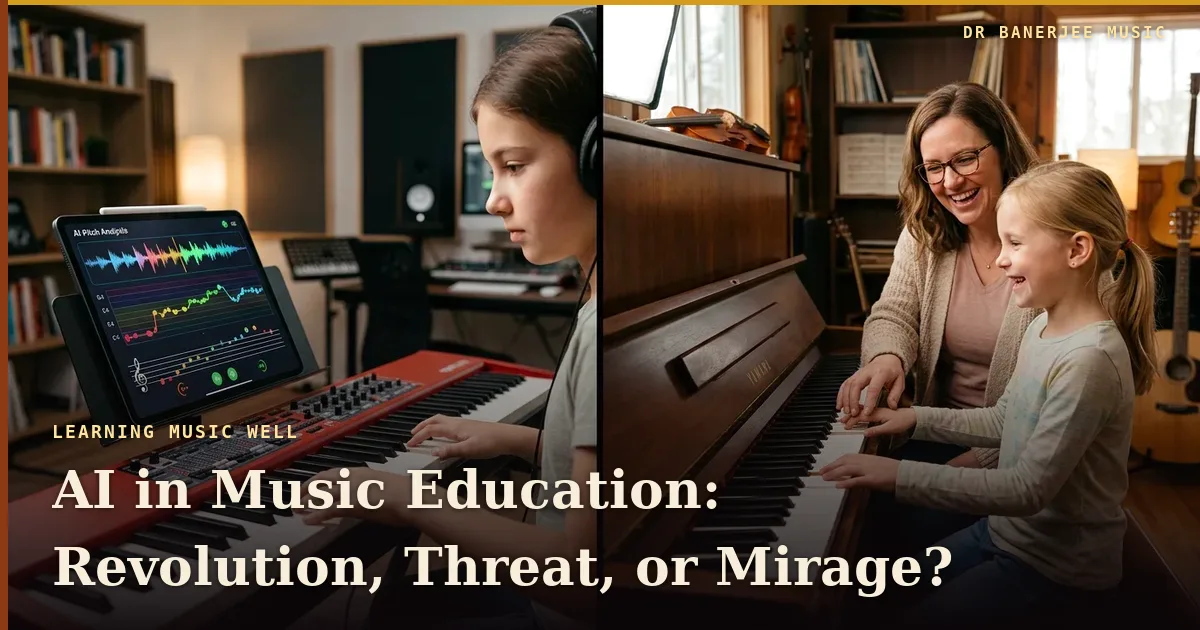
Artificial intelligence can check whether you sang flat or suggest the next chord in seconds. That is useful, but it is not the same as learning music. This guide explains what AI does well, where it fails, why Indian classical music exposes its limits, and how to use it without losing musicianship. If you study singing, guitar, piano, harmonium, flute or ukulele — in Jalandhar or through online music classes worldwide — the hybrid model below keeps the machine as a tool and the teacher as the guide.
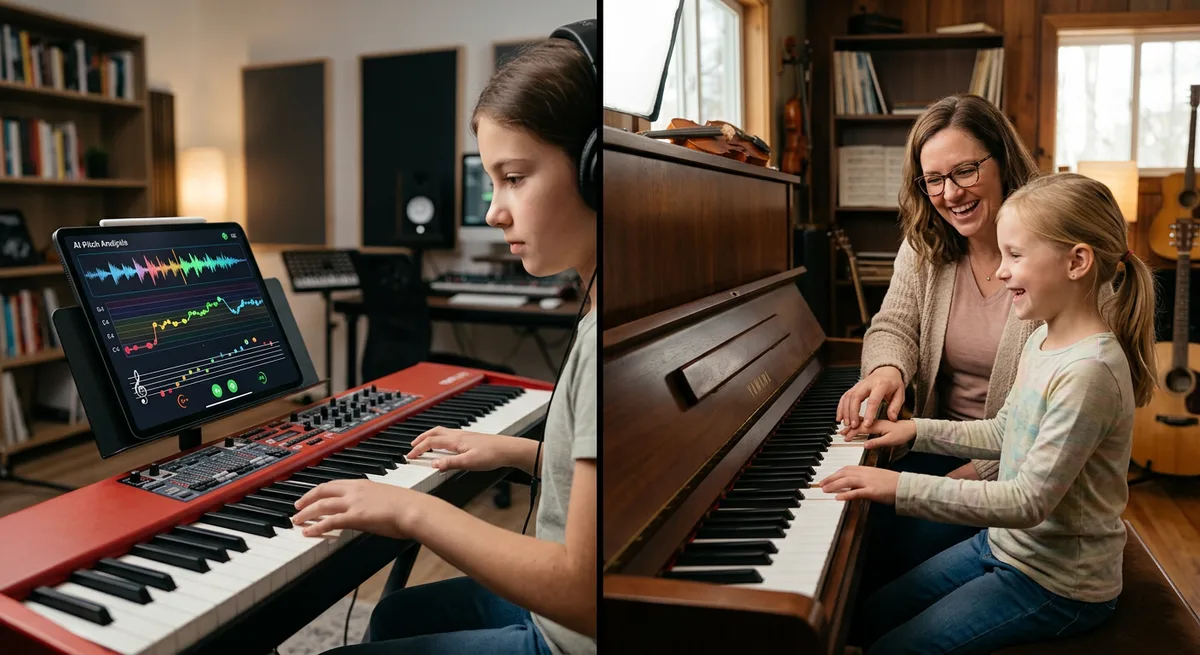
Save this guide: AI manages mechanics between lessons; the teacher shapes judgement in the lesson.
What can AI do well for music students?
AI is confident with patterns. Given enough data it will spot a rushing tempo, a late chord change or a drifting Sa with impressive consistency. For a beginner that feels liberating: the machine does not tire, does not judge and does not forget yesterday’s drill. It also helps access — a student without daily teacher contact can get immediate feedback on basic accuracy.
Practical strengths are real:
- Practice analytics. Track tempo, pitch stability and repetition counts without guesswork.
- Ear-training support. Generate intervals, chord types or raga phrases on demand.
- Composition prompts. Models inspired by Suno can sketch a progression to unblock ideas, if you do not mistake the sketch for a finished thought.
- Workflow help. Scheduling, sheet formatting and quick video review are chores machines handle well.
These make learning more accessible when they stay in their lane. The risk appears when students ask the tool to act as a teacher. AI is excellent at noticing deviation; it is poor at explaining why a choice matters musically. That explanation — cultural and aesthetic — remains human work.
Where does AI still fail in music learning?
Music is a physical, cultural and emotional practice shaped by breath, tension and memory. Three gaps persist.
Why does emotion and phrasing resist automation?
A tuner can say you were 12 cents sharp. It cannot say why a phrase should linger to suggest longing, or why a meend between two swaras must float rather than slide. In Indian classical singing the truth of a phrase lives in micro-timing and breath. AI maps movement; it does not justify meaning.
Why is aesthetic judgement not computable?
Students ask, “Is this good enough?” AI can only say whether your take matches its training data. True judgement asks: does the ornament suit the raga’s character? Is the tempo honest to the bandish? Those answers depend on cultural memory and artistic identity — none of which a model possesses.
Why does the teacher-student relationship matter?
A good teacher provokes — shifts your perspective, challenges a habit and protects confidence while raising standards. That provocation builds personality alongside technique. AI offers correction without provocation, and music thrives on provocation. See also why short videos cannot teach music and how attention itself has become the first instrument to practise.
Why does Indian classical music expose AI's limits?
Try an alap. In Hindustani music an alap is not a test of competence; it is revelation — slowly uncovering a raga’s character without a click or score. AI can label swaras, but it does not hear:
- Shruti — microtonal shades that colour a raga
- Rasa — the emotional essence that makes one raga tender and another austere
- Space and silence — the pause that shapes tension more than any note
- Improvisation — choices made in the moment, never by formula
- Discipline and freedom together — the paradox mastery requires
The machine hears frequencies; the musician hears intention. That is why why raga apps fail remains a warning: the app is precise about pitch and vague about music. Learning a raga still depends on riyaz and on understanding fundamental terms such as shruti and swara before you outsource listening to software.
How should you use AI without losing musicianship?
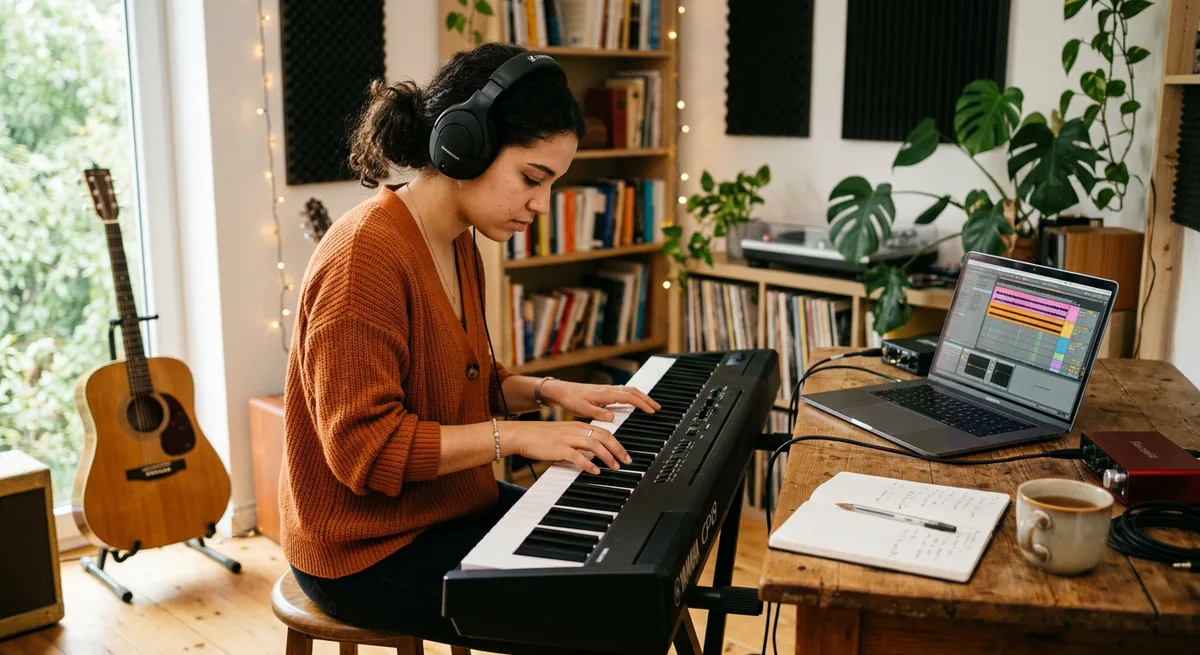
Treat AI as a tool, not a teacher. Let the machine manage mechanics; let the teacher shape judgement.
A healthy workflow:
- Use AI between lessons for diagnostics — check a held Sa, count tempo drift, generate ear-training — then bring questions, not conclusions, to your lesson.
- Keep slow, deep practice non-negotiable. Long tones, alankars and paltas at a steady pulse are where judgement is built. See how long it really takes to learn music.
- Insist on human feedback on the same material weekly. If AI says “in tune” and your teacher says “in tune but lifeless,” trust the teacher.
- Record short takes and reflect before you re-run the app. Machines reward repetition; musicianship rewards attention.
The most dangerous online story is that AI can make you “play like a professional in seven days.” That confuses speed with depth. AI accelerates feedback; only disciplined work builds wisdom.
Can AI replace a good music teacher?
No. It will, however, replace a poor one — the teacher who only corrects notes without cultivating artistry. AI already does that faster and cheaper.
A good teacher hears intention behind the error, places a phrase inside a tradition, chooses when to withhold correction so you learn to hear yourself, and carries you through plateaus no dashboard can cheer you through.
The near future belongs to a hybrid model:
Human teacher + AI tools = structurally efficient, artistically grounded learning.
The machine handles repetition and quick checks; the teacher handles phrasing, culture and long-term direction. Build your timetable around human lessons first, then slot AI checks around them — not the other way round. For organising that routine, see how to practise effectively and online setup.
Music remains one of the few disciplines where soul matters as much as skill. Use AI to see the notes more clearly; learn from a teacher to understand what the notes are for.
Frequently Asked Questions
Can AI teach me to sing or play from scratch?
AI can guide basic accuracy — pitch, timing and repetition — but it cannot teach phrasing, tone or judgement. Beginners benefit most when AI handles daily checks and a teacher shapes technique, posture and listening from the first weeks, so habits are formed correctly rather than quickly.
Is AI better than a human music teacher?
No. AI is faster at detection and patient with drills. A good teacher is better at interpretation, cultural context and long-term planning. The strongest progress comes from combining both: AI for mechanics between lessons and a teacher for meaning inside the lesson.
How can I use AI for riyaz and ear training without harming my progress?
Keep AI diagnostic, not decisive. Use it to track pitch stability or generate intervals, then test improvement in slow, teacher-guided practice. Record, listen without the app and let your teacher confirm whether the change is musical as well as correct.
Will AI make music teachers redundant?
It will replace teachers who only correct mistakes. Teachers who teach judgement, repertoire and artistry become more valuable as tools improve, because students need help deciding what is worth practising. The future favours teachers who integrate tools thoughtfully.
Is AI feedback reliable for Hindustani classical music and raga riyaz?
Only for narrow tasks such as stable pitch holding. For shruti, meend, rasa and alap structure, AI misses essential information. Treat app scores as rough signals and rely on a trained teacher for anything that concerns raga character or expression.
Questions about anything in this article? WhatsApp +91-62800-75157 or email drbnrj@gmail.com.