The Best Music Classes for Kids, From Age Seven

Doctorate in World Music, University of Oxford · teaching since 1992. More about the teacher.
The best music classes for kids are the ones a seven-year-old still wants to attend in week eight. That is the whole test, and it has very little to do with the school's reputation or how impressive the brochure looks. What follows is what actually keeps a child playing — the age, the length of the lesson, the price and the first instrument — from thirty years of teaching, in person and live online across India. Fees are as of September 2026, in INR.
The age, and the lesson that fits it
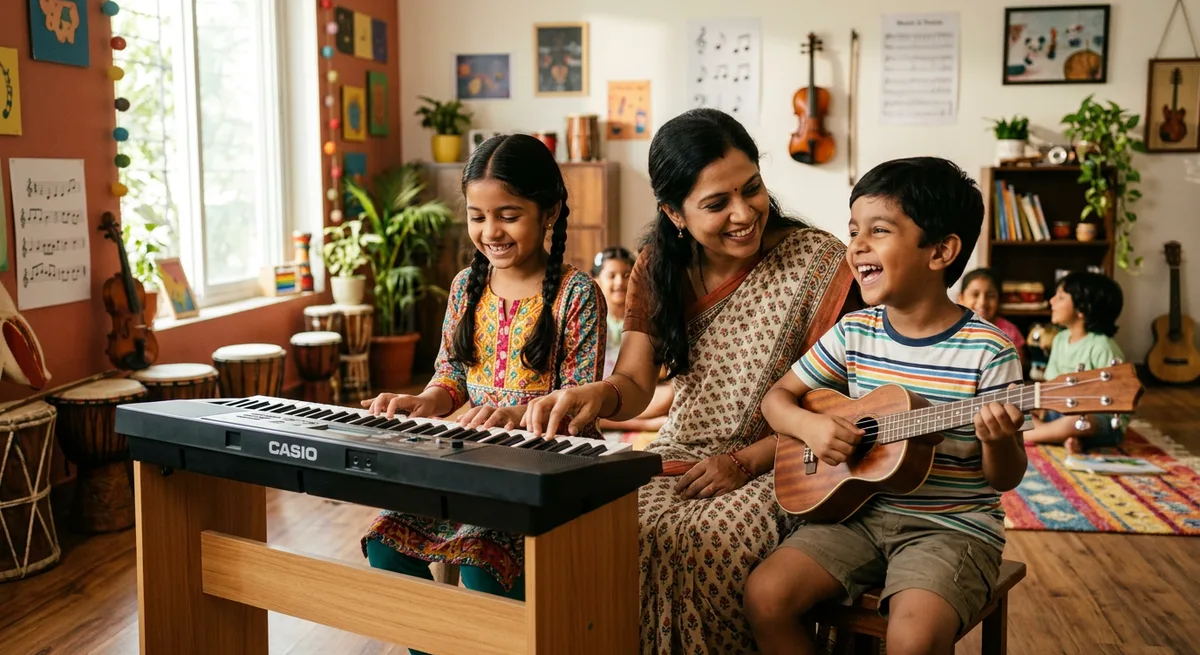
Classes take children from age seven — old enough for thirty focused minutes, young enough that music settles in before self-consciousness does. A one-to-one class runs 45 to 60 minutes, sized to the child's attention rather than the clock; group batches run 6–10 students, which for many children is the friendliest possible first year, because the child next to them is fighting the same chord change.
Online works better for children than most parents expect. The camera stays on the hands, the parent is already in the room, and there is no travel at the end of a school day. Where online is genuinely weaker — a first-year group of seven-year-olds, and anything that needs the teacher to physically adjust a wrist — I say so rather than pretend otherwise.
What kids' classes cost
Physical group classes for singing are ₹1,000 per month per student, and online group classes are ₹2,000 per month per student. Physical one-to-one is ₹2,500 per 8 classes (any one instrument — guitar, piano and keyboard, harmonium, flute and bansuri, ukulele) and ₹3,500 per 8 classes (singing), while online one-to-one is ₹3,500 per 8 classes. All are the standard fees, not a children's rate: a child pays what an adult pays, and the full list with the rules attached is on what music classes cost.
For students outside India the rate is confirmed individually before the first class rather than published. There is no card form on this website and there will never be one.
The two instruments kids pick most
Piano and keyboard — the sound is instant, the notes are laid out in plain sight, and reading music makes visual sense on a keyboard before it makes sense anywhere else. Guitar — the first song arrives quickly, the instrument travels to grandparents, and being a guitarist needs no explaining at school. Both lead somewhere: the piano and keyboard classes and guitar classes pages describe the same path a child follows.
If the child is drawn to Indian music rather than Western, the harmonium and Indian classical vocal pages cover that route, and the two are not competitors — plenty of students do both.
Helping practice stick at home
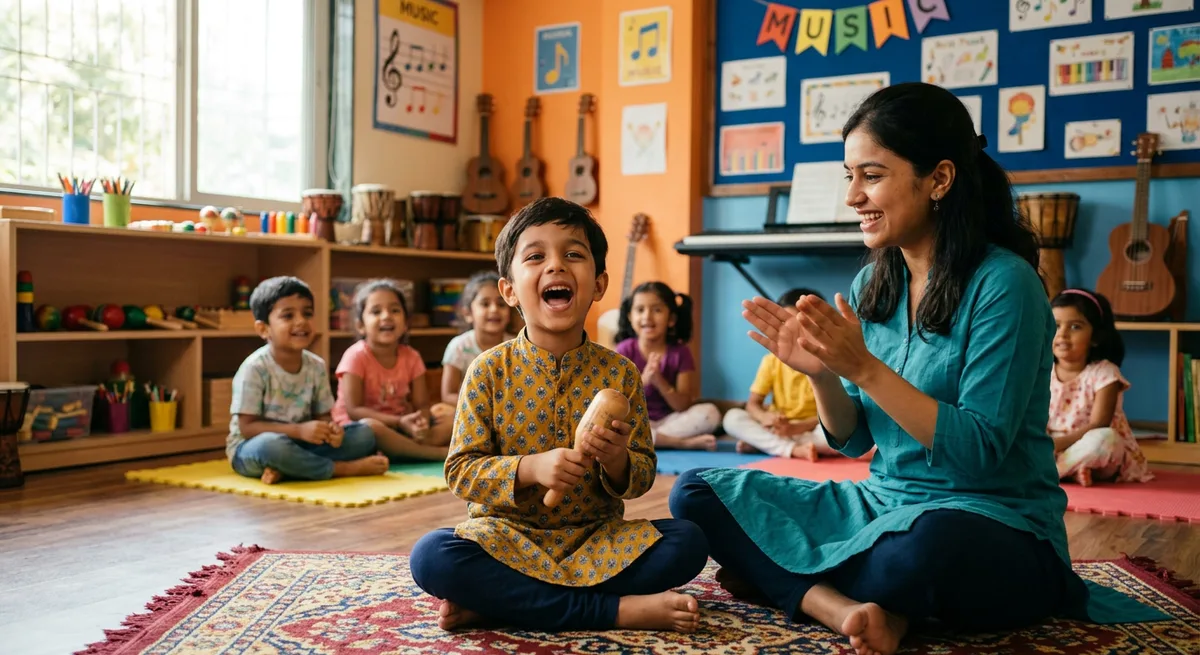
Short and same-time beats long and occasional: fifteen to twenty minutes, daily, at a fixed slot, is the whole method. Praise the sitting-down, not the talent — a child praised for practising practises. Practice notes follow every class, so the parent's job is only the calendar, not the teaching.
What to check before you pay anyone
Ask these four questions of any teacher, here or elsewhere. The answers tell you more than any review.
- Who actually teaches the class? An academy that takes your money and sends a different student each month is not the same offer as a teacher who teaches every class themselves.
- Is there a free introductory or demo session? A teacher confident in the fit does not need to charge for an initial meeting before paid classes begin.
- Can you sit in? For a seven-year-old you should be able to.
- What happens in month three? If the answer is only "more of the same", ask what the child will be able to do by then.
At the studio in Jalandhar
Children in and around Jalandhar can also come to the studio in person. A studio student performing at her school's ASMUN 7.0 event at Apeejay School, Jalandhar — tap to play, loads only on tap:
Direct link if embed does not load: Student: Miss. Atinder Kaur performed in the event ASMUN 7.0 | Apeejay School, Jalandhar
For in-person students, a one-time visit to the studio is required before classes begin — one meeting, once, so the first class is with a teacher the child has already met. Online students never visit Jalandhar: every online plan starts instead with a free 15–30-minute demo class, where days, timings, syllabus and progression are agreed. The address, the timetable and the map are on the in person page.
Reading and lesson routes
For individual work on the voice behind a song, the online singing lesson format explains the next step.
Frequently Asked Questions
What is the best age to start music classes?
Seven is the age classes start here, and it is a good one: hands are ready, reading is arriving, and the ear is wide open. Younger children are better served by free musical play at home than by formal classes — there is nothing to catch up on.
Do online music classes work for young children?
From about age eight, reliably, provided a parent is nearby for the first few lessons and the camera can see the hands. Below that it depends entirely on the child's attention rather than on the technology. The honest answer is that some seven-year-olds do very well online and some need a room to be in.
What should parents buy before the first class?
Usually nothing beyond the instrument, and even that can wait for the teacher's advice — the keyboard-versus-piano decision is covered in Digital Piano vs Keyboard: Which to Buy First?, and the practice expectations worth setting at home are in How Long Does It Take to Learn Music?.
Questions about anything in this article? WhatsApp +91-62800-75157 or email drbnrj@gmail.com.