What Music Classes Cost, Plainly Stated


Doctorate in World Music, University of Oxford · teaching since 1992. More about the teacher.
What music classes cost deserves a plain answer, so this page lists every fee exactly as the site states it everywhere else — as of September 2026, in INR. Nothing below is an introductory rate, and nothing has a condition attached. The rates are the same whether you are in Punjab or Kerala; what differs is only whether you come to the studio or meet online.
The full fee list
| Fee | Timings | |
|---|---|---|
| Online One to One Classes | ₹3,500 per 8 classes | twice a week |
| Online Group Classes | ₹2,000 per month per student | Tue & Fri from 9:00 pm (IST) |
| Physical Classes One to One (any one instrument) | ₹2,500 per 8 classes | twice a week |
| Physical Classes One to One (singing) | ₹3,500 per 8 classes | twice a week |
| Physical Classes Group (singing) | ₹1,000 per month per student | Mon & Thu from 10:00 am · Wed & Sat from 6:30 pm |
The instruments covered at the one-to-one rate are guitar, piano and keyboard, harmonium, flute and bansuri, and ukulele. A one-to-one class runs 45 to 60 minutes, sized to the student rather than the clock, and group batches run 6–10 students. Fees are per learner.
Online one-to-one costs more than in person, and the reason is not the internet: an online lesson needs the camera on the hands, the sound set up properly and the teacher's attention undivided for the full hour, with no second student in the room. Group online is the cheapest way in, and for many students it is the right first year.
Outside India
The published rates are for India. If you are outside India, contact me for fees and I will confirm the rate in your currency before your first class — there is no worldwide figure on this site, because a single number that is honest in three currencies does not exist. There is no card form on this website and there will never be one; you pay the teacher, not a platform.
Every online plan, in India or elsewhere, starts with a free 15–30-minute demo class, where we agree days, timings and the syllabus. If the fit is wrong, say so and we stop there.
The rules that come with the price
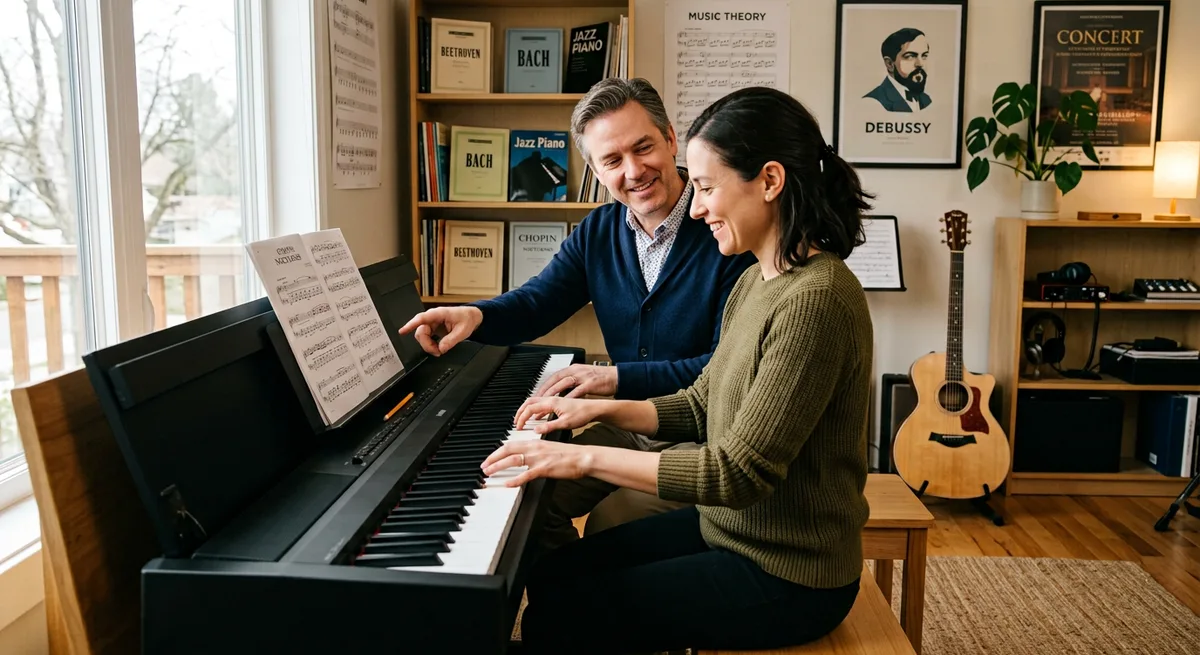
Classes take children from age seven, and adults of every age. Practice notes follow every class, in person and online alike, so the fee buys the week between classes as well as the class itself — that is the part most fee lists leave out, and it is the part that decides whether anyone improves.
The subjects taught are the ones above with their prices: guitar, piano, keyboard and harmonium, singing, Indian classical vocal, flute and bansuri, and ukulele. If you are choosing for a child rather than yourself, the fees in prose and the age guidance are collected in the best music classes for kids.
At the studio in Jalandhar
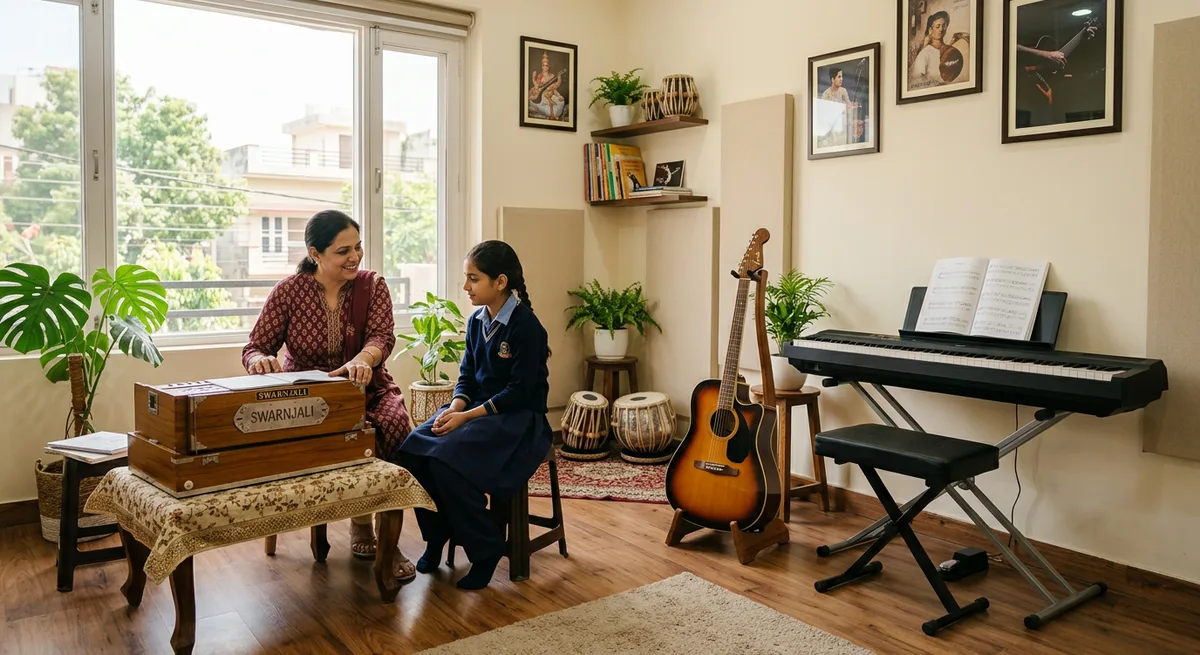
For in-person students the studio is at Urban Estate II, Near Taj Food (Dulhan Palace), Jalandhar, and a one-time visit is required before classes begin — one visit, once, so teacher and student have met before the first class. Online students do not visit at all: every online plan starts instead with a free 15–30-minute demo class, where days, timings, syllabus and progression are agreed. The address, the map and the group timetable are on the in person page.
Compare what a fee actually buys
When comparing lessons, I ask a prospective student to separate class length, frequency, format and feedback. A monthly figure alone does not tell you how many teaching sessions it covers or whether the teacher hears you individually. A group plan and a one-to-one plan can both be useful, but dividing their fees by minutes does not capture the difference in personal correction.
Check the quoted unit carefully. “A single session”, “a block of eight classes” and “a calendar month” are not interchangeable. Ask what happens when the teacher cancels, when you miss a session and when you need to stop. Those answers belong in the written agreement, not in assumptions based on a friendly first conversation. My current amounts and plan descriptions are maintained on the fees page; the terms explain the conditions.
Budget for usable practice, not only attendance
An instrument that is difficult to use can make an apparently affordable lesson expensive in wasted effort. Before buying anything, show me what you already have. A tuner, stable stand or suitable seat may matter more than an upgrade. Conversely, extra equipment should not be added automatically to make a beginner feel fully prepared.
Your available time matters too. Paying for lessons while having no realistic opportunity to practise can produce frustration rather than progress. I would rather discuss a manageable goal during the demo than encourage a plan based on a result you have no time to work towards.
Keep country and date in view
Published India rates should not be converted mentally into a promise for every country. Students outside India should ask for the applicable fee in their currency before starting. Likewise, an older article's comparison is not a live price list for other teachers. Use it to ask better questions, then verify the actual offer and terms with the person providing the lessons.
Frequently Asked Questions
What is included in the 8 classes?
Eight one-to-one classes of 45 to 60 minutes each, held twice a week, so the plan runs about a month. Every class ends with written practice notes for the days between, and the syllabus is set to the student's level and goals rather than to a fixed batch.
Why is online one-to-one more expensive than in person?
Because it takes more, not less. In the studio a teacher can correct a wrist by touch and hear the room; online every correction has to be spoken precisely, the camera has to be positioned so the hands are visible, and the whole hour is one student. The group rate online is where the price comes down.
Is there a joining fee or a lock-in?
No joining fee, and no lock-in. The 8-class plan is the unit, and you stop by giving notice before the next month starts. Once the month begins the fee is not refundable: one-to-one classes you have not taken stay on your account for two months as credit, then lapse, and group fees are not carried forward. The terms of use set this out in writing, including the ₹2,000 deduction that applies only when you withdraw before the first class of a one-to-one plan.
Questions about anything in this article? WhatsApp +91-62800-75157 or email drbnrj@gmail.com.