How to Practise Guitar Daily: A 30-Minute Routine That Works


Doctorate in World Music, University of Oxford · teaching since 1992. More about the teacher.
Most guitarists do not need a longer practice session. They need a smaller one they can repeat tomorrow. The players who improve steadily are rarely the ones who put in a heroic Sunday afternoon. They are the ones who pick the guitar up on the days they do not feel like it and do something small and specific. This is a routine for those days, and it takes half an hour.
Why daily beats weekend binges
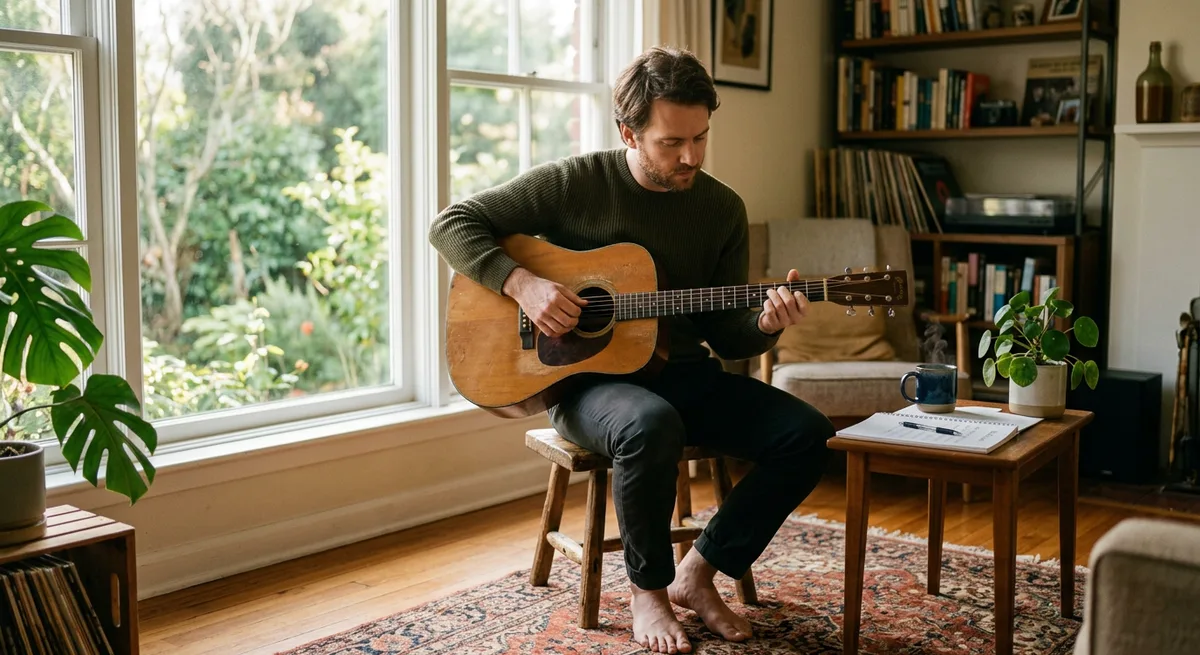
Two fifteen-minute sessions on two days will teach your hands more than one three-hour Sunday, and the reason is not motivation. Motor learning consolidates during sleep. A movement practised today is filed away tonight, so a weekly session gives that filing system one chance a week to work.
The second reason is closer to the instrument. Calluses and finger strength build through frequent, moderate contact with the strings, not through one heroic session that leaves your fingertips too sore to play for three days. Weekend-only players spend much of their time at the edge of discomfort; daily players spend most of theirs comfortable enough to think about rhythm and tone.
Fatigue also protects technique. It builds quietly: the wrist collapses at the knuckle, the thumb creeps over the neck, the picking hand tightens. You notice none of it while you are concentrating on a song. Stop before that point and you spend your practice rehearsing good habits instead of tired ones.
How long should you practise? A realistic daily quota
For most players, thirty focused minutes a day is enough to make steady progress for years. Ten to fifteen minutes is the minimum that still counts as practice, and anything past an hour usually costs your next session more than it adds to today's.
Ten to fifteen minutes is the maintenance floor. A brutal day you still showed up for is a win, not a failed session. Keep the streak and drop the guilt.
Thirty minutes is the realistic default. Warm-up, one focused block, then consolidation. Six of these a week is 180 minutes, which is about 156 hours of deliberate practice across a year.
Forty-five to sixty minutes is the ambitious tier. It is fine when you are motivated or preparing something specific, and a week at this level tops 300 minutes. Add the extra time to the focus block, never to the warm-up.
Longer than an hour gives diminishing returns. If you want to go deep, do it on a day whose next twenty-four hours can absorb the cost.
Consistency compounds; volume does not. A small daily quota kept for a year will beat the heroic one abandoned in week three. Pick the smallest tier you can defend on your worst week, and let the good weeks over-deliver.
The 30-minute session, minute by minute
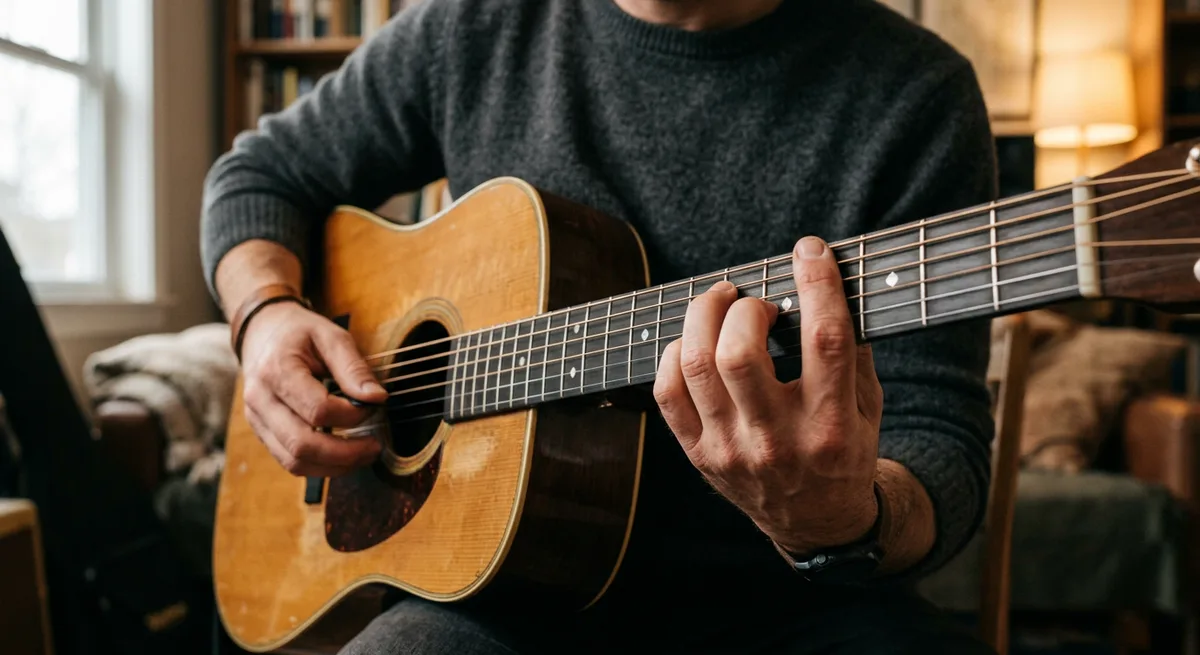
Five minutes of warm-up. Long tones, or a slow chromatic run up and down the neck. You are raising the temperature of your hands and checking that both of them still agree with each other. The drill matters less than the order: you do it first, every time. Five drills with clear tempos sit in guitar warm-ups for beginners if you want a specific routine to follow.
Five minutes of review. Yesterday's material, at the tempo you finished on. No new ground here.
Fifteen minutes on one new problem, and only one. A chord change that keeps arriving late, four bars of a solo, a strumming pattern that falls apart at speed. Take it apart, slow it down, put it together again.
Five minutes of consolidation. Play something you love. This is not a reward bolted on at the end; it is where the session's work gets attached to music you actually want to play.
One item per session, written down. Two half-learned items teach you less than one finished one.
Working with a teacher shortens the loop. One-to-one guitar classes in Jalandhar are ₹2,500 for 8 classes, twice a week, as of September 2026, INR unless stated, and group classes are ₹1,000 a month. Every learner, online or in person, starts with a free 15–30 minute demo class, and you can book that demo on WhatsApp.
Anatomy of a practice log
A practice log is five columns: the date, the minutes, what you worked on, the tempo you reached, and one line about what to do next time. That last column is the one that earns its keep. It is written by today's player for tomorrow's, and it removes the aimless ten minutes that most sessions begin with.
Keep it wherever the guitar lives. Paper, a notes app, the back of a set list: the medium does not matter, and a log that takes thirty seconds to write is a log you will keep.
When progress stalls
Plateaus are usually blamed on the amount of practice and are rarely caused by it. When a change stops landing, move a variable instead of adding hours.
Slow the metronome by ten beats per minute and check whether the passage is still clean. Move it into another key. Rebuild the left-hand shape from the wrist rather than the fingers. Subdivide the beat differently so the accents fall somewhere new.
One of those will move something. If none of them does, the problem is usually upstream: the passage is too long to hold in your head at once. Cut it in half.
Making it stick to a real life
Attach practice to something that already happens. After the morning coffee, before the evening shower, while the kettle boils. The cue does more work than the willpower.
Leave the guitar out on a stand; the instrument you have to unpack is the instrument you play less. A ten-minute floor on bad days keeps the habit alive, and the streak itself becomes a reason to pick it up.
Drop the idea of practice debt. A missed day is not a loan to be repaid with interest on Sunday. The next session simply continues the work, which is a habit that transfers to any instrument, including the breath work in flute and bansuri classes in Jalandhar.
The next step. If you would rather not build this routine alone, one-to-one guitar classes in Jalandhar run at ₹2,500 for 8 classes, twice a week, as of September 2026, INR unless stated, alongside group classes at ₹1,000 a month. Physical classes begin after one studio visit, and every online plan starts with a free 15–30 minute demo class, which you can book on WhatsApp. More practice writing sits in the Blogs & Articles archive.
Frequently Asked Questions
How long should a beginner practise guitar each day?
Fifteen minutes a day is a good start, growing to thirty by about the fourth week. A session counts when it has a warm-up and one focused block. Longer sessions without structure build bad technique faster than short ones build patience.
Is 15 minutes of practice enough?
Yes, as a floor. Fifteen focused minutes a day will move a beginner forward, and they are far better than nothing. Once the habit is steady and the fingers are comfortable, extend the middle block rather than the warm-up, and keep the same order so nothing gets skipped.
Is practising every day really necessary, or can I do weekends?
Every day is the fastest route, because sleep consolidates a new movement, but six days out of seven is realistically just as good. Weekend-only practice still works; it is simply slower, and it keeps your fingertips sore for much of every session.
What if I miss days?
Nothing is broken and nothing needs repaying. Come back at the same time and the same length rather than trying to make up the lost minutes in one long sitting. If you miss a week, restart at the maintenance floor of fifteen minutes and build back to thirty.