How to Choose Your First Guitar (Step-by-Step)


Doctorate in World Music, University of Oxford · teaching since 1992. More about the teacher.
The question at the shop is almost never "which guitar is best". It is "is this the right one for me", and it arrives in the last five minutes of a visit, with a salesperson waiting and your confidence draining. The way to answer it is to decide most of it before you walk in, and to check the rest with your hands.
Start with the sound you want, not the budget

Name two recordings where you love the guitar. Not the playing — the sound. Bright and ringing, or warm and thick? A strummed acoustic under a voice, or a distorted electric carrying a riff?
That answer decides the instrument, and it decides it more honestly than any budget does. Beginners who buy the guitar they were told to buy, rather than the one whose sound made them want to learn, are the ones who stop playing by the third month.
Budget comes second, and it is a range rather than a number. Set that range before you go, so the decision at the shop is between two instruments inside it rather than between playing and not playing.
Body size and comfort
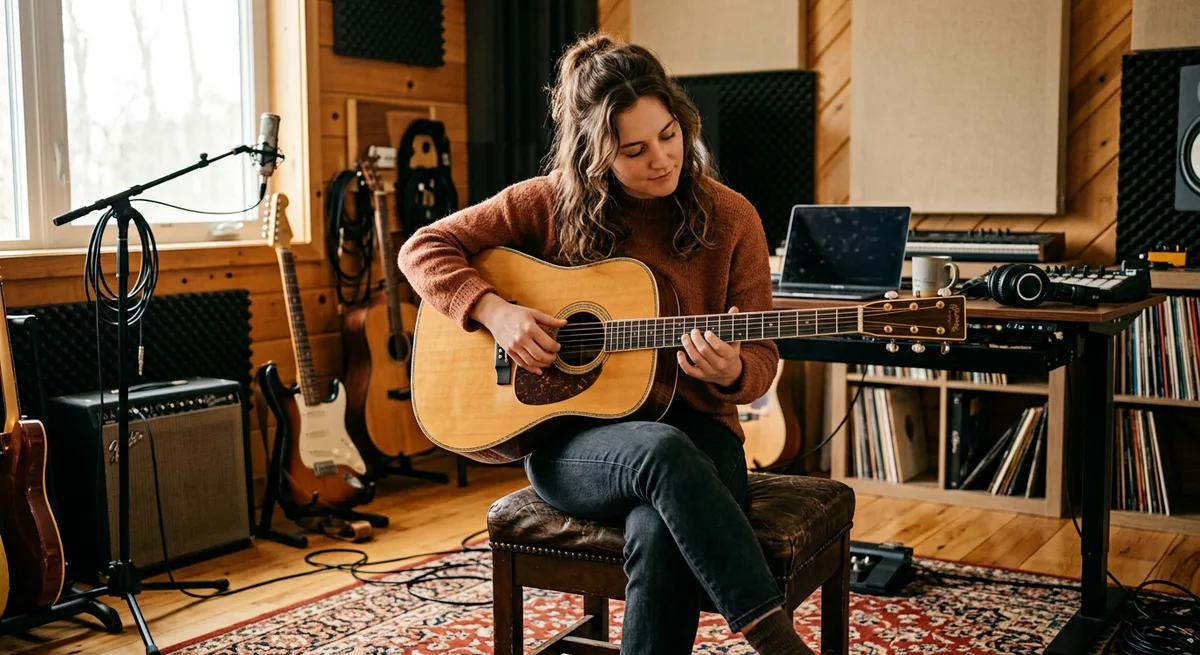
Hold the instrument before anything else. Comfort is not a luxury at this stage; it decides how often the guitar comes out of its case.
Check the waist cut: a body that digs into your ribs when you sit will still dig in an hour later. Check the depth of the body, because a deep dreadnought is a lot of guitar for a smaller player, and there are plenty of narrower and shorter-scale options that lose very little in sound.
Then check the neck, which is where most beginners are defeated. Can you wrap your hand around it and reach the fifth fret without strain? Is the fretboard narrow enough that your fingertips are not muting the neighbouring string?
Finally, look down the neck from the headstock and check the action, the height of the strings above the frets. High action is the real beginner killer: it makes every chord hurt, and painful playing is abandoned playing. Action can be lowered by a technician, and on a first guitar you should assume it will need to be.
What to spend and what to skip
Entry-level instruments are genuinely better than they were ten years ago. Manufacturing has improved to the point where a modest guitar with a proper setup plays better than an expensive one that was never adjusted.
So buy the setup, not the logo. A shop that will set the action and intonation before you take the instrument home is worth more than a fancier body with a name on the headstock.
Spend on the parts that touch the strings and your hands: a spare set of strings, a strap, a tuner, and a decent cable if you are going electric. These are cheap individually and they are what makes the first month frictionless. A guitar that stays in tune and has a strap already fitted gets played more than one that needs a trip back to the shop.
Buying is easier when someone shows you what to do with it. One-to-one guitar classes in Jalandhar are ₹2,500 for 8 classes, twice a week, as of September 2026, INR unless stated, with group classes at ₹1,000 a month, and every learner starts with a free 15–30 minute demo class: book it on WhatsApp.
The 6-point shop check
Run these in order, on the instrument you are about to buy, not on a display model.
Tune stability. Tune it, play a chord sequence for a minute, and check the tuning again. A guitar that drops pitch immediately needs new strings or has a problem at the nut.
Fret sprout. Slide your hand along both edges of the fretboard. If the fret ends catch your palm, the neck has dried out or was never finished properly.
Straight neck. Look from the headstock down the edge of the fretboard. A gentle curve is normal; a visible bow or a twist is not.
Electronics, on an electric. Plug into the quietest amp in the shop and move through every pickup position and every knob. Listen for crackles and for controls that do nothing.
Cracks at the neck join. Look closely where the neck meets the body, on both sides, and around the bridge. Any crack or lifting finish is a walk-away.
Your playing angle. Sit and stand with the guitar, in the position you will actually practise in. If the instrument fights you for thirty seconds in the shop, it will fight you for a year at home.
New vs used
Used instruments are where first guitars become good value, provided you inspect them the way you would inspect anything mechanical.
Check the fret wear under the first three frets, since deep grooves mean a fret dress or a replacement. Check that the tuners turn smoothly and hold. Check for repaired headstock cracks, which is the most common serious damage on a used guitar and the easiest to hide with a good finish job.
A shop setup is worth paying for on any used instrument, and on most new ones. The one part never to compromise on is the neck: everything else can be replaced or adjusted, and a twisted or badly worn neck usually cannot be fixed at a price that makes sense.
First-week plan
In the first seven days, do not try to learn a song. Get the guitar in tune every time you pick it up, learn four chords, and practise moving between two of them slowly. Ten to fifteen minutes a day is enough at this stage.
Leave it out on a stand, and put a timer on your phone. The thirty-minute daily practice routine takes over once those two chords are landing cleanly, and if you have not chosen an amplifier yet, what actually matters in a first guitar amp is the next decision.
Smaller-stringed instruments teach the same habits with less finger pressure, which is why some beginners start on a ukulele first: ukulele classes in Jalandhar run alongside the guitar classes and move across later. Teachers cover the same ground in one-to-one guitar classes in Jalandhar, and the Blogs & Articles archive collects the rest of the beginner series.
Have a teacher play it before you pay. Fifteen minutes with someone who plays for a living tells you more about a guitar than an hour in the shop, and one-to-one guitar classes in Jalandhar begin with a free 15–30 minute demo class that costs nothing to try: book it on WhatsApp. Classes are ₹2,500 for 8 classes, twice a week, as of September 2026, INR unless stated.
Frequently Asked Questions
Acoustic or electric first for a beginner?
Whichever sound made you want to play. Acoustics need no extra equipment and build finger strength quickly; electrics are easier on the fingers and quieter with headphones. The instrument you are excited to pick up is the one that gets practised, and that matters more than either list.
How much should a first guitar cost?
Set the budget before you go and treat it as a range. A modest instrument with a proper setup plays better than an expensive one that was never adjusted, so leave part of your budget for setting it up, a spare set of strings, a tuner and a strap.
Is a cheap guitar a bad idea?
An unplayable one is, whatever it costs. High action or a twisted neck makes every chord hurt, and painful practice is abandoned practice. Entry-level instruments are better than they used to be, so the real question is not the price but whether the setup is right.
What should I check before buying a used guitar?
Fret wear under the first three frets, smooth tuners that hold, and any repaired crack where the neck meets the headstock or the body. Look down the neck for twists, then tune it and play for a minute to see whether the tuning survives.