Guitar Amp for Beginners: Choosing Your First Amp (2026)

Doctorate in World Music, University of Oxford · teaching since 1992. More about the teacher.
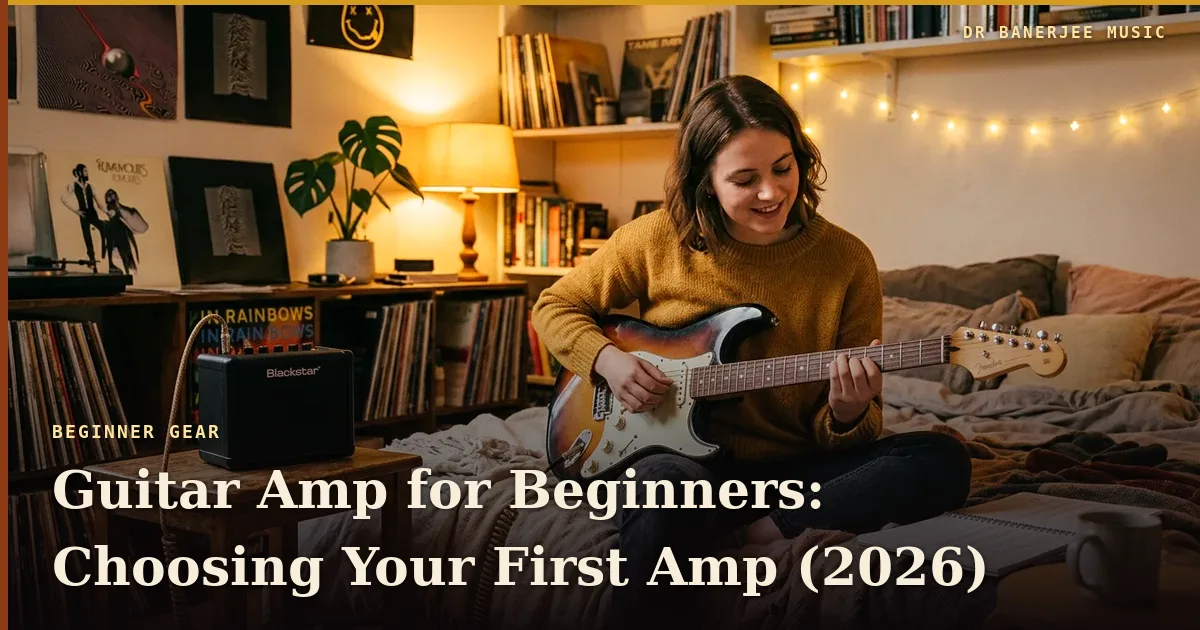
Walk into any music shop and the amplifiers are arranged to impress: stacked cabinets, glowing panels, a wall of knobs. Almost none of it is aimed at the person who has been playing for six weeks. The amplifier that helps a beginner practise daily is small, simple, and usually sitting quietly in the corner. Here is how to find it.
Do you need an amp at all?
Start with your instrument, because the answer is different for each.
Electric. You can begin without an amplifier, and many players do: an unplugged electric still makes enough sound to learn chord shapes on. What it cannot give you is the instrument's actual voice, and the reason to play it. Within a month or two, most electric beginners want something to plug into.
Acoustic. An amplifier is genuinely optional. The guitar is its own amplifier, and at home the only reason to add one is if you want effects, or you are playing somewhere that needs more volume than the instrument can produce.
There is a third category worth counting as a real option: headphone and USB amplifiers. They plug straight into the guitar, cost less than a combo, keep the household peace, and can send audio to a laptop for recording. For a beginner in a flat, that is often the better first purchase.
Power and speaker size, in real rooms
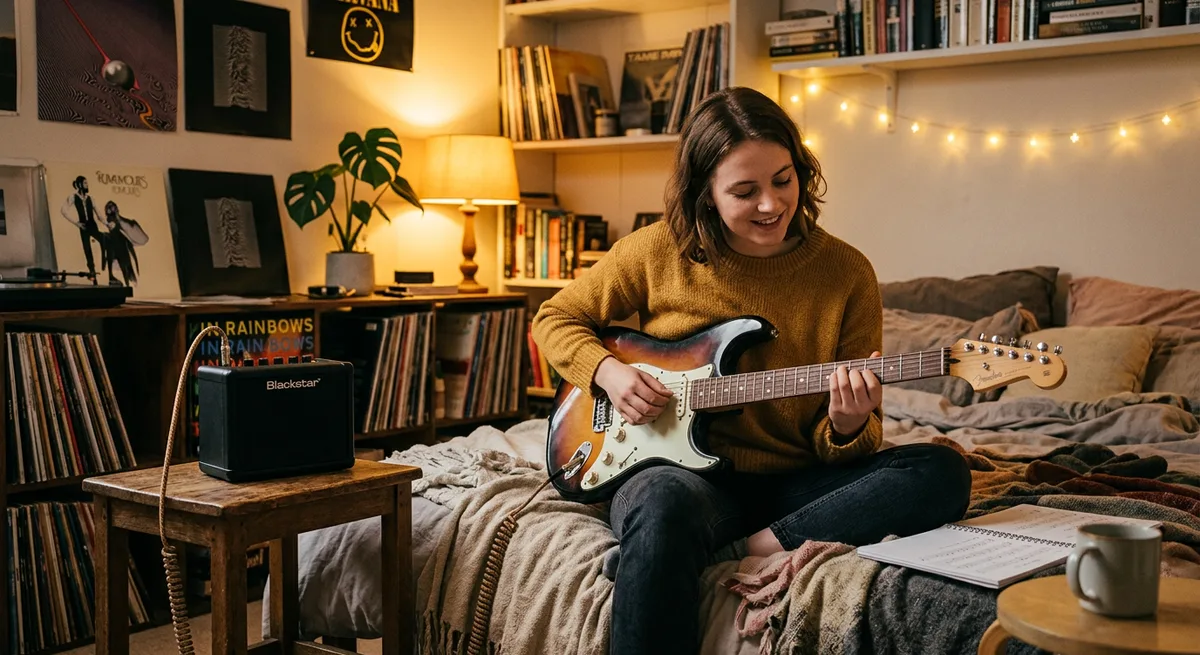
Watts are about headroom, not about how good the amp sounds. A five-watt practice combo turned up to three in a bedroom is usually louder than anyone in the next room wants to hear; a thirty-watt amp in the same room never gets past two, which means you never hear what it sounds like working.
Speaker size does more for tone than the number on the front. An eight-inch speaker in a small cabinet sounds focused and slightly boxy, which is fine for practice. A twelve-inch speaker moves more air and gives the rounder low end most players associate with a guitar amp, but it needs volume to sound like itself.
Valve or solid-state, in three sentences: valve (tube) amplifiers break up warmly when pushed and are heavier, dearer and need occasional maintenance; solid-state amplifiers stay clean, weigh less and cost less; at practice volume, in a bedroom, the difference is much smaller than the internet suggests.
The five controls worth learning
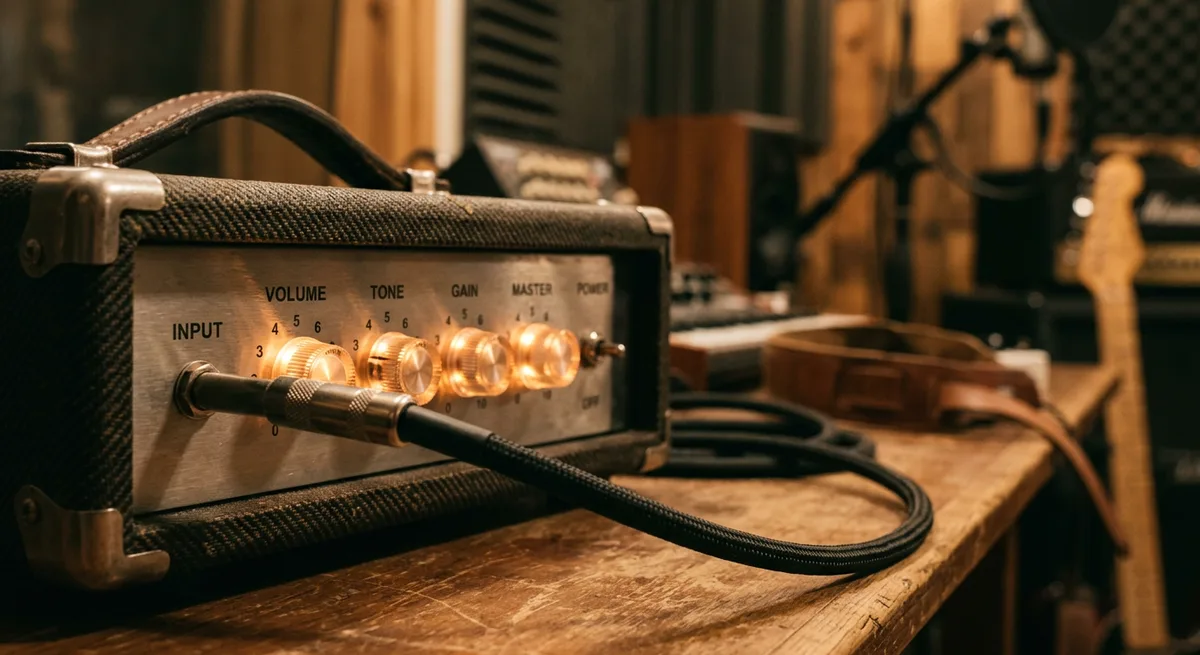
Most first amps carry a dozen knobs because the same chassis is sold to gigging players. Five of them matter.
Gain is how hard you hit the preamp. Low gain plus high master volume gives a clean sound; high gain gives the distorted one.
Master volume is the output level, and on a small amp it is the knob that decides whether you can hear yourself at a sensible hour.
EQ is bass, middle and treble. Beginners should start flat and move one knob at a time; the middle control is the one that decides whether a guitar sits inside a mix or disappears.
Reverb adds space. A little goes a long way, and the difference between a good player and a beginner is often how much reverb they leave switched off.
The effects loop can be ignored for a year at least. It exists for pedals you do not own yet.
Modelling, USB and apps
A small modelling amplifier, one that imitates a handful of classic sounds and connects to a computer, is the sensible default first buy now. It gives you several usable tones, a headphone output, and a way to record yourself, which is the single most useful practice tool a beginner can own.
What you lose is immediacy: menus, apps and firmware mean the amp can become a small computer that needs configuring before it makes a sound. Choose one with knobs you can use without the app.
What you do not lose is tone. At beginner volume, a good model of a familiar amplifier is close enough that it will not be the thing holding you back — your hands will be, for a good while yet.
Wondering whether it is worth the money? If you are already practising most days, the answer is usually yes; if you are not, a lesson is the better spend. One-to-one guitar classes in Jalandhar are ₹2,500 for 8 classes, twice a week, as of September 2026, INR unless stated, and online lessons run worldwide for £55 per 8 classes, twice a week. Every learner starts with a free 15–30 minute demo class: book it on WhatsApp.
What to avoid as a first buy
A hundred-watt stack in a bedroom is a piece of furniture that never gets switched on, and it will not sound good at the volume you can actually use.
Valve heads need a speaker cabinet as well, which doubles the cost and the weight before you have learned a single scale.
"Starter packs" that bundle an amplifier, a cable and a tuner are worth reading closely. The cable is usually the part that hums, and the tuner is the part that drifts. Buy those two separately and the pack becomes a reasonable deal.
Boutique anything is a mistake at this stage, because the differences it sells you are differences you cannot hear yet. And buying on looks is the most expensive habit in the hobby: the amp that looks best in photographs is rarely the one that helps you practise.
Trying before buying
Take your own guitar into the shop. Someone else's instrument through someone else's settings tells you very little about how the amp behaves with your hands.
Play at the volume you will actually use at home, not at the volume the shop sounds best at. Then hold one clean chord for twenty seconds and listen to how it decays, for hiss when you stop playing, and for any buzz as you move the cable.
If the amp is right, the next thing to think about is the guitar itself, and how to choose your first guitar walks through that in the same order of priorities. The thirty-minute daily routine is the other half of the purchase, and keyboard players face the same decisions in piano and keyboard classes in Jalandhar.
The amp rewards a player who is already playing. One-to-one guitar classes in Jalandhar are the quicker route to that habit, at ₹2,500 for 8 classes, twice a week, as of September 2026, INR unless stated, and online music classes worldwide run at £55 per 8 classes. Every learner starts with a free 15–30 minute demo class: book it on WhatsApp.
Frequently Asked Questions
What wattage is enough for a beginner amp?
Around five watts is plenty for a bedroom, and ten to twenty covers a small room and a friend with a drum kit. More watts buy headroom you cannot use at home. If you need to be silent, a headphone output matters more than the wattage figure on the box.
Tube vs solid-state: which first?
Solid-state, almost always. It is cheaper, lighter, needs no valve changes, and sounds consistent at low volume. Valve amplifiers reward players who can turn them up, which is rarely the situation a beginner is in. Revisit the question once you are playing with others.
Can I practise electric without an amp?
Yes. An unplugged electric is quiet but perfectly usable for chord changes, scales and finger exercises. It will not teach you tone or dynamics, and it hides mistakes, so most players end up with a headphone amp fairly quickly rather than plugging in nothing at all.
Is a modelling amp bad for learning?
No, with one condition. If you spend the session scrolling presets instead of playing, it is bad for learning. Set one clean sound and one distorted sound, leave the rest alone for a month, and the modelling section becomes an advantage rather than a distraction.