Guitar Warm-Ups for Beginners: 10-Minute Daily Routine

Doctorate in World Music, University of Oxford · teaching since 1992. More about the teacher.
A warm-up is the least glamorous ten minutes in guitar playing, which is exactly why most beginners skip it. Then the first half of the session goes into getting the hands to cooperate, and the last half into being tired. Ten structured minutes at the start change the shape of everything after them.
What a warm-up is actually for
Nothing mystical happens in a warm-up. It raises the temperature of the hands, wakes up the coordination between the two of them, and gives the ear something steady to check against before you ask it to judge anything difficult.
That last part is the one people forget. Your ear calibrates from the first things it hears. Start with a clean, slow, in-tune drill and everything afterwards is measured against that. Start by fumbling a song at speed and your ear spends the rest of the session recalibrating downwards.
Five drills, two minutes each
Play them in this order. Each one has a tempo to aim for, and each one has the same stop rule: if it hurts, stop.
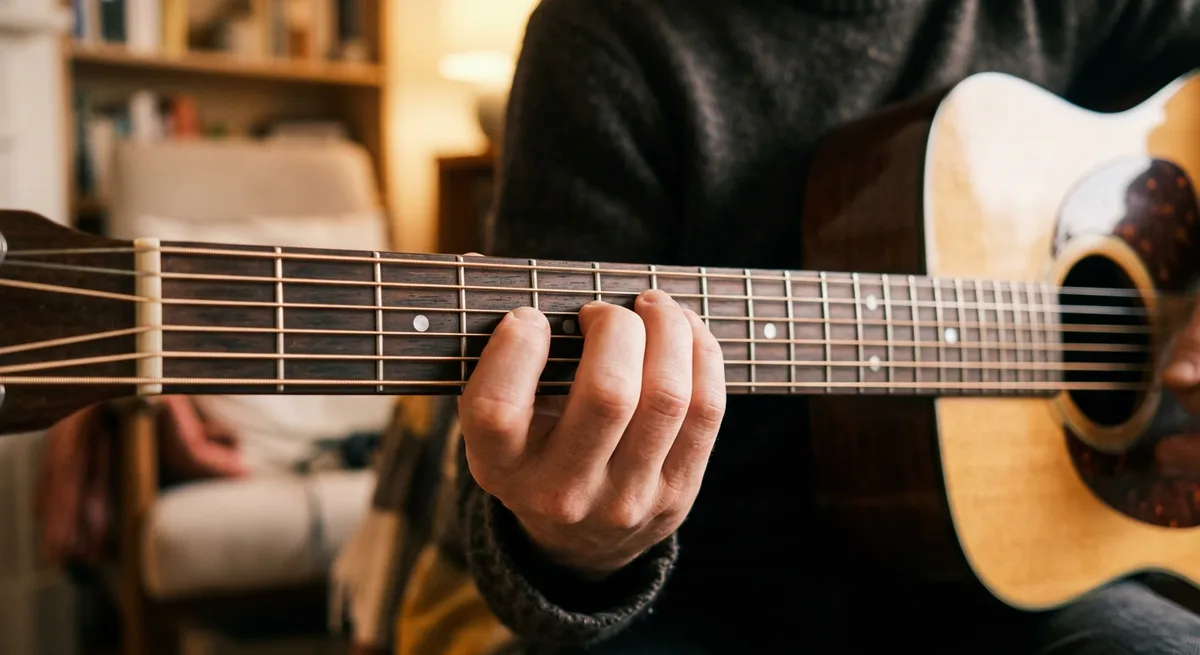
1. One-finger-per-fret chromatic. Start on the low E string, first fret, and walk up the neck one fret per finger. Then back down. Use the metronome at 60 beats per minute, one note per beat, and take the same shape across all six strings in both directions. Two minutes gets most beginners through it comfortably. The target is evenness, not speed.
2. The 1-3-4 spider. Frets one, three and four, one finger per fret, moving across strings slowly and without lifting the fingers more than an inch above the strings. No bouncing. If the third and fourth fingers will not stay curved, slow down until they do.
3. Strumming open strings. Down-up-down-up on one chord you know, at 60 beats per minute, then 80. Keep your pick angle consistent and your wrist moving from the forearm rather than the elbow. The aim is a steady hand, so the ear is listening for an even stream of single notes, not a chord played faster.
4. Hammer-on and pull-off ladder. On the top two strings, hammer from the first fret to the third, then pull off back to the first, four beats each. At 60 beats per minute this is slow work and it should stay slow; the hammered note must be as loud as the picked one.
5. Long tones. Fret a note, play it, and let it ring for four counts. Listen for the decay and for any buzz. Work through four or five notes across different strings. This is the drill that teaches tone, and it is the one beginners drop first.
Four drills at two minutes each plus a two-minute set of long tones is the ten-minute routine. Let the long tones run to five minutes if you have the time, which takes the full pass to about thirteen.
Learning this with a teacher is faster. One-to-one guitar classes in Jalandhar are ₹2,500 for 8 classes, twice a week, as of September 2026, INR unless stated, with group classes at ₹1,000 a month. Every learner begins with a free 15–30 minute demo class, and you can book the demo on WhatsApp.
Common injuries and what to do
Sharp pain is a stop signal. Stop the drill, put the guitar down, and come back tomorrow at a slower tempo. Achiness that builds gradually is a shrink-the-session signal rather than a stop signal: cut the time and keep the routine.
Watch three things. The wrist of the fretting hand should stay close to straight, not folded back. The thumb should sit behind the neck rather than hooked over the top, which is comfortable for blues bends and costly for everything else. The shoulders should be down, because tension travels from there into both hands.
Persistent pain needs a doctor, not the internet. That is not a disclaimer; it is the actual advice, because hand injuries in guitarists are common and early treatment is much cheaper than late treatment.
Warm-ups that are not warm-ups
Playing songs you already know is playing, not preparation. It feels productive because it is enjoyable and because the notes come out, and it does almost nothing for the hands you are about to ask for something new.
Scales played at sprint speed are the other false friend. Speed at the start of a session is risk rather than work: the technique falls apart before the hands are ready, and the mistakes get rehearsed. Scales belong in the focus block later, at a tempo you can play cleanly.
The same rules apply whichever instrument you sit behind. Piano and keyboard players run the identical logic in piano and keyboard classes in Jalandhar: short, slow, and identical every day.
Building a 10-minute habit
Run the drills in the same order, every day. The order is the routine; if you redesign it each morning you will spend the warm-up deciding what to do.
Set a timer on your phone rather than watching the clock, one timer for the whole ten minutes. And do not talk while the metronome is running: a warm-up with a conversation in it stops being a warm-up, because attention is the active ingredient.
If you want the same principle applied to the rest of the session, the thirty-minute daily practice routine picks up where the warm-up ends, and the Blogs & Articles archive carries the rest of the series.
Have someone watch the hands. A warm-up fixes what you can hear; a teacher fixes what you cannot yet see. One-to-one guitar classes in Jalandhar run at ₹2,500 for 8 classes, twice a week, as of September 2026, INR unless stated, with group classes at ₹1,000 a month, and every learner starts with a free 15–30 minute demo class you can book on WhatsApp. Physical classes begin after one studio visit.
Frequently Asked Questions
Do I really need to warm up on guitar?
Yes, for two reasons. The hands work better when they are warm, and a slow drill sets your ear's reference point before anything difficult starts. Skipping it usually means the first ten minutes of playing are spent getting ready anyway, and at a worse tempo.
How long should a guitar warm-up last?
Ten minutes is the useful baseline: four two-minute drills and a short set of long tones. Beginners and anyone returning after a long break do better with fifteen, and players with cold hands do better with a five-minute extension of the long tones rather than more speed work.
Why does my hand hurt after practising?
Usually because the wrist is folded, the thumb is hooked over the neck, or the session has run past the point where technique holds. Sharp pain means stop now. Achiness means shorten the next session and keep the warm-up in place. If it persists beyond a week, see a doctor.
Should beginners use a metronome from day one?
Yes. It is the only way to know whether the drill is even, and it turns "it sounds fine" into a tempo you can write down and beat next week. Start at 60 beats per minute, and only raise it when the current setting is clean for a full pass.