40 Music Theory Terms: Western and Hindustani Parallels

Doctorate in World Music, University of Oxford · teaching since 1992. More about the teacher.
Most Indian students today encounter Western music terminology through guitar lessons, piano tutorials, DAW production videos or online theory courses. Many already carry an indirect familiarity with Hindustani concepts too - through singing, film music, bhajans or raga exposure. The problem is that the two systems are usually taught separately, as though they belong to different intellectual worlds. They do not.
Why comparative theory matters
Western music theory and Hindustani musicology evolved from very different historical and aesthetic priorities, yet both are highly sophisticated systems for organising pitch, movement, tension, memory and emotional direction. Western theory developed heavily through harmony, modulation and vertical architecture; Hindustani music evolved primarily through melody, raga behaviour, tonal gravity and temporal expansion. Studying them side by side lets students think structurally instead of memorising isolated terminology - the same structural habit I argue for in why music theory matters at all.
40 essential terms with Hindustani comparisons
| Western Music Theory Term | Hindustani Parallel | Structural Difference |
|---|---|---|
| Ascending | Aroh | Western ascent is usually scalar; aroh may omit or treat swaras asymmetrically according to raga grammar. |
| Cadence | Nyas / melodic resolution | Western cadence is harmonic; Hindustani closure is melodic and swara-centred. |
| Chord | No exact traditional equivalent | Hindustani music is fundamentally melodic-drone based rather than harmonic. |
| Circle of Fifths | No direct equivalent | Western theory organises tonal relationships harmonically; Hindustani music organises ragas through that, swara behaviour, and rasa. |
| Descending | Avaroh | Avaroh may differ structurally from aroh in raga practice. |
| Diminished Fifth | Tritone-like swara relation | Western music uses it harmonically for tension; Hindustani music does not traditionally treat it as a functional harmonic device. |
| Dominant | Pa (partial parallel) | Western dominant resolves harmonically to tonic; Pa is stable but not functionally dominant in the same way. |
| Extended Chord | No direct equivalent | Hindustani expansion is melodic and improvisational, not chord-extension based. |
| Flat | Komal swara | Komal swaras are not always equal-tempered like Western flats. |
| Harmonic Interval | Simultaneous swaras | Harmony is structurally central in Western music but secondary in Hindustani classical practice. |
| Harmony | Drone/accompaniment texture | Hindustani music prioritises melodic linearity over chord progression. |
| Interval | Swar-antar | Hindustani intervals may involve shruti nuance beyond equal temperament. |
| Inversion | No direct equivalent | Chord inversion belongs to harmonic architecture absent in traditional Hindustani systems. |
| Key | Sa-based tonal framework | Western keys are fixed pitch systems; Hindustani Sa is movable. |
| Major Scale | Bilawal that | Similar swara material, but raga behaviour differs fundamentally from scale usage. |
| Major Second | Shuddha Re from Sa | Hindustani usage depends on raga context and ornamentation. |
| Major Seventh | Shuddha Ni from Sa | In Hindustani music this is treated melodically rather than harmonically. |
| Major Sixth | Shuddha Dha from Sa | Functional role differs because Hindustani music is non-harmonic. |
| Major Third | Shuddha Ga from Sa | Hindustani Ga may involve raga-specific intonation and ornamentation. |
| Melodic Interval | Sequential swaras | Hindustani melodic motion includes meend, gamak, and raga-specific phrasing. |
| Melody | Bandish / Swar-vistar | Hindustani melody is governed by raga grammar and improvisational development. |
| Minor Scale | Kafi/Asavari-type frameworks | Hindustani music does not classify emotional affect simply as "sad". |
| Minor Second | Komal Re relation | Pitch treatment may differ from equal-tempered semitone usage. |
| Minor Third | Komal Ga relation | Hindustani usage is raga-behavioural, not purely intervallic. |
| Minor Seventh | Komal Ni relation | Western minor seventh often implies harmonic function; Hindustani treatment is melodic. |
| Minor Sixth | Komal Dha relation | Emotional and structural treatment differs culturally. |
| Mode | Jati / modal raga framework | Raga is behaviour-based, not merely a rotated scale. |
| Octave | Saptak | Broadly equivalent, though Hindustani music strongly distinguishes mandra, madhya, and tar saptaks in performance practice. |
| Root | Sa / tonal centre | Western root may define harmonic structure; Sa defines melodic orientation. |
| Rootless Voicing | No direct equivalent | A jazz-harmonic concept absent from traditional Hindustani structure. |
| Scale | Swar arrangement / That | That is classificatory; raga behaviour exceeds simple scalar logic. |
| Secondary Dominant | No direct equivalent | Functional modulation is not central to Hindustani classical systems. |
| Semitone | Closest swara spacing | Hindustani intonation may include shruti-sensitive pitch nuance. |
| Seventh Chord | No traditional equivalent | Hindustani music traditionally avoids stacked-tertian harmony. |
| Sharp | Tivra swara | Hindustani theory traditionally recognises only Tivra Ma as a formally altered swara. |
| Tone | Whole-step relation | Hindustani interval spacing may not align exactly with equal temperament. |
| Tonic | Sa | Sa is movable according to performer range; Western tonic is often fixed to concert pitch. |
| Transpose | Changing Sa | Hindustani musicians commonly shift Sa without altering raga identity. |
| Triad | No direct equivalent | Triads emerge from harmonic thinking rather than melodic raga grammar. |
| Unison | Same swara | Often reinforced through tanpura resonance and octave doubling. |
The most important difference: harmony versus melody
The single biggest distinction between these systems lies in how musical movement is understood. Western classical and contemporary music largely evolved through harmonic motion - chord progressions, modulation, cadences and vertical layering. Hindustani music evolved through melodic behaviour - raga grammar, swara treatment, ornamentation, and tension created through movement and resting points. This is why many Western concepts have no true Hindustani equivalent, and why concepts such as raga-rasa, pakad, nyas and alap have no exact Western equivalent either. The systems overlap at the level of pitch organisation but diverge deeply in aesthetics, philosophy and structural logic. For a fuller sense of the Hindustani side, see my introduction to Indian classical music for beginners.
Why beginners should study both
Modern musicians rarely remain inside a single tradition. Film composers, producers, singers, guitarists and programmers constantly move between DAW-based harmony, raga-inspired melodies, orchestration, folk traditions, cinematic scoring and digital production environments. A learner who understands only one system often develops a technical blindness toward the other. Comparative study builds stronger ear training, better compositional flexibility, deeper listening, improved improvisation, greater historical awareness and more intelligent cross-cultural musicianship. Most importantly, it stops students treating musical systems as simplified internet shortcuts - the same trap I describe in why short-form tutorials cannot teach music. Music theory is not vocabulary memorisation; it is a way of understanding how musical thought itself is organised.
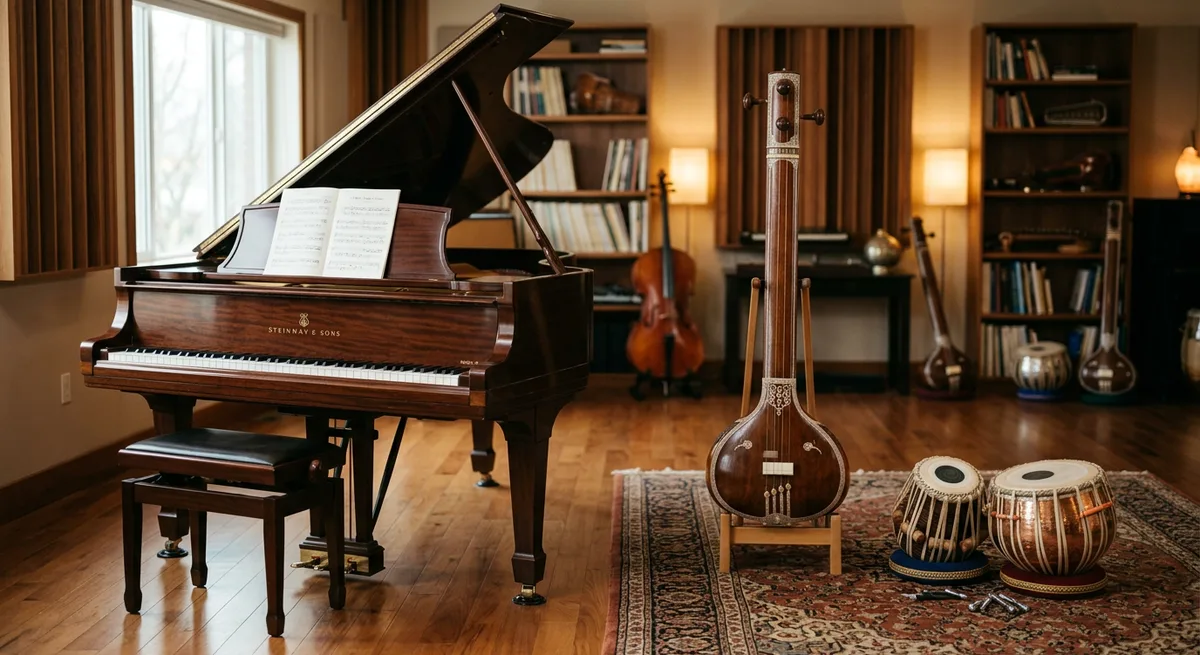
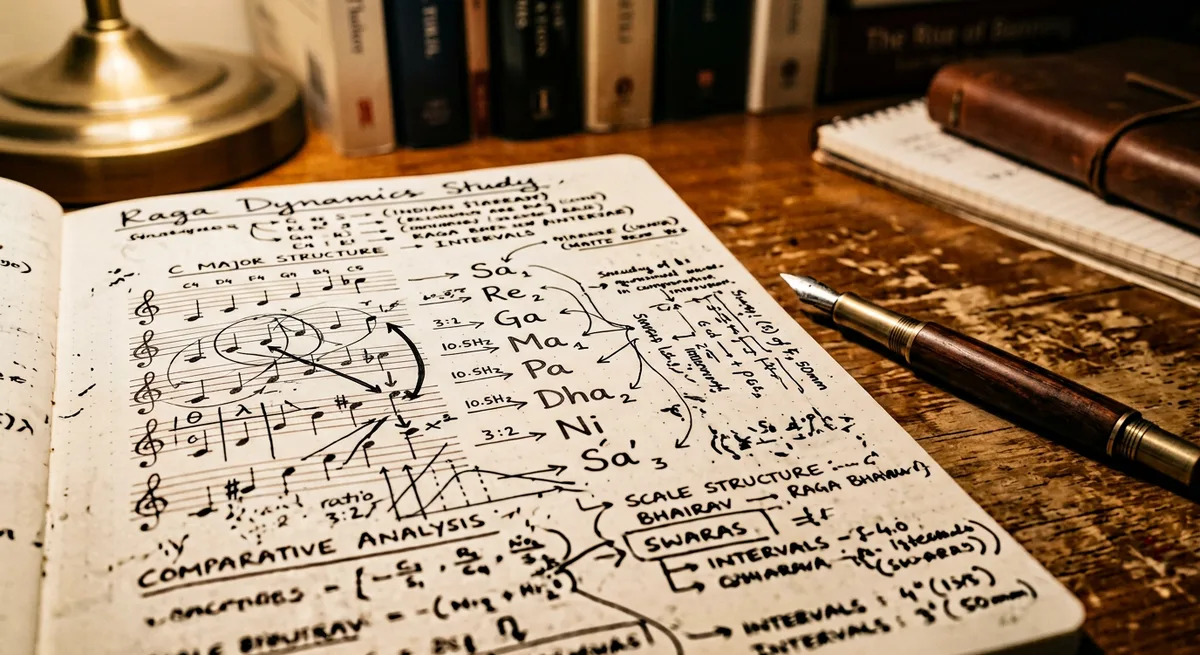
The two body illustrations above are AI-generated for conceptual and educational purposes, and should not be read as historically exact depictions of instruments, manuscripts or performance traditions. The theoretical analysis is independently researched and pedagogically structured.
Frequently Asked Questions
Do Western and Hindustani music share the same notes?
They overlap at the level of pitch organisation - both divide the octave and share a tonal centre. But Hindustani intonation can involve shruti nuance beyond equal temperament, and the Sa is movable rather than fixed to concert pitch, so the systems align on pitch while diverging on tuning and function.
Why does harmony have no real Hindustani equivalent?
Because Hindustani music is melodic and drone-based rather than harmonic. Movement and tension come from raga grammar, swara treatment and ornamentation over a tanpura drone, not from chord progressions, modulation or vertical layering. Concepts such as triads, inversions and secondary dominants therefore have no traditional parallel.
Should a beginner learn both systems at once?
Studying both broadens ear training, improvisation and cross-cultural fluency, which is valuable for modern musicians who move between DAWs, film scoring and raga-based melody. Beginners should still build a secure grounding in one system first, then use comparison to deepen structural understanding rather than to collect terminology.