Chand Chupa Badal Mein: Guitar, Piano and Singing Lesson

Doctorate in World Music, University of Oxford · teaching since 1992. More about the teacher.
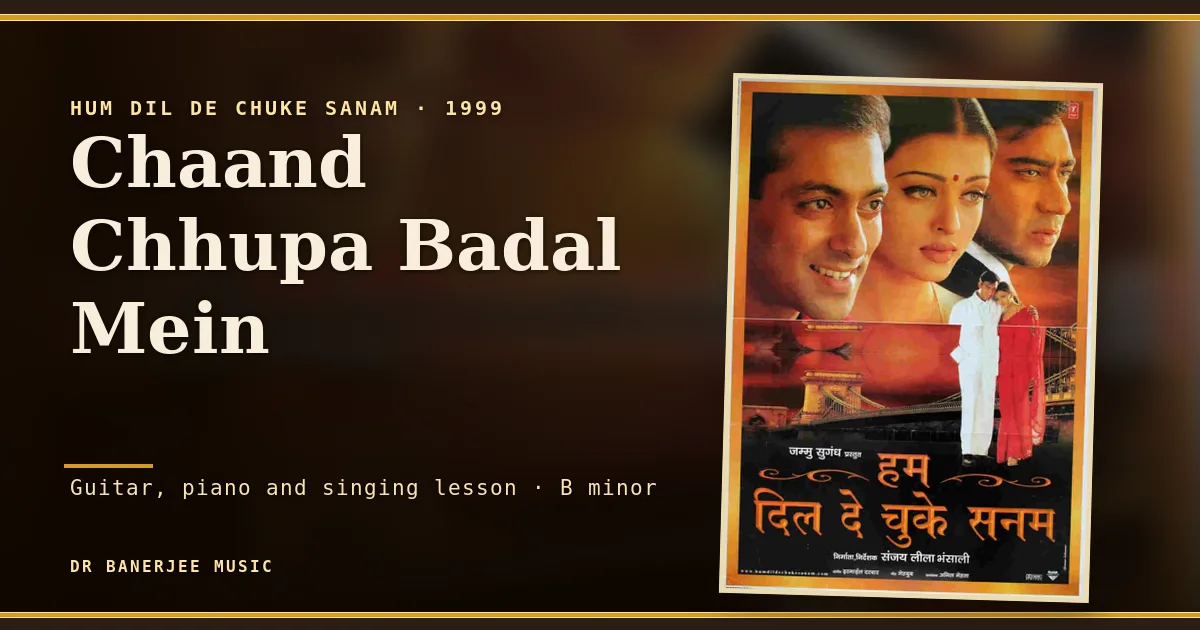
Few romantic songs from late twentieth-century Hindi cinema possess the melodic elegance and harmonic simplicity of Chand Chhupa Badal Mein. Released in 1999 as part of Hum Dil De Chuke Sanam, the composition remains one of the finest examples of melody-driven Bollywood songwriting. Its popularity has endured not merely because of nostalgia but because the music is exceptionally well constructed.
Composed by Ismail Darbar, with lyrics by Mehboob Kotwal and sung by Udit Narayan and Alka Yagnik, the song demonstrates how restrained harmonic movement can support expressive vocal writing without overwhelming the melody.
For students, this makes the composition remarkably valuable. The chord progression is approachable for beginners, while the phrasing, dynamics and expressive timing provide enough depth for intermediate musicians seeking to improve their interpretation.
This lesson is not intended merely to provide chords. Instead, it examines how the harmony functions, how guitarists should approach accompaniment, and why the composition remains pedagogically useful more than two decades after its release.
Song Information
Song: Chand Chhupa Badal Mein
Movie: Hum Dil De Chuke Sanam (1999)
Music Composer: Ismail Darbar
Lyrics: Mehboob Kotwal
Singers: Udit Narayan & Alka Yagnik
Music Style: Romantic Bollywood Ballad
Difficulty
Guitar: Beginner–Intermediate
Piano: Beginner–Intermediate
Harmonium: Beginner
Vocals: Intermediate
Why Every Music Student Should Learn This Song

Many Bollywood songs rely upon elaborate arrangements that can obscure the underlying harmonic structure. Chand Chhupa Badal Mein does the opposite.
Its musical value lies in:
- Smooth harmonic transitions.
- Memorable melodic phrasing.
- Controlled vocal ornamentation.
- Moderate tempo suitable for learners.
- Clear verse and refrain structure.
- Emotional expression without excessive technical complexity.
Because of these characteristics, the song is appropriate for guitarists, pianists, harmonium players and singers studying accompaniment, phrasing and ensemble balance.
Song Chords
First line, with its chords: (Bm)Chaand Chhupa Ba(Em)dal Mein…
The full sheet below is best followed along with the original recording — each chord in brackets lands on the syllable where the change comes:
(Bm)Chaand Chhupa Ba(Em)dal Mein
(A)Sharma Ke Meri (D)Jana (F#m)aa
(Bm)Seene Se Lag (Em)Jaa Tu
(A)Balkhake Meri (Bm)Jana
Ghum(F#)sum Sa Hai Gupchup Sa Hai
Mad(Bm)hosh Hai Khamosh Hai
(Em)Ye Sama Haan Ye (F#m)Sama Kuchh (F#)Aur Hai
Naz(A)dikiyaan Badh (D)Jaane De
Are (A)Nahi Baba Nahi Abhi (F#m)Nahi Nahi Nahi
Ye (A)Dooriya Mit (D)Jane de
Are (A)Nahi Baba Nahi Abhi (F#m)Nahi Nahi Nahi
(F#)Door Se Hi Tum (Bm)Ji Bhar Ke Dekho,
(F#)Tum Hi Kaho Kaise (Bm)Door Se Dekhu
(Bm)Chand Ko Jaise (A)Dekhta Cha(D)kor (Bm)Hai
The same progression serves all three instruments: guitarists strum it, pianists voice-lead it with the common tones described below, and singers use it to hear where the F♯ major pulls the line back home to B minor.
Analysis
Although the progression appears simple, it demonstrates several important harmonic ideas.
B Minor as the Tonal Centre
The song revolves primarily around B minor, creating a reflective and intimate atmosphere. Unlike many commercial Bollywood songs that rely heavily on tonic and dominant movement, this composition employs softer transitions that allow the melody to remain central.
Use of the Relative Harmony
The movement between Bm, Em and D produces a natural sense of expansion without dramatic harmonic tension.
Instead of forcing emotional contrast through frequent modulation, Ismail Darbar allows the melody itself to carry the expressive weight.
This is one reason why the song feels fluid rather than theatrical.
F♯ Major Creates Direction
One of the most effective moments occurs when F♯ major appears before resolving back towards B minor.
This dominant function creates expectation and subtly propels the phrase forward without sounding overly dramatic.
Students should recognise this as an excellent example of harmonic preparation.
Voice Leading
Notice that the chord changes rarely interrupt the vocal line.
The harmony follows the singer rather than competing with the melody.
This is an important lesson for accompanists:
Good accompaniment supports the melody; it does not attempt to dominate it.
Related study
This song is taught as part of the guitar classes and singing classes at Dr Banerjee Music, in the studio in Jalandhar and live online.
Few Bollywood compositions combine accessibility and musical sophistication as successfully as Chand Chhupa Badal Mein. While its melody is immediately appealing, closer study reveals careful harmonic planning, balanced orchestration and expressive vocal writing that continue to offer valuable lessons for musicians.
Whether approached on the guitar, piano, harmonium or through vocal practice, the song encourages the development of essential musical habits: attentive listening, controlled technique, thoughtful phrasing and disciplined accompaniment. These principles extend beyond a single composition and form part of a broader musical education.
Students who engage with the song analytically rather than simply memorising chords are likely to gain a deeper appreciation of how melody, harmony and performance interact to create enduring music.
Related: Yeh Dil Sun Raha Hai: Guitar Chords and Piano Harmony
Related: Diye Jalte Hain: Piano Notes and Guitar Tabs
Related: 40 Music Theory Terms: Western and Hindustani Parallels
Related: How Long Does It Take to Learn Music? Practice, Lessons and Progress
Frequently Asked Questions
Is this song suitable for beginners?
Yes.
The chord progression is relatively straightforward, making it accessible to beginners. However, expressive performance requires patience and disciplined practice.
What is the original key?
The lesson is presented in B minor, which corresponds with the supplied chord progression.
Can the song be transposed?
Certainly.
Students should transpose the harmony whenever necessary to accommodate a singer's vocal range rather than forcing uncomfortable pitches.
Which instrument is easiest for learning this song?
Each instrument develops different musical skills.
- Guitar emphasises rhythm and chord transitions.
- Piano develops harmonic understanding.
- Harmonium strengthens melodic continuity.
- Singing improves phrasing and breath control.
Learning the song on multiple instruments provides a more complete understanding of its structure.
Should beginners copy every ornament from the original recording?
No.
The priority should always be:
- Accurate pitch.
- Correct rhythm.
- Clean phrasing.
- Stable tempo.
Only after these foundations have been mastered should decorative ornamentation be introduced.
Questions about this lesson? WhatsApp 62800-75157 or drbnrj@gmail.com.