Tanha Tanha Yahan Pe Jeena: Guitar Chord Progression

Doctorate in World Music, University of Oxford · teaching since 1992. More about the teacher.
Many guitar students begin learning through film songs because the chord movements are approachable and musically engaging. Yet in most cases, the song is treated only as a sequence of shapes on the fretboard rather than a harmonic structure worth understanding.
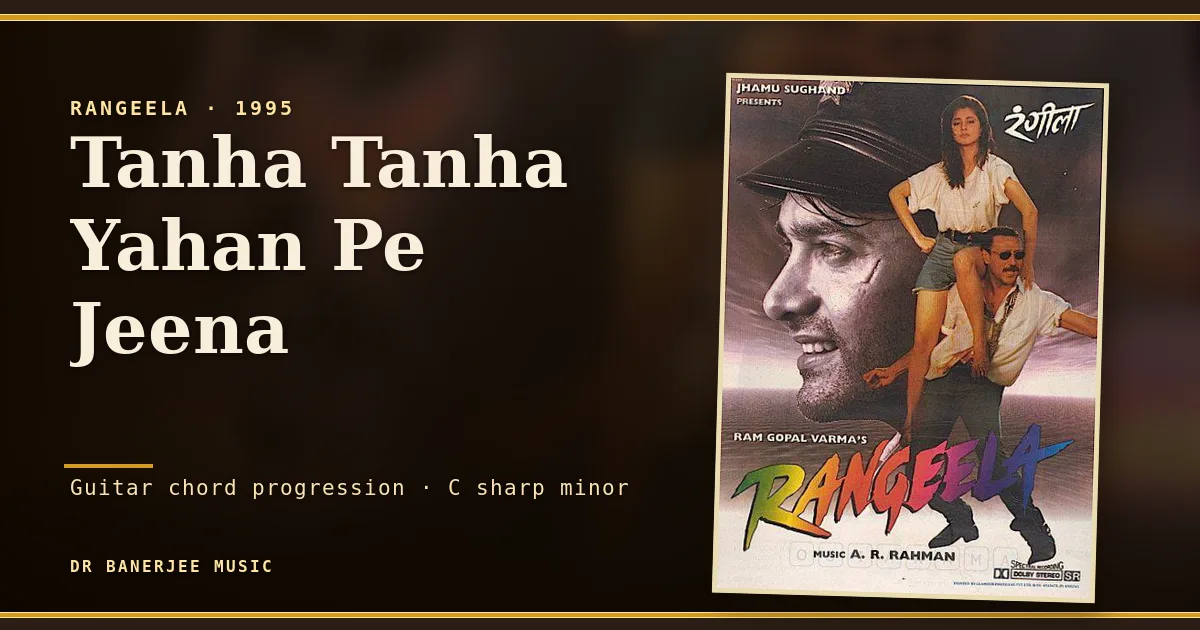
This article examines the chord movement used in the song “Tanha Tanha Yahan Pe Jeena” from the film Rangeela (1995). The purpose is to observe how a C♯ minor tonal centre operates within a simple progression and how such a structure can serve as an effective practice framework for guitar learners.
The mid-1990s marked a period of significant sonic transformation in Hindi film music. One of the central figures in that transition was A. R. Rahman, whose soundtrack for Rangeela introduced a fresh blend of electronic textures, melodic clarity, and rhythm-driven arrangements.
Within this environment, songs often relied on economical harmonic progressions that allowed the arrangement and vocal expression to carry emotional weight. For guitar students, such progressions are pedagogically valuable because they demonstrate how a limited set of chords can still create strong musical character.
The song discussed here illustrates this principle clearly.
The studio's own chord clip for this song, from the Dr Banerjee Music channel — tap to play, loads only on tap:
Direct link if embed does not load: Song Chords : Tanha Tanha Yahan Pe Jeena #guitar #piano #bollywoodsongs
Song Information
Song: Tanha Tanha Yahan Pe Jeena
Singer: Asha Bhosle
Film: Rangeela (1995)
Director & Writer: Ram Gopal Verma
Starring:
Jackie Shroff, Aamir Khan, Urmila Matondkar, Gulshan Grover, Avtar Gill
Music Composer & Producer: A. R. Rahman
Lyrics: Mehboob
Release Date: 14 May 1995
Recording Studio: Panchathan Record Inn
Music Label: Tips Music
The song revolves around a minor tonal centre built on C♯ minor. The harmonic vocabulary is intentionally limited, making the progression suitable for guitar practice.
Chords used in the progression:
C♯m - C# Minor; B - B Major; A - A Major; G♯m - G# Minor
Despite the small number of chords, the sequence creates expressive motion through descending harmonic movement.
First line, with its chords: Tan(C#m)ha tanha ya(B)han pe jeena…
Four chords, and every line either falls from C♯ minor (to B, to G♯m, to A) or climbs back into it from A or B — the descending contour analysed below is heard in the sheet before a note is played.
The full sheet with the words in place, exactly as taught in the clip above — each chord in brackets lands on the syllable where the change comes:
Tan(C#m)ha tanha ya(B)han pe jeena
(A)Ye koi baat hai (C#m)
Koi (C#m)saathi nahin tera (B) yahaan to
(A)Ye koi baat hai (C#m)
Kisi (C#m)ko pyaar (G#m)dede
Kisi (C#m)ka pyaar (B)lele
Is (C#m)saare zamaa(B)ne mein
Yehi (A)pyaari baat (B)hai
(C#m) Kisika to (G#m)sapna ho
(A) Aankhon mein (B)teri
(C#m) Koi gher (G#m)karta ho
(A) Baahon mein (B)teri
(C#m) Koi to bane (G#m) humsafar
(B) Raahon mein (C#m)teri
(C#m) Koi to bane (G#m) humsafar
(B) Raahon mein (C#m)teri
(C#m) Ye zinda(A)gi to vaise
(C#m) Ek sa(A)za hai
(C#m) Saath ki(A)sika ho to
(B) Aur ye ma(C#m)za hai
The musical strength of this progression lies in its descending tonal contour. Beginning with C♯ minor, the harmony moves downward through B and A, producing a sense of reflective motion.
Descending harmonic movement often generates emotional depth because the ear perceives gradual release from the tonal centre rather than dramatic modulation. In this case, the progression remains firmly rooted in the minor key while allowing gentle shifts in colour.
For guitar learners, recognising this directional movement is more valuable than simply memorising the chord sequence.
A widespread misconception among beginner guitarists is that learning songs automatically develops musical understanding. In reality, students often reproduce chord progressions without recognising the tonal centre, the direction of harmonic motion, or the emotional logic behind the sequence.
Such practice leads to mechanical repetition rather than musical awareness. The guitarist becomes dependent on chord charts rather than developing the capacity to hear structural patterns.
The difference between playing chords and understanding harmony therefore marks an important threshold in musical education.
Students studying this progression should approach it as a harmonic exercise, not merely a song.
A useful practice method includes:

- Establish the tonal centre by repeatedly playing C♯ minor and listening carefully to its tonal colour.
- Practise the movement C♯m → B → A slowly while maintaining consistent rhythm.
- Loop the progression until the transitions feel physically relaxed and rhythmically stable.
Through attentive repetition, the student begins to recognise the emotional direction of the harmony rather than simply executing chord shapes.
When guitar learning includes harmonic awareness, songs cease to be isolated pieces of repertoire. Instead, they become examples of broader musical patterns that recur across many genres and compositions.
Recognising these patterns gradually transforms instrumental practice into deeper musical literacy.
Film songs often appear simple on the surface, yet their harmonic structures frequently reveal subtle musical design. For the attentive student, even a small chord progression can become an entry point into the larger language of tonal movement.
Learning a song, therefore, is not only about reproducing music that already exists. It is also an opportunity to observe how harmony quietly shapes musical expression.
Related study
This song is taught as part of the guitar classes at Dr Banerjee Music, in the studio in Jalandhar and live online.
- 40 Music Theory Terms: Western and Hindustani Parallels
- Chand Chupa Badal Mein: Guitar, Piano and Singing Lesson
Frequently Asked Questions
What key is Tanha Tanha in?
C sharp minor, built on a small chord set — C sharp minor, B major, A major and G sharp minor. The tonal centre never really leaves the home minor; the expressiveness comes from how sparsely the other chords are used around it.
Is Tanha Tanha hard to play on guitar?
Not harmonically — four chords is well within a beginner reach after a few months. The work is in the timing and the feel: the groove sits slightly behind the beat, and rushing it flattens the song entirely.
Why do guitar teachers use film songs?
Because a song a student already loves carries its own motivation. The chord changes arrive inside music the learner can hear in memory, which makes progression, phrasing and dynamics teachable in context rather than as abstract drills.
Questions about this lesson? WhatsApp 62800-75157 or drbnrj@gmail.com.