Diye Jalte Hain: Piano Notes and Guitar Tabs

Doctorate in World Music, University of Oxford · teaching since 1992. More about the teacher.
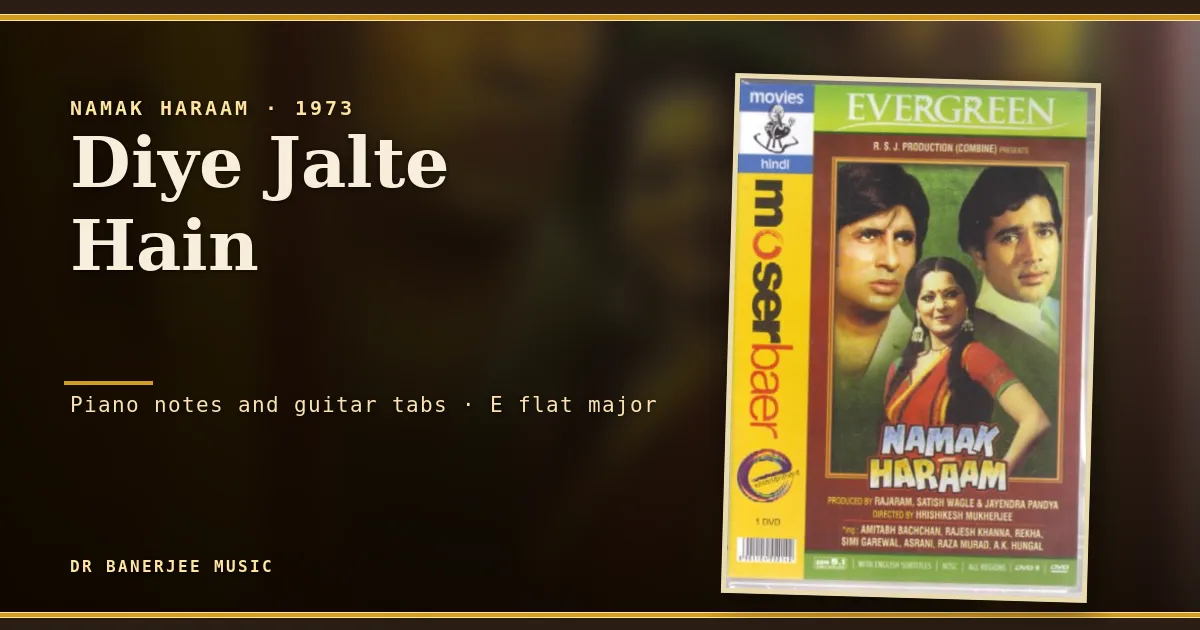
Diye Jalte Hain from Namak Haraam (1973), composed by R. D. Burman and sung by Kishore Kumar, is deceptively simple. Beneath its accessible melodic line lies a carefully controlled emotional architecture—minimalist, yet deeply expressive.
The composition operates within a restrained tonal space, allowing phrasing and breath to carry meaning rather than harmonic complexity. This makes it ideal for pedagogy: the student is forced to confront nuance.
Why This Song Matters for Learners
Most beginners approach such songs casually, assuming simplicity equals ease. That assumption is flawed.
This piece teaches:
- Controlled sustain and note release
- Emotional phrasing without ornament overload
- Breath-based melodic shaping
- Economy of movement on both piano and guitar
In essence, it trains restraint—something modern learners often lack.
A studio piano student's performance of the song, from the Dr Banerjee Music channel — tap to play, loads only on tap:
Direct link if embed does not load: Diye Jalte Hain - Mrs. Sukhwinder Kaur #PianoCover #Piano #PianoGirl #bollywoodsongs
Piano Notes (Melodic Structure)

Below is the structured notation derived from the lesson file:
VERSE 1
N EbG  AbDb'C' Bb  (BbC'BbA)
W Diye Jal--te Hain---------
C                   Eb......

N   A     A  BbAb G   (FG)
W   Phool Khil-te Hain----
C F............Eb.........

N G G  G AbF   G  F G F
W Badi Mushkil Se Magar
C .....................

N EbG C' Bb   F    Ab G  Eb
W Duniya Mein Dost Milte Hain
C ............Bb.........Eb..

VERSE 2
N G   G G F  F F G  G
W Jab Jis Waqt Kisi Ka
C Eb..................

N G  G G Eb EbAb Ab
W Yaar Juda Hota Hai
C ............Ab....

N Ab   C'Ab F  F    G  BbG Eb  Eb
W Kuch Na-- Poochho Yaaron Dil Ka
C Fm................Eb...........

N D  F Bb   BbC'BbC'Ab G
W Haal Bura Ho------ta Hai
C Bb................Eb....

N    D'  D' Bb BbC' C' Ab GF
W    Dil Pe Yaadon- Ke Jaise
C Bb...........Ab...........

N    F  Bb F  BbAb G    Ab G Eb
W    Teer- Chal-te Hain Hmmm...
C Bb............Ab...........Eb
Guitar Interpretation (Practical Approach)

This composition translates cleanly onto guitar using a chord-melody or light accompaniment style.
Suggested Chord Framework (Key: Eb Major)
- Eb (Tonic stability)
- Bb (Dominant resolution)
- Ab (Subdominant warmth)
- Fm (Emotional shading)
Basic Progression
Eb → Bb → Eb
Eb → Ab → Eb
Fm → Eb → Bb → Eb
Playing Approach
- Use arpeggiated picking, not aggressive strumming
- Keep tempo relaxed; avoid rhythmic over-definition
- Let notes ring—this song breathes in sustain
Phrasing and Expression: The Real Lesson
This is where the composition becomes pedagogically valuable.
- Delayed Resolution
Notes often resolve slightly later than expected—do not rush them.
- Micro-Dynamics
The difference between two repeated notes is not pitch, but weight.
- Silence as Structure
The gaps between phrases are not empty—they define emotional pacing.
- Linear Emotion
Unlike ornament-heavy compositions, this melody moves forward without excessive deviation. Maintain that discipline.
Common Mistakes
- Overusing vibrato or slides (destroys simplicity)
- Playing in strict metronomic time (kills expression)
- Ignoring sustain control
- Treating it as a “beginner song” rather than a phrasing study
Pedagogical Insight
From a teaching perspective, this song is not about notes—it is about behaviour.
It exposes whether a student:
- Listens to their own sound
- Understands melodic intention
- Can control musical space
In many ways, this is more revealing than technically difficult repertoire.
Related study
This song is taught as part of the piano, keyboard and harmonium classes and guitar classes at Dr Banerjee Music, in the studio in Jalandhar and live online.
- Yeh Dil Sun Raha Hai: Guitar Chords and Piano Harmony
- Chand Chupa Badal Mein: Guitar, Piano and Singing Lesson
Frequently Asked Questions
What key is Diye Jalte Hain in?
E flat major, presented in the lesson as a suggested chord framework rather than a fixed rule. Players who find the fingering heavy may transpose, but the melodic shape should be learnt in the original first.
Should I learn this song on piano or guitar first?
Piano first suits most learners here, because the melodic structure — the notes themselves — is the real lesson. Once the melody is solid, the guitar arrangement becomes an interpretation of something already known rather than a set of positions.
What is the most common mistake with this song?
Rushing the phrasing. The melody breathes in long lines, and learners who chase the notes at speed lose the rests that give those lines shape. Slow practice, phrase by phrase, against the recording is the correction.
Questions about this lesson? WhatsApp 62800-75157 or drbnrj@gmail.com.