Gehra Hua: The Guitar Chords Lesson from Dhurandhar

Doctorate in World Music, University of Oxford · teaching since 1992. More about the teacher.
Song Credits
- Song: Gehra Hua
- Film: Dhurandhar (2025)
- Singers: Arijit Singh, Shashwat Sachdev
- Music: Shashwat Sachdev
- Lyrics: Irshad Kamil
The film is built as motion and interference. The song does the opposite work: it holds still. That is why a guitar lesson for Gehra Hua is a chord lesson first. The studio sheet writes the harmony on the words so the left hand does not invent a second melody.
The E minor map
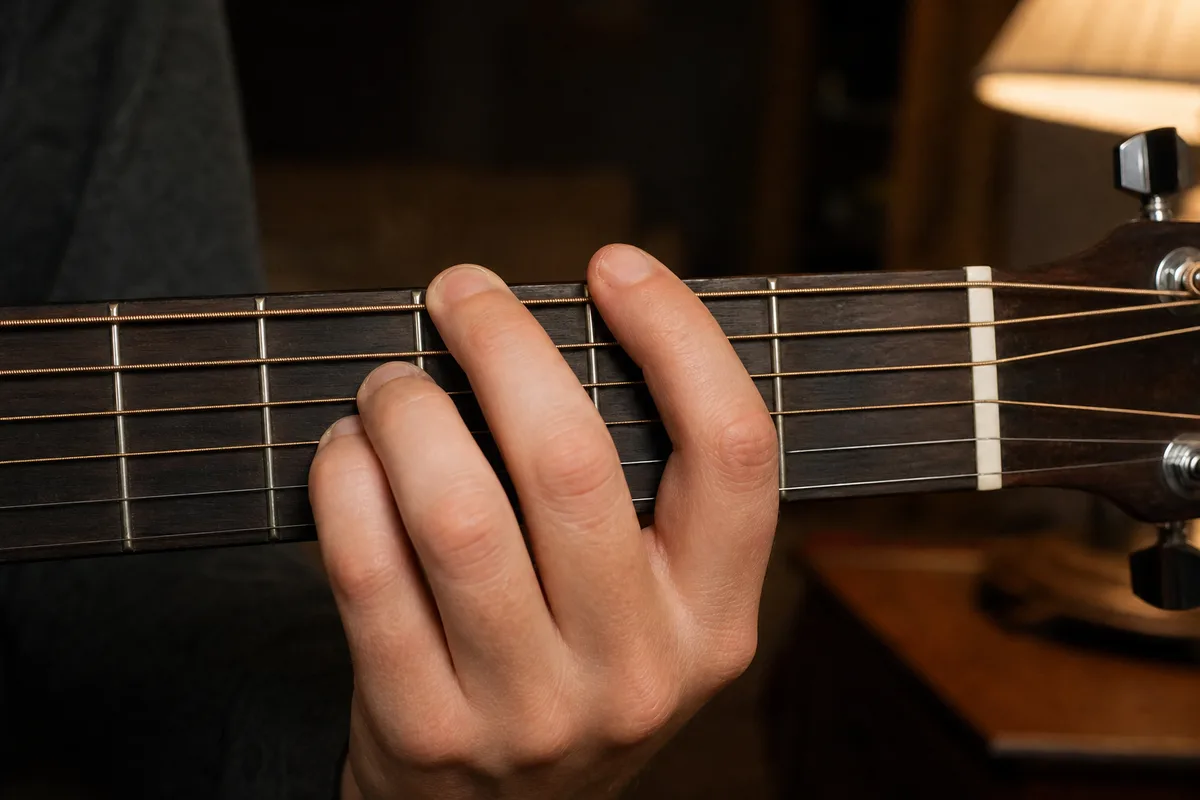
The verses sit in a four-chord descent: Em, D, C, Bm. One chord per line is enough. The pre-chorus lifts on Am and G. The title line returns to Em–D–C–D, then a short close on the tonic.
That economy is the pedagogy. Learners who add extra colour on every beat lose the vocal. Stay with the named chord until the next bracket.
How to practise it
- Speak each line without the guitar.
- Place only the chord in brackets. Hold it for the whole line unless a second bracket arrives mid-phrase.
- Sing the title line last. Gehra hua wants sustain, not a rush to D.
- If Bm collapses, isolate the change and try the upper-string voicing explained below; keep unused strings silent.
Songs Lesson
(Em)Palkein jhapakta hai aasmaan
(D)Laakhon farishton ki hai tu jaan
(C)Woh poochhte hain, "Rehti kahaan?"
Meri (Bm)baahon mein rehti, unko bata
(Em)Palkein jhapakta hai aasmaan
(D)Usne bhi tujhsa dekha kahaan
(C)Hai raunakien wahan, tu hai jahaan
Meri (Bm)baahon mein rehna, yahi hai dua

(Em)Tu agar meri, hai fasaana tera
(D)Tu agar meri, toh zamaana tera
(C)Tu agar meri, main hoon te(Bm)ra

Betaab(Am)sa mohabbat ka tu (G)inqalaab hai
Mera ja(Am)haan teri baahon mein (G)khwaab, khwaab hai

Gehra hu(Em)a, gehra hu(D)a
Rang aashi(C)qui gehra hu(D)a
Tera hua

(Em)Tu agar meri, yeh hawayen teri
(D)Tu agar meri, saari raahein teri
(C)Tu agar meri, main hoon te(Bm)ra
Work with a teacher if the Bm stretch collapses the line.
Make the Em–D–C–Bm descent playable
I separate this progression into two changes before asking for the whole verse. Start with Em to D and check the D chord string by string. The lowest two strings do not belong in a standard open D shape; brushing across all six can obscure the chord even when the fretting fingers are correct. Next isolate C to Bm, where the hand has a different job. A clean Em does not prove that this transition is ready.
For a smaller Bm voicing, the upper four strings can be played at frets 4–4–3–2, read from the D string towards the high E. That gives F sharp, B, D and F sharp. Keep the lower two strings silent. This is a specific voicing, not a promise that any two-finger substitute will retain the harmony. If it is uncomfortable, slow down and have the hand position checked rather than squeezing harder.
Practise one quiet attack per count at a manageable speed. The exercise tempo is your practice choice, not a claim about the recording's BPM. Keep the right hand moving through the transition even when the first attempt sounds imperfect. Then pause and fix the contact point causing the fault. Repeatedly stopping before Bm teaches a pause that the song does not need.
Hear the contrast before adding a strum
The Am–G passage changes the route of the harmony. I first ask the learner to play those two chords and hum the phrase without the rest of the verse. Listen for the different arrival on G, then return to Em. This comparison makes the sections recognisable without relying only on the printed lyric.
The supplied chart marks chord placements; it is not a complete rhythmic transcription. Do not interpret every printed line as exactly one bar. Listen for the lyric entry and carry the chord until its next marked change. When the placement is secure, add a restrained strum that leaves the voice audible. A complicated pattern should not force the words to arrive early.
Combine singing and playing in small steps
Speak the lyric over the accompaniment before singing it. If the chord changes move when you speak, the coordination needs more work before pitch is added. Take only one line, repeat it accurately, then join its ending to the next entry. This avoids learning each line as an isolated event with an accidental pause between them.
If the recorded range does not suit you, transpose every chord by the same interval or discuss a suitable capo position. Do not change only Bm because it is difficult: that alters the harmony rather than the key. I judge readiness by an unbroken phrase, clear changes and comfortable singing, not by how closely a beginner imitates the recorded vocal colour.
Related study
This song is taught as part of the guitar classes and singing classes at Dr Banerjee Music, in the studio in Jalandhar and live online.
- Oonchi Oonchi Waadi: Guitar Tabs, Notes and Chords
- Yeh Dil Sun Raha Hai: Guitar Chords and Piano Harmony
Frequently Asked Questions
Which film is Gehra Hua from?
Dhurandhar (2025), directed by Aditya Dhar. The song is the soundtrack's slow centre: Arijit Singh and Shashwat Sachdev on voice, Irshad Kamil on the words, Shashwat Sachdev on the music.
What key is the lesson in?
E minor. The verses walk Em, D, C and Bm; the lift uses Am and G; the title line returns to Em and D. Stay in that family until the words sit.
How should the brackets be read?
A chord in brackets lasts until the next bracket. Mid-line changes (Bm on tera, Am on Betaabsa) are the only places to move early. Do not add passing chords the sheet does not name.
Questions about this lesson? WhatsApp 62800-75157 or drbnrj@gmail.com.