Jaiye Sajana: Guitar Chords and Song Lesson

Doctorate in World Music, University of Oxford · teaching since 1992. More about the teacher.
Song Credits
- Song: Jaiye Sajana (the supplied chord file is titled Jaiye Sajna)
- Film: Dhurandhar: The Revenge (2026)
- Singers: Jasmine Sandlas, Satinder Sartaaj and Shashwat Sachdev
- Music: Shashwat Sachdev
- Lyrics: Satinder Sartaaj and Jasmine Sandlas
The official audio from T-Series is here to practise along with; the player loads only when you press play:
Direct link if the player does not load: Jaiye Sajana (Audio): Dhurandhar The Revenge
The D minor chord map
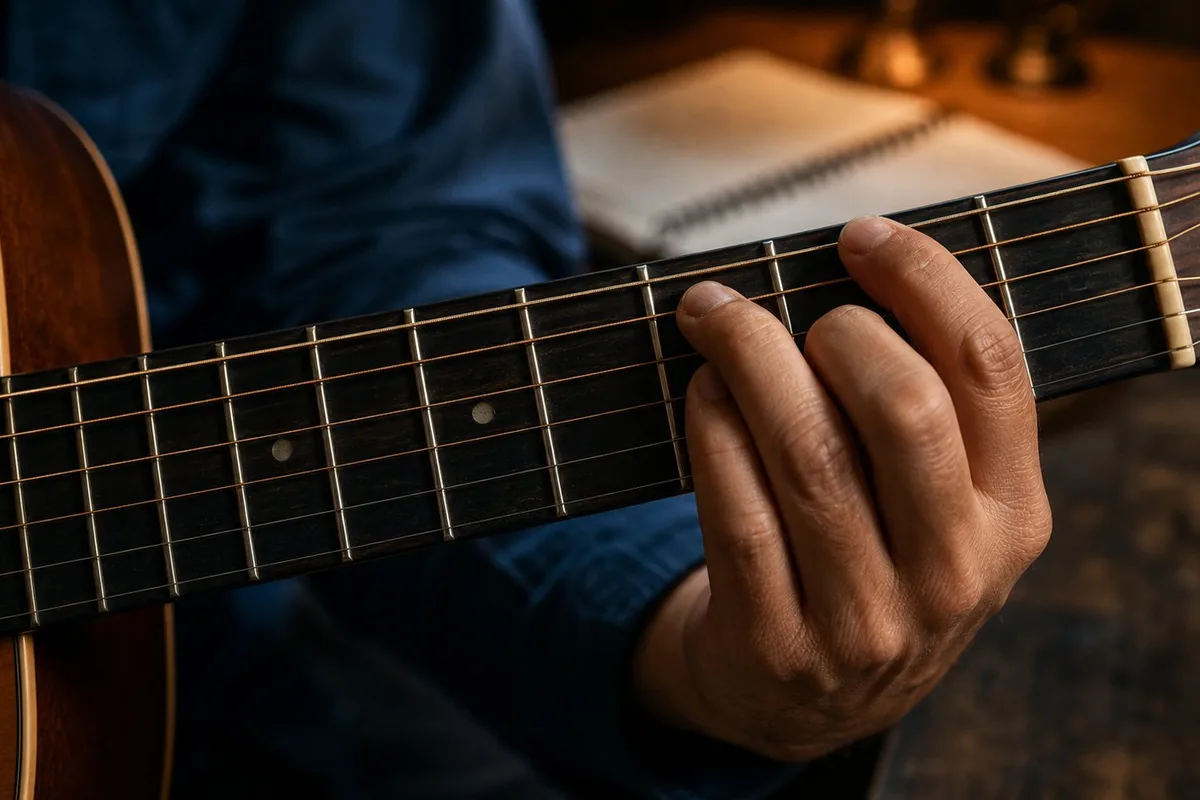
The supplied chord sheet is centred on D minor (Dm). The opening moves from Dm to Bb, then Gm to A. The verse uses Dm, Bbmaj7, Gm, Gm7 and A, returning to Dm. The refrain follows Dm–Bbmaj7–D#–Dm.
The chart writes the refrain chord as D#; that pitch is enharmonically equivalent to E♭ (Eb). Keep the spelling from the supplied sheet while you practise; the return to Dm is marked on the final syllable of “sajna”.
A chord in parentheses marks where to change. Hold it until the next bracket or the end of the line. A bracket placed inside a word marks a mid-word change—follow its position rather than moving early.
How to practise it
- Speak or sing each line in time without the instrument.
- Loop Dm–Bb and Gm–A slowly; keep the pulse even as the hand moves.
- Practise the Gm–Gm7 change by itself, then return to the full verse without stopping.
- Isolate the refrain, Dm–Bbmaj7–D#–Dm, and listen for the Dm resolution.
- Add a light, steady strum or keyboard accompaniment. The supplied chart gives chord placements, not a fixed strumming pattern, so match the rhythm to the recording and the singer.
Jaiye Sajana chord sheet
The chord-and-lyric sheet from the supplied text, kept in its spelling and chord placements:
(Dm) Badlaan chon diggde hanjoo, (Bb) akh meri phir vi royi na
(Gm) Aisi preet la layi rabba, (A)jaisi hor kade hoyi na

Tere (Dm)jaan ton main baad ik din soyi na
Poora (Bbmaj7)shehar begaana ethe mera koi na
Phir (Gm)preet kise de naal (Gm7)kade hoyi na
(A) Zamaana zaalim (Dm)taan vi royi na
Saare (Dm)rang vekh laye hun koi darr nahi
Jiyundi (Bbmaj7)rahoon aashiqui eh kade na marni
Chahe (Gm)turdi ravaan mil(Gm7)na ve kar ni
(A) Koi na ethe dil (Dm)diyaan dass daan

Saanu (Dm)saariyan visar gaiyaan (Bbmaj7)raahvaan ve
Kehde paase (D#)jaiye saja(Dm)na
Saanu (Dm)saariyan visar gaiyaan (Bbmaj7)raahvaan ve
Kehde paase (D#)jaiye saja(Dm)na
Keep the chord colours distinct
I would not treat Bb and Bbmaj7 as interchangeable labels in this lesson. Bb contains Bb, D and F; Bbmaj7 adds A. On keyboard, play the triad first and then add the seventh so you can hear the difference. On guitar, check the voicing you choose instead of adding a finger simply because the name is longer. The purpose is to hear the added tone within the phrase, not to make every chord as large as possible.
The Gm–Gm7 movement similarly adds F to G, Bb and D. Practise that change without the rest of the song and listen to which voice actually moves. If the hands jump to an entirely unrelated shape, a small harmonic change can become an unnecessarily large physical task. I look for a comfortable voicing that preserves the intended notes and supports the next chord.
Why the A chord needs attention
The chart uses A major, whose notes include C sharp. Replacing it with A minor changes the pull back towards Dm. Play A followed by Dm and listen for the resolution before returning to the lyric. This short listening comparison gives the chord a musical reason; otherwise a beginner may memorise the shape while repeatedly playing the minor version out of habit.
For the refrain, the supplied D# spelling represents the same sounding chord as Eb in equal temperament. In this D-minor context, Eb is often the clearer name to think with, while I preserve the supplied chart's spelling above. This is an explanation of notation, not a reason to add another chord between it and Dm.
Test the refrain without a run-up
Begin directly at the refrain rather than always playing the entire opening first. Count yourself in, speak the words and place each change at its bracket. If you cannot begin without hearing the verse, the starting pitch or rhythmic entry may need separate practice. Resolve that uncertainty before increasing the pace.
Then connect the last part of the preceding section to the refrain. This tests a different skill: arriving from the music rather than from silence. Both starts should feel dependable. A recording can help establish the phrasing, but pause it when checking whether you can maintain the passage independently.
When singing and playing together, reduce the accompaniment first. One well-placed chord is more useful than a fluent strum whose accents fight the lyric. I would add colour and movement only after the changes, words and breathing can coexist without an avoidable stop.
Related study
This song can be worked on in the guitar classes and singing classes at Dr Banerjee Music, in the studio in Jalandhar and live online.
- Barsaat: Guitar Chords Lesson from Banjaare
- Gehra Hua: The Guitar Chords Lesson from Dhurandhar
- Yeh Dil Sun Raha Hai: Guitar Chords and Piano Harmony
Frequently Asked Questions
What key is this Jaiye Sajna chord sheet in?
The supplied progression is centred on D minor, with Dm as its home chord. Transpose every chord by the same interval if you need a different pitch for your voice.
Which chord comes between Bbmaj7 and Dm in the refrain?
The chart places D# on “jaiye”, followed by Dm on “sajna”. D# is enharmonically equivalent to Eb.
Can I use these chords on piano or keyboard?
Yes. Chord symbols are not specific to guitar. Use the same changes on piano or keyboard, choosing voicings that leave the melody clear.
Questions about this lesson? WhatsApp 62800-75157 or drbnrj@gmail.com.