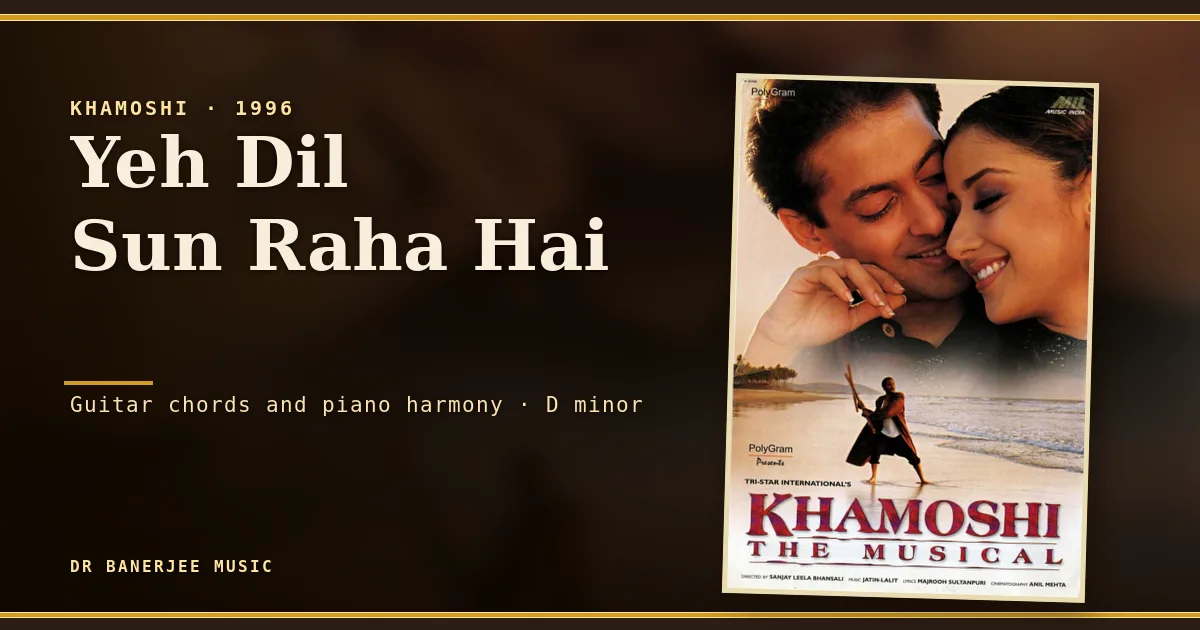
Yeh Dil Sun Raha Hai: Guitar Chords and Piano Harmony

Doctorate in World Music, University of Oxford · teaching since 1992. More about the teacher.
Listening Before Playing

Yeh Dil Sun Raha Hai, composed by Jatin–Lalit and sung by Kavita Krishnamurthy, operates within a restrained minor tonal space. The composition is not harmonically dense, yet it is emotionally precise.
This makes it ideal for learners: the simplicity allows focus on phrasing, voice-leading, and tonal gravity rather than technical excess.
Tonal Centre and Scale Behaviour
The song broadly centres around D minor (Dm).
However, like many Hindi film compositions of the 1990s, it does not strictly adhere to Western harmonic rigidity. Instead, it borrows colour tones through modal interchange—particularly via Eb major and Bb major, which introduce a subtle shift in emotional shade.
This is not accidental. It reflects a semi-classical sensibility translated into film harmony.
Chord Progression (Core Structure)
First line, with its chords: Ye (Dm)dil sun ra(C)ha hai…
Read the progression as behaviour, not as a shape list: Dm is home, C and Gm are its neighbours, and Bb and Eb are the borrowed colours that give the song its shade. The practice method below builds the loop in exactly that order.
The full sheet with the words in place — as the studio teaches it, each chord in brackets landing on the syllable where the change comes:
Ye (Dm)dil sun ra(C)ha hai
Tere (Gm)dil ki zu(Dm)baan
Ae me(Bb)re humna(C)shi
Mai wa(Eb)han tu ja(Dm)han
Meri sa(Dm)da mein(Eb) bole (Dm)tu
Ye ko(Eb)i (F)kya (Gm)jaane
Geet (Eb)mein (Dm)hai Saaz (Eb)mein (Dm)hai
Tu hi (Bb)tu nagma ka(F)han
Ye dil sun raha hai...
Dard e mohabbat ke siwa mai bhi kya tu bhi kya
Ye zameen hum aasman hum ab hume jaana kahan
Jaana ka(F)han ab hu(Eb)mein
Jaana ka(F)han jaana ka(Eb)han
Ye dil sun raha hai...
Sing the mukhda until the Dm → C and Gm → Dm moves stop needing thought, then add the antaras — the borrowed Bb and Eb arrive exactly where the melody leans on them.
Guitar Approach
For guitarists, the piece benefits from slow arpeggiation rather than strumming.
- Use fingerstyle patterns (P–i–m–a) to sustain emotional continuity
- Keep transitions between Dm → C → Gm smooth; avoid percussive breaks
- Let open strings ring where possible to preserve resonance
The song is less about rhythm and more about sustained harmonic breath.
Piano Interpretation
On piano, avoid block chords as the primary texture. Instead:
- Left hand: broken octaves or root–fifth patterns
- Right hand: voice-led triads with minimal movement
For example:
- Move from Dm to C by shifting only necessary fingers, not entire shapes
- Maintain common tones wherever possible
This creates continuity, which is essential for this composition.
Harmonic Observation (Why It Works)
Three aspects deserve attention:
1. Minor Stability with Soft Deviations
The D minor base is never abandoned, but it is gently coloured through Bb and Eb.
2. Emotional Restraint
There are no dramatic dominant resolutions. The absence of strong V–I cadences keeps the song suspended, almost unresolved.
3. Repetition as Design
The repetition of phrases is not redundancy—it is reinforcement. Each cycle deepens the emotional register without adding harmonic complexity.
Music Production Perspective
For producers, this song offers a clear lesson:
- Sparse arrangement is intentional, not incomplete
- Pads and strings should support, not dominate
- Reverb space plays a compositional role, not just an effect
A modern recreation should avoid over-layering. The strength lies in air, not density.
Practice Method
Rather than playing the full song immediately:
- Loop Dm → C → Gm → Dm until transitions are fluid
- Add Bb and Eb only after tonal stability is achieved
- Sing internally while playing—this aligns phrasing with harmony
This reflects a pedagogical principle: structure before performance.
Yeh Dil Sun Raha Hai is often treated as a “simple song.” Structurally, it is simple. Musically, it is not.
Its restraint, modal colouring, and refusal to resolve dramatically make it a valuable study in controlled emotional writing. For learners, it offers a disciplined entry into minor-key expression without harmonic overload.
Related study
This song is taught as part of the piano, keyboard and harmonium classes and guitar classes at Dr Banerjee Music, in the studio in Jalandhar and live online.
- Diye Jalte Hain: Piano Notes and Guitar Tabs
- Chand Chupa Badal Mein: Guitar, Piano and Singing Lesson
Frequently Asked Questions
What is the tonal centre of Yeh Dil Sun Raha Hai?
D minor, and the lesson treats the centre as a behaviour rather than a label: the harmony keeps returning to it from slightly different angles, which is what gives the song its unsettled, searching character.
What does the practice method ask for first?
Listening — several passes with the recording before touching an instrument. The sections are ordered deliberately: tonal centre, progression, then approach, so the ear already knows what the hands are about to attempt.
Is this song suitable for beginners?
The chord set is small and the tempo is moderate, so committed beginners manage it. The honest difficulty is expressive: the dynamics are restrained, and playing it loudly or evenly flattens exactly what the song is built on.
Questions about this lesson? WhatsApp 62800-75157 or drbnrj@gmail.com.