Kabir Amritwani: Guitar Tabs, Sargam and Chords

Doctorate in World Music, University of Oxford · teaching since 1992. More about the teacher.
The Structural Translation of Bhakti Poetry
The studio's all-in-one lesson clip for the bhajan — guitar, piano and harmonium chords with sargam — tap to play, loads only on tap:
Direct link if embed does not load: AiO - Kabir Amritwani #guitar #piano #harmonium #bhajan #chords #sargam #bollywoodsongs
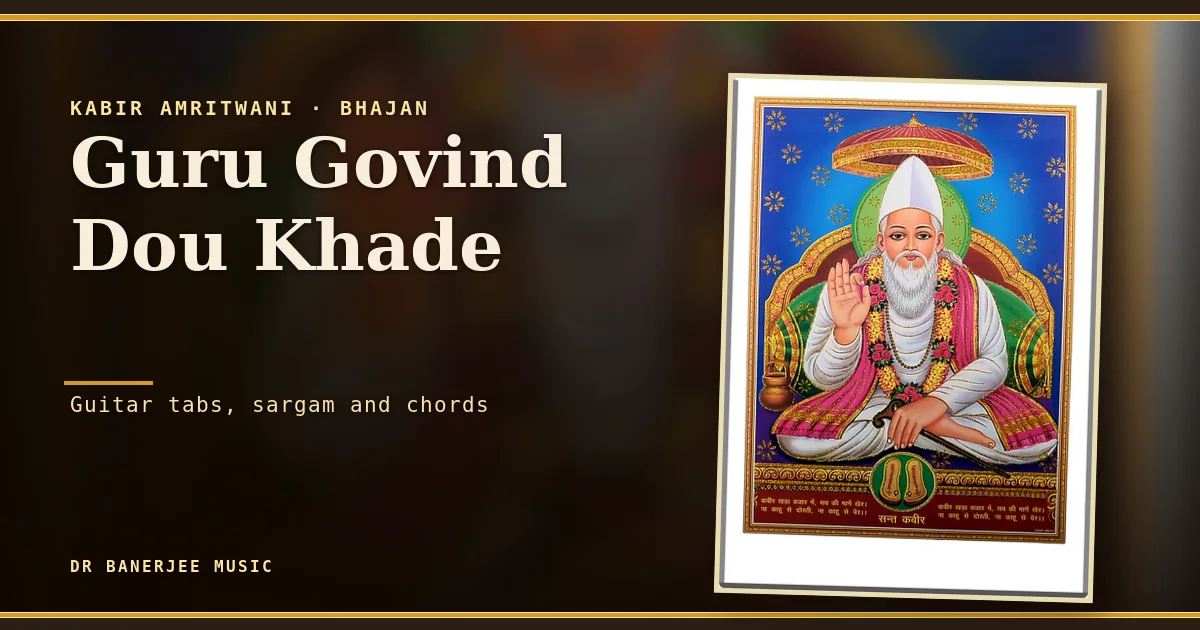
Translating the fluid, vocal-centric traditions of Indian Bhakti poetry onto a fretted Western instrument requires more than just knowing where to place your fingers. Music must always be treated as knowledge, not mere entertainment. When we approach the timeless verses of Kabir Amritwani, specifically the famous doha "Guru Govind Dou Khade", we must bridge the gap between Hindustani vocal phrasing (Sargam) and Western harmonic structures (Chords).
This guide provides a comprehensive, step-by-step tutorial mapping strings, frets, notes, and chords. By studying this structural breakdown, students will not only learn how to play the melody but will also understand the pedagogical relationship between the fretboard and the human voice.
Notation Legend and Scale Breakdown
To ensure a disciplined practice session, it is crucial to understand the layout of the notation provided below:
- F: Fret Number
- N: Western Note (e.g., Bb, Ab, C')
- H: Hindustani Sargam (e.g., Sa, Re, ga, ma, Pa, ni)
- W: Words / Lyrics of the Doha
- C: Accompaniment Chords
The melody is anchored around a B-flat minor foundation, utilising chords like Bbm, Fm, and Ab to support the underlying emotional weight of the verses.
Step-by-Step Guitar Tabs and Sargam
S     4 3  3 3  3    2  3 3   3  3
F     3 1  1 3  3    1  1 3   3  3
N     F Ab AbBb Bb   C' AbBb  Bb Bb
H     Pani niSa'Sa'  Re'niSa' Sa'Sa'
W     Guru Go-vind-- Do---u-- Khade
C Bbm..............................

S 4 3 3  3  2  2   2
F 3 1 1  3  2  1   2
N F AbAb Bb Db'C'  C'
H Panini Sa'ga'Re' Re'
W Ka--ke Lago----- Paye
C .................Ab..

S    2  2  2  2   1  1   2  2  2  3  2  2  3  3
F    1  4  4  4   1  1   4  3  1  3  2  1  3  1
N    C' Eb'Eb'Eb' F' F'  Eb'D' C' Bb Db'C' Bb Ab
H    Re'ma'ma'ma' Pa'Pa' ma'Ga'Re'Sa'ga'Re'Sa'ni
W    Ba-li-haari- Gu-ru- Aa-p--ne---------------
C Fm.....................Ab.....................

S     3 3    2  3  2   2  2  2
F     1 3    1  3  2   1  1  1
N     AbBb   C' Bb Db' C' C' C'
H     niSa'  Re'Sa'ga' Re'Re'Re'
W     Govind Diyo----- Ba-ta-ye-
C Bbm.....................Fm....

S 2  3  2  3  3     3 3    2  2   3  3  3
F 1  3  1  3  1     1 3    2  1   3  3  3
N C' Bb C' Bb Ab    AbBb   Db'C'  Bb Bb Bb
H Re'Sa'Re'Sa'ni    niSa'  ga'Re' Sa'Sa'Sa'
W Ka-bi----ra---    Govind Di-yo- Ba-ta-ye-
C ...............Ab.................Bbm....
Pedagogy Precedes Performance: How to Practice
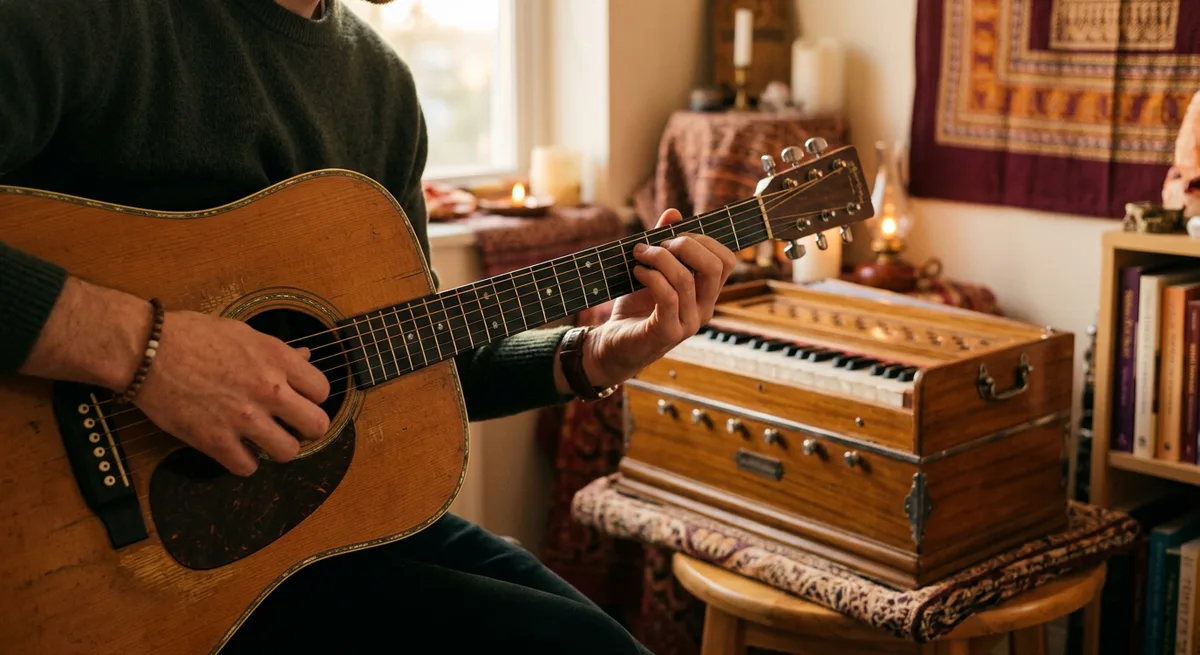
Having the notation is only the first step. Because this is a vocal melody, playing it with stiff, discrete plucks will strip the music of its essence. When moving between notes like 'ma' (Eb) to 'Pa' (F), incorporate subtle slides (meend) to replicate the human voice. Furthermore, the chords (Bbm, Fm, Ab) should not be strummed aggressively; they are structural pillars meant to provide a resonant, drone-like atmosphere behind the lead melody.
गुरु गोविंद दोऊ खड़े, काके लागूं पाए,
बलिहारी गुरु आपने, गोविन्द दियो बताय।
कबीर…गोविन्द दियो बताय।
यह तन विष की बेलरी, गुरु अमृत की खान,
सीस दिए से गुरु मिले, वो भी सस्ता जान।
कबीर…वो भी सस्ता जान।
ऐसी वाणी बोलिये, मन का आप खोये,
औरन को शीतल करे, आपहु शीतल होये।
कबीर…आपहु शीतल होये।
बड़ा भया तो क्या हुआ, जैसे पेड़ खजूर,
पंथी को छाया नहीं, फल लागे अति दूर।
कबीर…फल लागे अति दूर।
निंदक नियरे राखिये, आँगन कुटी छवाए,
बिन साबुन पानी बिना, निर्मल करे सुभाए।
कबीर…निर्मल करात सुभाए।
बुरा जो देखन मैं चला, बुरा ना मिल्या कोई,
जो मन देखा अपना, तो मुझसे बुरा ना कोई।
कबीर…तो मुझसे बुरा ना कोई।
दुःख में सुमिरन सब करे, सुख में करे न कोई,
जो सुख में सुमिरन करे, तो दुःख कहे को होये।
कबीर…तो दुःख कहे को होये।
माटी कहे कुम्हार से, तू क्या रोन्धे मोहे,
एक दिन ऐसा आएगा, मैं रोंधुंगी तोहे।
कबीर…मैं रोंधुंगी तोहे।
मालिन आवत देख के, कलियाँ करे पुकार,
फूले फूले चुन लिए, काल हमारी बार।
कबीर…काल हमारी बार।
Related study
This song is taught as part of the guitar classes and Indian classical music classes at Dr Banerjee Music, in the studio in Jalandhar and live online.
Frequently Asked Questions
Who wrote Guru Govind Dou Khade?
Kabir, the fifteenth-century poet whose couplets circulate in both devotional and classical settings. The doha is traditional repertoire in the public domain, which is why it can be notated and taught line by line in full.
What do the six notation rows mean?
Each phrase is written across six aligned rows: fretting, fingering, note names, sargam, words and chords. Reading any single column gives one complete view of the phrase; reading across shows how the views lock together.
How should this piece be practised?
Slowly, with the sargam sung before it is played. The pedagogy in the lesson asks for the notation to be read, then sung against a drone, then transferred to the instrument — the mechanical tab is the last step, not the first.
Questions about this lesson? WhatsApp 62800-75157 or drbnrj@gmail.com.