Anadi: Primordial Sound and the Thread Across Faiths

Doctorate in World Music, University of Oxford · teaching since 1992. More about the teacher.
Step past the mythology of the celestial hierarchy and you enter a far more philosophical question: how did the universe come to be, what connects the world's faiths, and why does sound sit at the very foundation of reality? These are not separate enquiries. They converge on one Sanskrit word and one acoustic principle. The word is Anadi (अनादि), meaning "without beginning." The principle is that before there is matter, there is resonance.
The Beginningless: Conceptualising Anadi
By literal translation, Anadi describes a state of existence that is uncaused, eternal and self-sustaining. To grasp it, we must confront a paradox of time. The human mind is wired to think linearly — past, present, future — and so we instinctively ask, "What came before Anadi?"
In Vedic thought, however, Time (Kala) is a dimension of the created universe (Prakriti). The concepts of "before" and "after" only become meaningful once time exists, just as a melody can only begin once a tempo has been established. The Supreme Reality — Brahman — is therefore Kalatita: beyond time. Because it stands entirely outside the framework of time, asking what preceded it is not difficult but meaningless. The dimension of "before" simply does not apply to the absolute.
This is worth pausing over, because it is a distinctive claim. Most cultures try to answer the question of origin by pointing ever further back in a chain of causes. Vedic metaphysics declines to keep walking the chain backwards. It does not offer an earlier moment; it dissolves the category of "earlier."
The Silence of the Nasadiya Sukta
If there was no time, no space, no gods and no matter, what exactly was that nothingness? The Rig Veda (10.129) captures this pre-creation, Anadi state in the Nasadiya Sukta, the Hymn of Creation:
Then there was neither non-existence nor existence…
There was no death, nor immortality then; no sign of night or day.
That One breathed, windless, by its own impulse;
Other than That, there was nothing whatsoever.
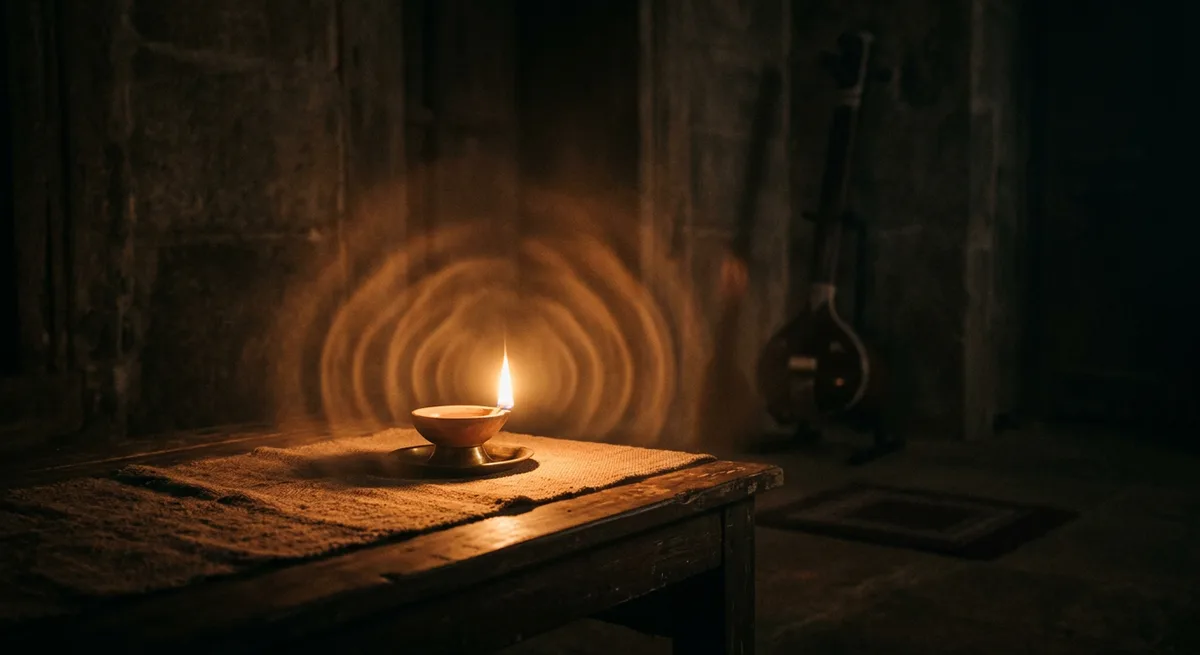
Before form, there was only Nirguna Brahman — an infinite, motionless ocean of pure consciousness. Picture the profound silence before a performance begins. That silence is not empty; it is dense with the unmanifested potential of every note and scale that could ever be played. It has not yet committed to a form, yet it holds the capacity for all forms. The audience does not hear the silence as nothing. They hear it as expectancy.
Across Traditions: Anadi, God and Allah
Look past cultural ritual and the Vedic idea of the Anadi reality resonates with the conceptions of God in Christianity and Allah in Islam. In all three traditions, the ultimate source is understood to be eternal, uncaused, omnipresent and sovereign. Islam names Allah as Al-Awwal, the First without beginning, and Al-Akhir, the Last without end. Christianity describes God as the Alpha and the Omega. Each tradition, in its own grammar, reaches towards a being who cannot be chronologically located. The parallels are worth noting, but this essay does not claim the three are the same being; it observes that they are asking a remarkably similar question.
The Core Philosophical Distinction
Where the traditions truly differ is not in what the ultimate reality is, but in how it relates to the universe.
The Abrahamic view — the painter and the painting. In Christianity and Islam, God creates the universe out of nothing (creatio ex nihilo). God and creation are entirely separate, like a painter and a canvas. The painter makes the art, but the painter is not the art.
The Vedic view — the ocean and the waves. The Anadi state of Brahman does not create the universe from external matter; it manifests the universe out of itself. Creator and creation are not separable. Brahman is the ocean, and every star, planet and living being is a temporary wave rising on its surface. The wave is not different in substance from the water; it is only different in duration.
Both are internally coherent models within their own traditions. The difference concerns relationship, not rank — and neither tradition needs to yield to the other for either to be deeply and sincerely held.
To bridge this abstract infinity so that the human mind can revere it, Sanatan Dharma offers Saguna Brahman — God with form and attributes, also called Ishvara. In function this bears comparison with a personal God in the Abrahamic faiths, though each tradition understands that function in its own way.
The Golden Thread: Primordial Sound and Oneness
How does a motionless, silent, infinite consciousness begin to create a physical universe? Across the world's great mystical traditions the answer is strikingly uniform: through sound and vibration. Before physical matter, there is resonance.
Nada Brahman: God as Sound
In Sanatan Dharma, the universe begins with a cosmic vibration, historically conceived as Om (Aum). Just as a fundamental drone note anchors an entire raga, giving every subsequent note a contextual centre, this primal vibration acts as the anchor for the whole physical universe. The formless wind of consciousness moves, producing a vibration that structures itself into the melody of physical reality. It is worth noting that this is not a metaphor for the musician alone; it is the structural model the musician is meant to practise. Any raga, in this light, is a formal demonstration of how a single rooted tone organises everything that follows it.
Sikhism and "Ik Onkar"
Guru Nanak Dev Ji distilled this ancient philosophy into two words: Ik Onkar. Ik is the one absolute, undivided reality; Onkar is the primordial cosmic vibration. Sikhism teaches that the Timeless Being (Akal Purakh) first expressed itself through this primal sound wave. Like breath travelling through an Indian bamboo flute (bansuri), the formless, invisible air of the Creator becomes the structured, audible melody of the universe. Nothing in Creator, nothing in creation, is alien to sound.
Sai Baba and "Sabka Maalik Ek"
Shirdi Sai Baba used the phrase "Sabka Maalik Ek" — the Lord of all is one — to harmonise Hindu and Islamic devotion. He pointed out that whether a devotee prays to the Ocean (Brahman) or the Painter (Allah), each is turning towards a sound-borne origin, in its own language and instrument. The fundamental note each reaches for is, in Sai Baba's framing, shared; only the human instruments and languages differ. This is precisely the kind of cross-tradition thread that appears in the devotional traditions of the subcontinent, from the sants to the shloka. It is the same thread one hears in a Kabir Amritwani and in the recitation of the Shivastakam — a single reverence voiced in different registers.
The Universal Principle of "The Word"
This acoustic architecture of creation echoes around the globe. In Christianity: "In the beginning was the Word, and the Word was with God, and the Word was God" (John 1:1). In Islam, creation occurs at the moment Allah speaks the vibratory command "Kun" — "Be" — and it manifests (fayakun).
The ultimate, beginningless (Anadi) consciousness is silent. But when it wishes to create, it vibrates. That singular vibration is the root of every atom, every soul and every faith in existence.
What This Means for the Musician

This is not abstract theology; it carries a practical discipline. If the universe is built on a foundational vibration, then the musician's drone — the sa, the tanpura, the harmonium's tonic — is not merely an accompaniment. It is a return to the origin. Listening to the drone is a form of listening to the Anadi condition: the still, formless note out of which all movement rises and into which all movement resolves.
It also explains why the silence into which a phrase falls matters as much as the phrase itself. The pause is not the absence of music; it is the Nirguna ground from which the next Saguna gesture emerges. Students who learn to respect the drone and the rest are, whether they know it or not, learning a metaphysics of vibration. In an age that prizes quantity, speed and accumulation, this discipline is both a musical skill and a philosophical orientation — one best carried into the practice room with the same slowness the idea demands. The musician's discipline of the pause is, at root, a discipline of attention.
A Note on Method
This essay is a comparative-philosophical meditation, not a work of theology. It draws attention to parallels between traditions; it does not claim to interpret, reconcile or override the distinctive teachings of any single faith, nor to establish that God, Brahman and Allah are the same being. Each tradition holds its own doctrine and its own devotion, and each deserves to be read on its own terms. What the essay offers is a musician's observation: that across the world's great spiritual lines, sound has repeatedly been named as the first act of creation. That observation is offered as a point of kinship, not as a claim of identity.
Oneness Beyond the Abstract
There is a temptation to treat metaphysical claims as intellectual ornaments. But the argument here is closer to a claim about what music is. If sound is the first act of an otherwise silent consciousness, then every act of sounding recreates creation in miniature. This is why the great traditions treat not just the pitch but the intention behind it as sacred.
The Anadi reality cannot be met by acceleration. It can only be approached by stillness, by a tone held long enough to be felt as ground, and by a silence generous enough to hold the note that follows. For the serious student, this is not a distraction from learning music. It is the reason learning music is worth the years.
Related study
Sound and its sources are studied as part of the Indian classical music classes at Dr Banerjee Music, in the studio in Jalandhar and live online.
Frequently Asked Questions
What does anadi mean?
Beginningless — that which was never created because it never started. The essay follows the idea from the Nasadiya Sukta's even-bolder position that even existence was not yet, through to traditions that name the divine itself as without origin.
Which traditions does the essay draw on?
The Vedic corpus, Nada Brahman in the classical tradition, Ik Onkar in Sikhism, the Sabka Maalik Ek saying associated with Sai Baba, and the Word as it appears in other scriptural language — read as one thread, not as a claim that they all say the same thing.
What does anadi ask of a musician?
Humility about where music begins. If sound is treated as prior to the player, then practice becomes participation in something already underway — which changes how a musician listens, and how seriously the discipline is held.
Questions about this lesson? WhatsApp 62800-75157 or drbnrj@gmail.com.