Koyi Fariyaad: Guitar Chords and Ghazal Lesson

Doctorate in World Music, University of Oxford · teaching since 1992. More about the teacher.
The Koyi Fariyaad guitar chords are seven shapes — Am, C, F, Dm, E, G and Em — and the entire song is built from them. It is the ghazal that Jagjit Singh sang for Tum Bin (2001), and for a guitar student it is unusually well behaved: no modulations, no key changes, and a chord sheet that stays inside A minor from the first line to the last.
What makes it worth studying is one chord. The song uses E major where the key of A minor would normally offer E minor, and that single raised note is where the ache in the melody comes from. Once you hear it, the rest of the progression explains itself.
Song Credits
- Song: Koyi Fariyaad (also written Koi Fariyaad, Koi Fariyad)
- Singer: Jagjit Singh
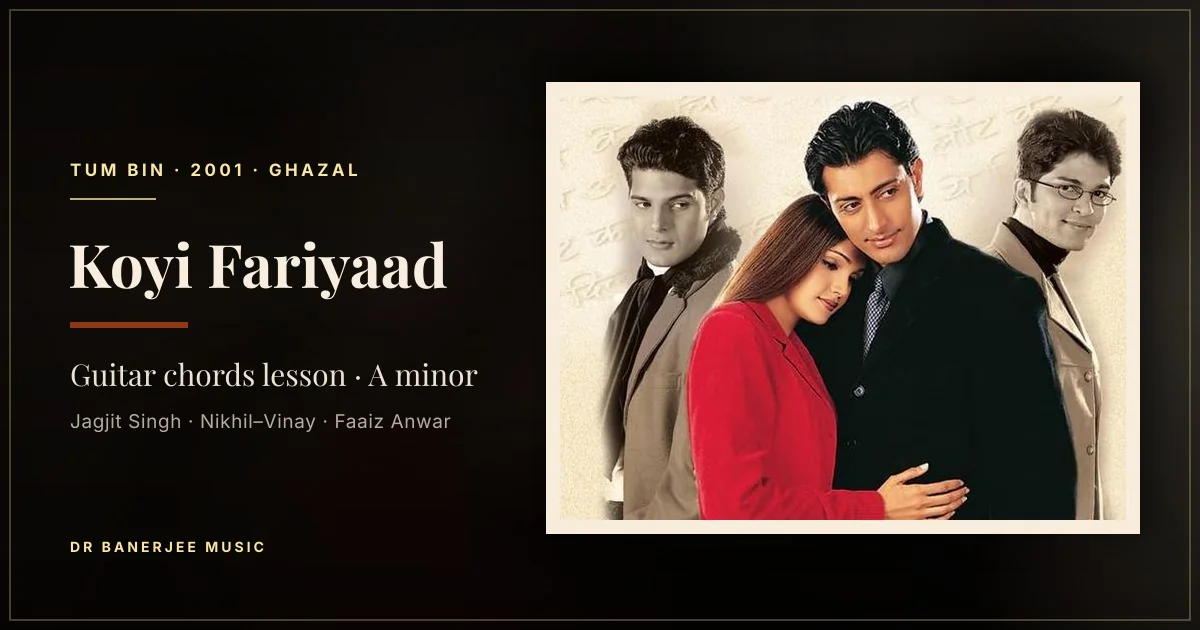
- Film: Tum Bin… Love Will Find A Way (2001)
- Director: Anubhav Sinha
- Starring: Priyanshu Chatterjee, Sandali Sinha, Himanshu Malik, Raqesh Bapat, Vikram Gokhale
- Music: Nikhil–Vinay
- Lyrics: Faaiz Anwar
- Music label: T-Series
- Released: 13 July 2001
The A minor chord map
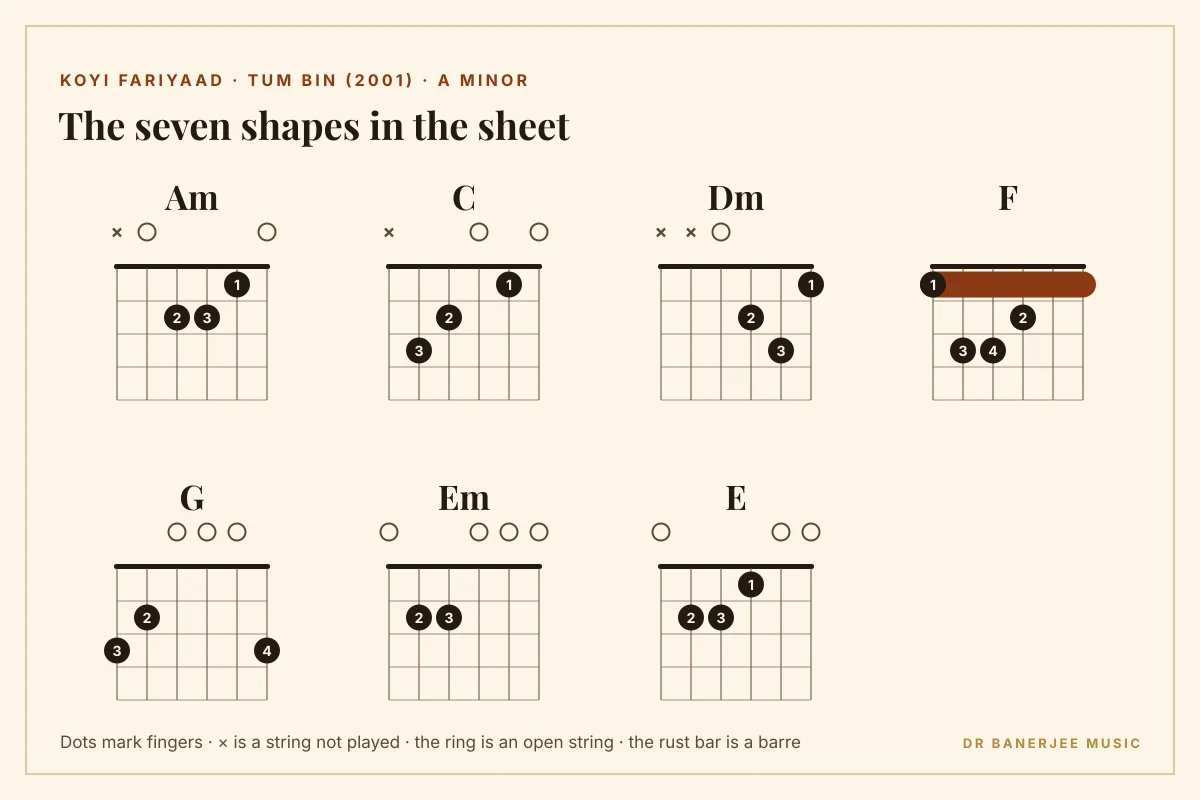
The supplied chord sheet sits in A minor. Every chord in it is diatonic to that key with one exception:
| Chord | Function in A minor | Shape (open position) |
|---|---|---|
| Am | i — the home chord | x02210 |
| C | III | x32010 |
| Dm | iv | xx0231 |
| F | VI | 133211, or xx3211 for the small version |
| G | VII | 320003 |
| Em | v — the natural minor fifth | 022000 |
| E | V — the raised third, G♯ | 022100 |
G♯ is not in A minor. A harmonic minor raises the seventh of the scale from G to G♯, and E major is the chord that contains it. That is why the sheet writes E and not Em at the end of the mukhda: Dabi (E) Ho Jaise (Am) is a real V–i cadence, the strongest close the minor key can offer. Play the same line with Em instead and the resolution sags — the music suddenly sounds like a folk strum rather than a ghazal.
Three shapes carry the whole song:
- F–Dm–E–Am — VI–iv–V–i. The opening line. The F falls to Dm (a change of one finger group), Dm steps up to E, and E resolves to Am on the word jaise.
- Am–C–F–Am — i–III–VI–i. The first antara, Har mulaqat pe mehsoos yehi hota hai. Nothing but stepwise colour; it never leaves the tonic for long.
- G–Em–F–Am — VII–v–VI–i. The answer line, Tune aankhon se koi baat kahi ho jaise. A descending fall back into the home chord.
Where the radif lands
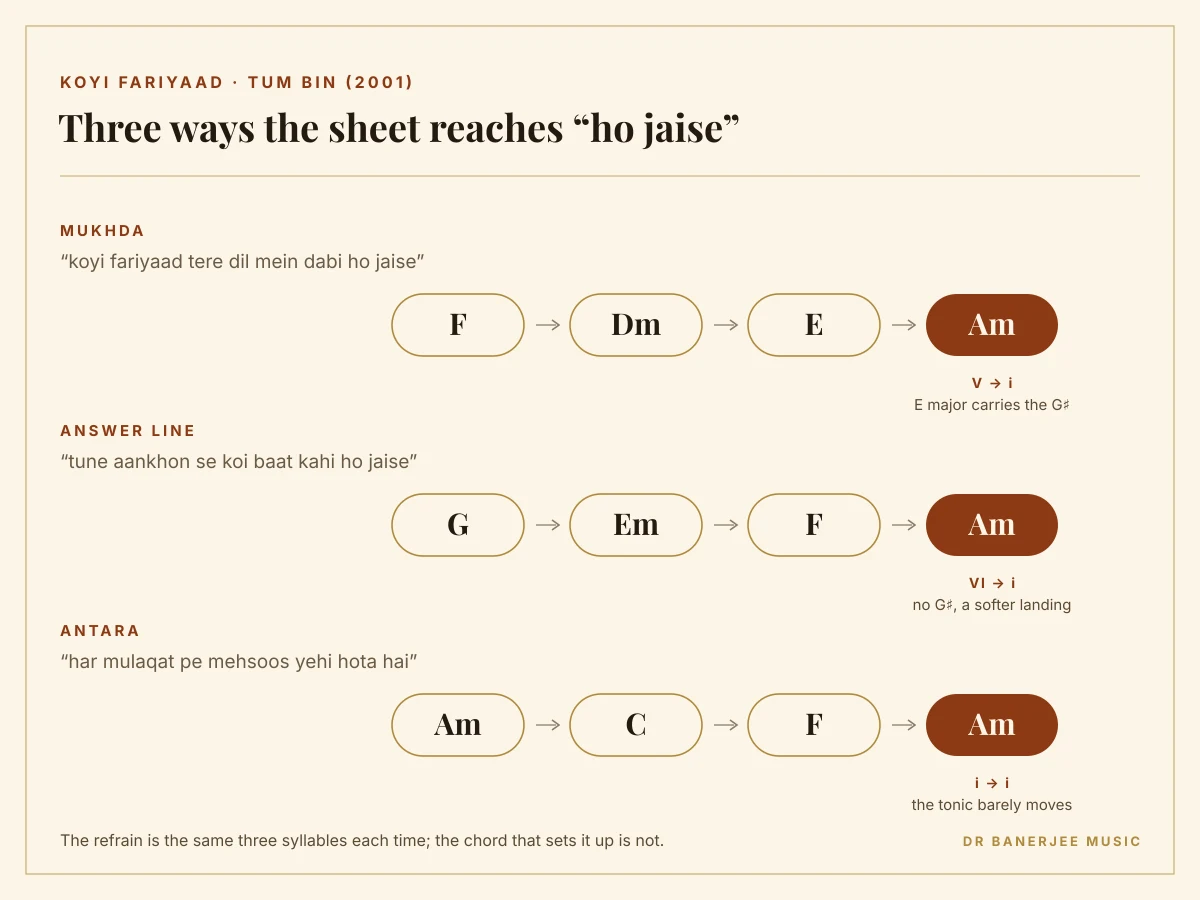
A ghazal repeats a refrain — the radif — at the end of every couplet. Here the radif is ho jaise, and the chord sheet puts it in the same place every time: the change happens on ho, and the resolution to Am lands on jaise.
What the sheet also shows, and what most chord charts flatten out, is that the cadence before the radif changes. The opening line approaches it from E — dabi (E) ho jaise (Am). The answer line approaches it from F — kahi (F) ho jaise (Am). Same three syllables, two different harmonic arrivals, one of them a dominant cadence and one a mediant one. Sing the two lines back to back and you can hear the difference without knowing a note name.
That is the actual lesson of this song: the chords are easy, and the interest lives in which chord sets up the refrain.
Reading the sheet
A chord in parentheses marks the syllable where the change happens. Hold it until the next bracket or the end of the line.
A bracket placed inside a word — Fari(F)yaad, Aan(G)khon, Mulaa(Am)kat, Chal(Am)te — is a mid-word change. Move exactly where the bracket sits rather than a beat early; these are the changes that decide whether the song sounds sung or strummed.
The supplied text gives no strumming pattern and no tempo marking. Do not invent one from a tab site. Match the accompaniment to the recording: a slow, even stroke, or a simple arpeggio that leaves the voice in front.
How to practise it
- Speak the mukhda in rhythm without the instrument, and mark where each bracket falls.
- Loop Am–C slowly, then Am–F. These two pairs cover most of the song.
- Isolate F–Dm–E–Am. When F is a barre, the Dm is easier than it looks: keep the F and A ringing under the fingers and move the third finger.
- Practise the cadence on its own. E to Am, four beats each, until the change is quiet. Then F to Am, which is a smaller move and needs less hand.
- Add the words last, one line at a time, and check that every mid-word change still lands on its syllable at speed.
- Match the recording. Listen to where Jagjit Singh stretches the refrain; the accompaniment waits for him. A metronome is useful for the changes, not for the phrasing.
If the key sits too low for your voice, capo up and keep every shape. One fret up and the song is in B♭ minor; two and it is B minor. The progression, the cadences and the G♯ all travel with the capo, which is exactly why learning it in shapes rather than in fret numbers is worth the effort.
Koyi Fariyaad chord sheet
The chord-and-lyric sheet from the supplied text, kept in its spelling and chord placements:
MUKHDA
Koyi Fari(F)yaad Tere (Dm)Dil Mein Dabi (E)Ho Jaise (Am)
Koyi Fari(F)yaad Tere (Dm)Dil Mein Dabi (E)Ho Jaise (Am)
Tune Aan(G)khon Se Koi (Em)Baat Kahi (F)Ho Jaise (Am)
Jaagte (F)Jaagte Ek (Dm)Umar Kati (E)Ho Jaise (Am)
Jaagte (F)Jaagte Ek (Dm)Umar Kati (E)Ho Jaise (Am)
Jaan Baa(G)ki Hai Magar (Em)Saans Ruki (F)Ho Jaise (Am)

ANTARA 1
Har Mulaa(Am)kat Pe Meh(C)soos Yehi (F)Hota Hai (Am)
Har Mulaa(Am)kat Pe Meh(C)soos Yehi (F)Hota Hai (Am)
Mujhse Kuch (G) Teri Nazar (Em)Pooch Rahi (F)Ho Jaise (Am)

ANTARA 2
Raah Chal(Am)te Huye Ak(C)sar Yeh Ghumaan (F)Hota Hai (Am)
Raah Chal(Am)te Huye Ak(C)sar Yeh Ghumaan (F)Hota Hai (Am)
Woh Nazar (G) Chupke Mujhe (Em)Dekh Rahi (F)Ho Jaise (Am)
Woh Nazar (F) Chupke Mujhe (Dm)Dekh Rahi (E)Ho Jaise (Am)
Koyi Fari(F)yaad Tere (Dm)Dil Mein Dabi (E)Ho Jaise (Am)
Tune Aan(G)khon Se Koi (Em)Baat Kahi (F)Ho Jaise (Am)

ANTARA 3
Ek Lamhein Mein Simat Aaya Hai Sadiyon Ka Safar
Ek Lamhein Mein Simat Aaya Hai Sadiyon Ka Safar
Zindagi Tej Bahut Tej Chali Ho Jaise
Zindagi Tej Bahut Tej Chali Ho Jaise
Koyi Fariyaad Tere Dil Mein Dabi Ho Jaise
Tune Aankhon Se Koi Baat Kahi Ho Jaise

ANTARA 4
Iss Tarah Pehron Tujhe Sochta Rahta Hoon Main
Iss Tarah Pehron Tujhe Sochta Rahta Hoon Main
Meri Har Saans Tere Naam Likhi Ho Jaise
Meri Har Saans Tere Naam Likhi Ho Jaise
Koyi Fariyaad Tere Dil Mein Dabi Ho Jaise
Tune Aankhon Se Koi Baat Kahi Ho Jaise
Jaagte Jaagte Ek Umar Kati Ho Jaise
Jaan Baaki Hai Magar Saans Ruki Ho Jaise
The supplied text marks the remaining verses as played the same as above, so the chords from the mukhda apply to antara 3 and 4. Both of those verses begin on F, fall to Dm, and cadence E–Am — the same shape as the opening line.
Why this ghazal is worth the practice
Tum Bin was Anubhav Sinha's first film, and the song was written to carry its grief. Faaiz Anwar, a shayar rather than a film lyricist, wrote the words; the director has said he rejected dozens of couplets before the one that opens Ek lamhein mein simat aaya hai sadiyon ka safar arrived, and that Jagjit Singh recorded the vocal repeatedly until he was satisfied with it (Bollywood Hungama).
For a student, the detail that matters is the structure it produced. A ghazal's couplets stand independently — each sher closes its own thought — and Nikhil–Vinay set it so that the harmony supports that: one short, repeatable progression per sher, and a refrain that returns to the same two chords. Nothing is through-composed. That is why a beginner can play the whole song after learning four changes, and why a careful player can make it sound like more than four changes.
The harmony is limited, and the expression is not. That gap is the thing worth learning — the same lesson that runs through Tanha Tanha and Chand Chupa Badal Mein.
Related study
This ghazal is taught as part of the guitar classes and singing classes at Dr Banerjee Music, in the studio in Jalandhar and live online.
- Barsaat: Guitar Chords Lesson from Banjaare
- Jaiye Sajana: Guitar Chords and Song Lesson
- 40 Music Theory Terms: Western and Hindustani Parallels
Frequently Asked Questions
What key is Koyi Fariyaad in?
A minor, in the supplied sheet. The chords are Am, C, Dm, F, G, Em and E, with E major borrowed from A harmonic minor as the dominant. Every section returns to Am, and the song never modulates.
Why is there an E major chord in a minor-key song?
Because A harmonic minor raises the seventh note from G to G♯, and E major is the chord built on that note. Substituting Em removes the G♯ and with it the pull back to Am, which is the sound the ghazal depends on.
How hard is Koyi Fariyaad on guitar?
The changes are beginner level apart from F, which is a barre. Use the small four-string F until the hand is strong enough for the full shape. The difficulty is the phrasing, not the chords: the accompaniment has to follow the singer, not a fixed strum.
Can I play these chords on piano or harmonium?
Yes. Chord symbols are instrument-neutral; play the same Am–C–F–Dm–G–Em–E progression with voicings that leave the melody clear. On harmonium, keep the left hand light so the words stay audible.
What does "fariyaad" mean in the song?
A fariyaad is a complaint or a plea — a grievance put into words. The opening line, koyi fariyaad tere dil mein dabi ho jaise, says it looks as though some complaint is buried, unspoken, in your heart.
Questions about this lesson? WhatsApp 62800-75157 or drbnrj@gmail.com.