Music Theory for Beginners (Hindi Mein)

Doctorate in World Music, University of Oxford · teaching since 1992. More about the teacher.
Bahut saare Indian learners "music theory" ya sangeet shastra shabd sunte hi ghabra jaate hain — lagta hai jaise koi bhari school textbook ratni padegi jiska asli gaane-bajane se koi lena-dena nahi hai! In truth, good music theory for beginners Hindi India learners use every day is not dry memorisation at all: it is simply the clear map that connects what your ears hear (sur and laya) to what your hands or voice do on guitar, keyboard, harmonium, ukulele, or singing.
Jab aapko Hindustani sargam (Sa Re Ga Ma...) aur Western notes (C D E F...) dono ka aapsi rishta samajh aa jaata hai, you stop depending blindly on copy-paste YouTube tutorials. Let us walk through the four building blocks of music theory in clear, Hindi-friendly everyday language — and show how to turn every idea into sound within five minutes at home.
1. Swar aur Saptak: The 12 Notes Inside Every Octave
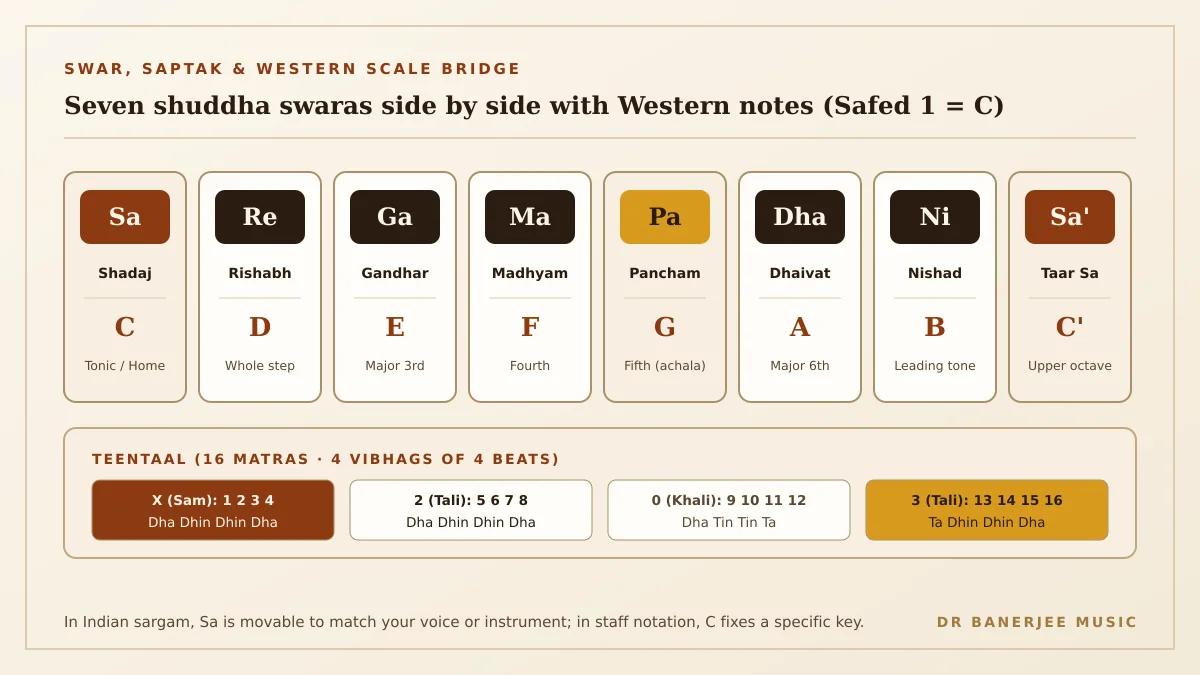
Open any harmonium or piano keyboard and count from one C (Safed 1) up to the very next C' — ignoring the final upper C', there are 7 white keys and 5 black keys: 12 notes in total. Almost all Indian and Western music you hear daily lives inside these 12 steps!
- 7 Shuddha Swaras (Natural notes):
Sa(षड्ज),Re(ऋषभ),Ga(गंधार),Ma(मध्यम),Pa(पंचम),Dha(धैवत),Ni(निषाद). If you takeSafed 1(C) as your homeSa, these seven shuddha swaras line up cleanly withC – D – E – F – G – A – B(theC Major/Bilawal Thaatscale). - 2 Achala (Fixed) Swaras:
SaandPanever move flat or sharp — they act like the ground floor and central pillar of your musical house. - 5 Vikrit (Altered) Swaras: four notes can step half a note lower as Komal swaras (
komal re,komal ga,komal dha,komal ni— matching flatsDb, Eb, Ab, BbwhenSa = C), whileMasteps half a note higher as Teevra Ma (F#).7 Shuddha + 5 Vikrit = 12 Swaras! - Three Saptaks (Octaves): Mandra Saptak (lower, warm chest register marked with a dot below), Madhya Saptak (comfortable middle register), and Taar Saptak (bright upper register marked with a dot above, e.g.
Sa').
One golden difference to remember: in Western notation, C always points to the same physical pitch (Safed 1). In Indian sargam, Sa is movable — if a singer's comfortable scale is Kali 1 (C#) or Safed 5 (G), that key becomes Sa, and the entire family of 12 swaras shifts smoothly with it!
2. Taal, Matra aur Tempo: Music Ka Heartbeat
Beautiful notes without steady time feel scattered, like words spoken with random pauses. Indian taal and Western time signatures describe the exact same musical heartbeat in two complementary ways:
- Matra / Beat: the steady pulse you tap with your foot (measured in BPM on a metronome).
- Keherwa Taal (8 matras:
4 + 4) & Western4/4time: the backbone of most Hindi film songs, Punjabi folk-pop, and Western acoustic strumming (1 2 3 4 | 5 6 7 8, withSam [X]on beat 1 andKhali [0]on beat 5). - Dadra Taal (6 matras:
3 + 3) &3/4or6/8feel: the gentle lilting pulse of ghazals, folk ballads, and waltz-style melodies (Dha Dhi Na | Dha Tu Na). - Teentaal (16 matras:
4 + 4 + 4 + 4): the foundational classical cycle (Dha Dhin Dhin Dha | Dha Dhin Dhin Dha | Dha Tin Tin Ta | Ta Dhin Dhin Dha), teaching you to hear where a 16-beat circle resolves cleanly on Sam (X).
3. Staff Notation aur Sargam Notation: Reading Without Fear
Beginners often ask whether they must learn five-line Western staff notation (Treble and Bass clef) or Indian Bhatkhande sargam notation:
- Five-line Staff Notation draws pitch visually up and down five horizontal lines and four spaces (
E–G–B–D–Fon treble lines,F–A–C–Ein the spaces), while note shapes (whole,half,quarter,eighthnotes) tell you exact beat duration. It is essential for two-hand piano/keyboard playing and graded Western boards. - Sargam & Chord/Tab Sheets write swara syllables grouped inside taal vibhags (or fret numbers on six guitar lines), making vocal phrasing, harmonium accompaniment, and Hindi song transposing super intuitive.
Confirm with your teacher right at the start how theory will apply directly to your chosen instrument — a guitarist needs fretboard intervals and chord-scale harmony right away, a pianist needs grand-staff reading alongside chord shells, and a vocalist or harmonium player thrives on thaat, swar-antar (ear intervals), and taal cycles!
4. Major vs Minor Chords: Sirf Ek Half-Step Ka Jaadu!
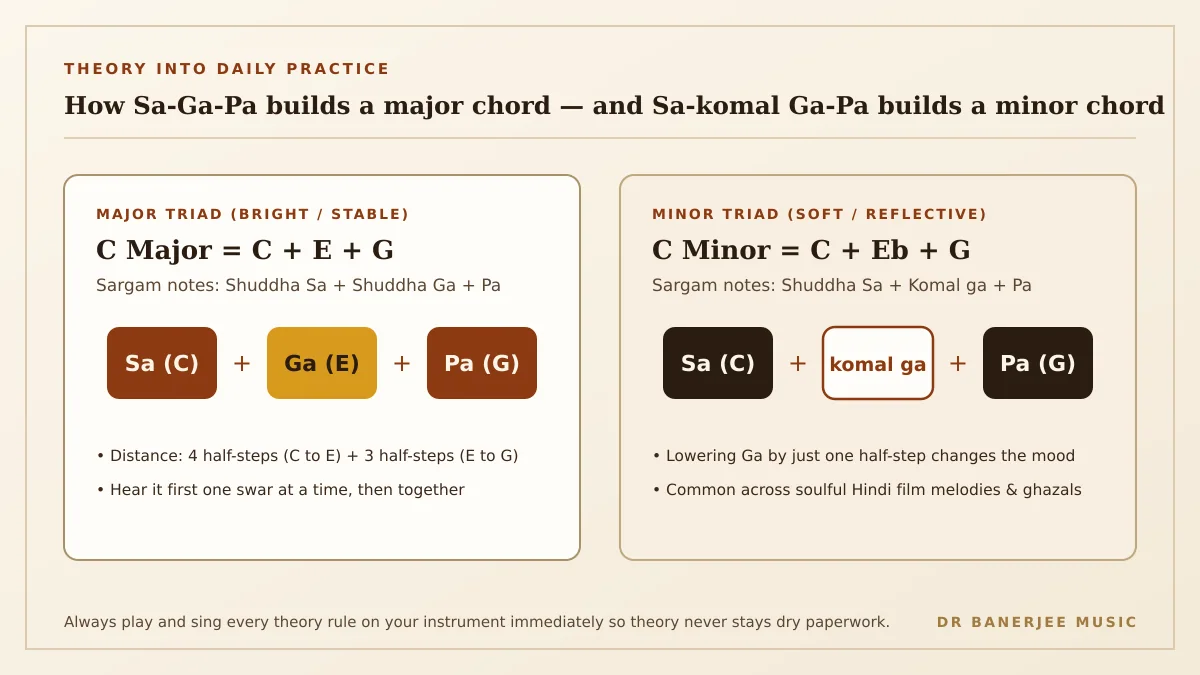
Ever wondered why one guitar or keyboard chord sounds bright and hopeful while another feels deep and nostalgic? Build a three-note chord (triad) using Indian sargam and the mystery vanishes immediately:
- Major Chord (
Sa + Shuddha Ga + Pa): start onC(Sa), count 4 half-steps up toE(Shuddha Ga), and 3 more half-steps up toG(Pa). PlayC – E – Gtogether — that is C Major! - Minor Chord (
Sa + Komal ga + Pa): keepC(Sa) andG(Pa) untouched, and simply lower the middle note by one single key fromEtoEb(Komal ga: 3 half-steps + 4 half-steps). PlayC – Eb – Gtogether — instantly you hear C Minor, the soulful mood behind countless Hindi melodies in Kafi or Asavari!
Music Theory for Beginners Hindi India: A 15-Minute Daily Home Routine
Never study music theory silently with your instrument closed in its bag! Spend 15 calm minutes a day connecting ear, hand, and notebook:
- Minutes 1–5 (Sing & Play Intervals): pick one
Sa(CorC#), sing and playSa–Ga,Sa–Ma,Sa–Pa, andSa–Komal gaslowly so your ear recognises each emotional distance. - Minutes 6–10 (Clap & Count One Cycle): set a metronome at
70 BPMand speakKeherwa,Dadra, orTeentaalbols aloud with clean hand claps (tali) and waves (khali) before touching a song. - Minutes 11–15 (Write 4 Bars in Your Notebook): jot down four bars of the melody or chord progression (
I – vi – IV – V, e.g.C – Am – F – G) you are currently practising so your eyes and ears learn together.
Learning Practical Music Theory Online with Dr Banerjee Music
Whether you want music theory explained comfortably in Hindi/Hinglish or English — for singing, guitar, piano/keyboard, harmonium, ukulele, bansuri, external board exams, or UGC NET Music — Dr Banerjee (Doctorate in World Music, University of Oxford; teaching since 1992) teaches live online across India through monthly one-to-one and group options.
Every online learner begins with a free 15–30-minute one-to-one introductory session before enrolment: we check your instrument or vocal background, confirm exactly how theory applies to the songs or exams you care about, and agree weekly timings; normal enrolment and monthly payment follow only if you choose to start. Explore plan details on the fees page, see how the free demo class works, or message through the contact page to confirm current India fees directly via WhatsApp (+91 62800 75157) or email drbnrj@gmail.com (for learners under 18, a parent or legal guardian shares guardian details, written permission, and the student's date of birth).
Frequently Asked Questions
Should I learn music theory before starting an instrument, or alongside it?
Always learn them together. Theory without sound feels abstract and forgettable; playing every scale, taal, and chord on your voice, keyboard, harmonium, or guitar the moment you learn it makes every concept stick for life.
Is Hindustani sargam completely separate from Western music theory?
Not at all — both describe the same 12 pitches per octave and steady rhythmic cycles from two rich angles. Learning how Bilawal aligns with the Major scale (Sa Re Ga Ma Pa Dha Ni = 1 2 3 4 5 6 7) lets an Indian musician navigate both worlds effortlessly.
Do singers really need chord or notation theory?
Even basic theory transforms a beginner singer: knowing your personal Sa, recognising whether a song sits in a major (Shuddha Ga) or minor (Komal ga) mood, and counting Keherwa vs Dadra beats stops off-key entries immediately.
Can children understand music theory explained in simple Hindi and English?
Yes! Children grasp sargam steps, clapping taals, and bright-versus-soft chords naturally when taught as listening games on their instrument rather than dry definitions.
Questions about this guide? WhatsApp 62800-75157 or drbnrj@gmail.com.