Online Music Classes for Children India: Age Aur Instrument Ka Guide

Doctorate in World Music, University of Oxford · teaching since 1992. More about the teacher.
Indian parents planning online music classes for children India age instrument choices usually ask two honest questions before anything else: "Kis age mein shuru karna sahi rahega?" and "Bachche ke haath aur interest ke hisaab se kaunsa instrument best hai?" Pick an instrument that is physically too heavy or demand 60 minutes of stiff sitting too early, and even a musical child begins avoiding practice within a month. Match the instrument to their curiosity, hand comfort, and attention span, and daily music becomes the happiest 15 minutes of their evening.
This practical parent guide explains how to judge true readiness beyond birth-year myths, how keyboard, ukulele, singing, harmonium, acoustic guitar, and bansuri compare for growing hands, and what supervision and child-safety standards every family should insist on online.
Readiness Comes From Three Signs — Not a Magic Birthday Alone
Two seven-year-olds can be at completely different stages of readiness for live online lessons. Before buying an instrument, watch for three simple everyday signs at home:
- Genuine curiosity toward sound: does your child hum film tunes, tap table rhythms, or gravitate toward keys or strings whenever they see an instrument?
- 15–20 minutes of calm listening: in an online lesson, the teacher guides verbally and visually rather than physically moving the child's fingers. A child who can follow calm two-step instructions ("place thumb on C, count 1–2–3–4") is ready for online learning.
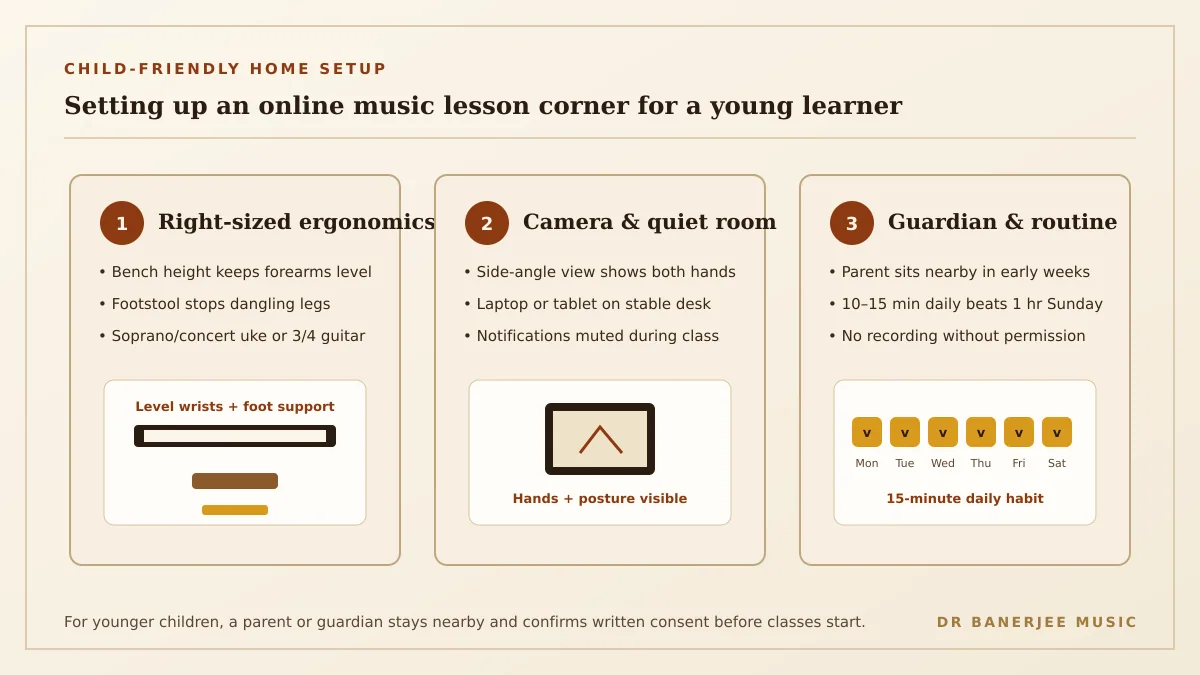
- Physical comfort with the chosen size: dangling feet at a high dining chair or stretching small fingers across a giant dreadnought acoustic guitar causes instant fatigue. Ergonomics matter just as much as age.
Because physical growth, vocal development, and syllabus pacing change rapidly between early childhood and the teenage years, sharing your child's date of birth (DOB) is required whenever age-based teaching applies — it lets the teacher recommend appropriate instrument scale lengths, safe vocal keys, and age-appropriate repertoire.
Online Music Classes for Children India Age Instrument Guide: Comparing Starter Choices
Here is how the most popular starter paths in Indian homes compare by physical comfort and learning curve:
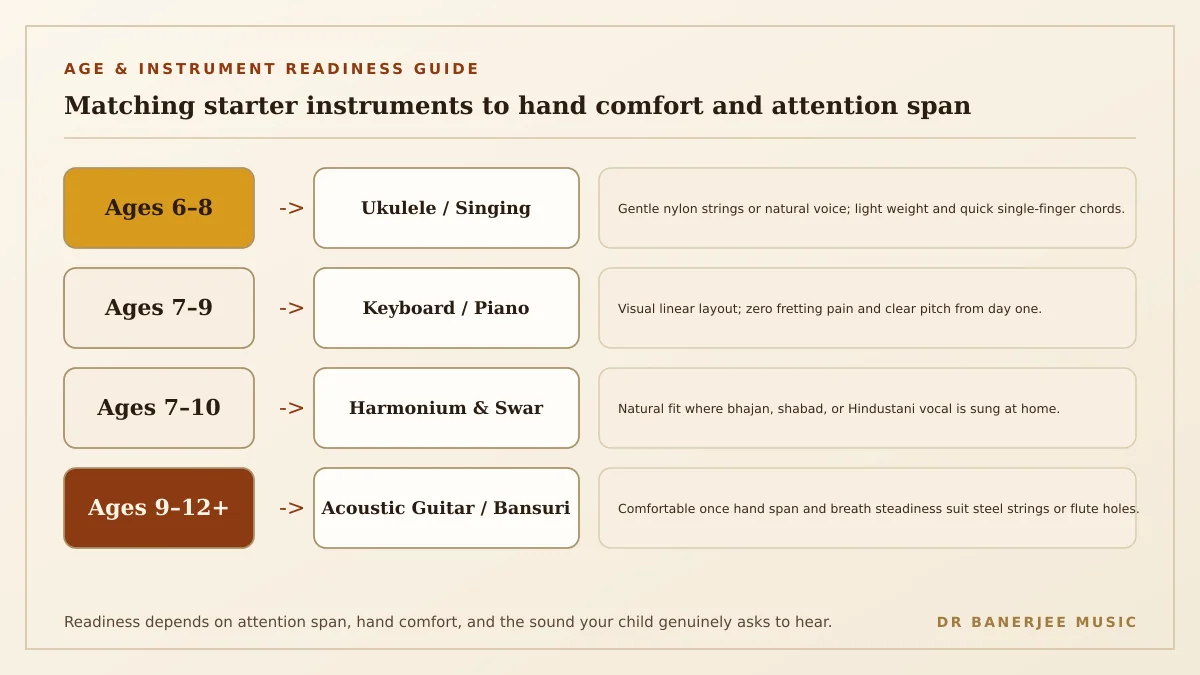
Ages 6 to 8: Singing, Ukulele, or Full-Size Touch Keyboard
- Singing (Swar, Balgeet, Devotional & Light Songs): zero physical weight to hold! Early vocal sessions focus on joyful pitch matching (
Sa Re Ga Ma), clapping steadyKeherwa/Dadrabeats, clear pronunciation, and healthy unforced singing — never loud shouting. - Soprano or Concert Ukulele: four soft nylon strings, feather-light wooden body, and one-finger starter chords (
CandAm) make the ukulele far kinder on young fingertips than a steel-string guitar. - Touch-Sensitive Keyboard / Digital Piano: pressing a key produces a clean note on day one without finger pain, and the left-to-right visual layout makes low-versus-high pitch crystal clear to young eyes.
Ages 7 to 10: Keyboard/Piano, Harmonium + Vocal, or 3/4-Size Guitar
- Harmonium with Sargam/Bhajan: if your household already listens to bhajans, shabads, or Hindustani melodies, learning right-hand sargam with gentle left-hand bellows builds deep Indian ear training early.
- Piano / Keyboard (Two-Hand Coordination): by 7–9, independent left-hand chord shells and right-hand melodies click nicely, along with staff notation or sargam reading.
- 3/4-Size Acoustic or Classical Nylon Guitar: if an eight-year-old specifically dreams of guitar, choose a properly set-up 3/4-scale instrument rather than handing down an adult full-size dreadnought.
Ages 9 to 13+: Full Acoustic Guitar, Bansuri, or Structured Exam Prep
- Acoustic Guitar: hand span and fingertip strength are now comfortable for full open chords (
G,C,D,Em,Am,Fmaj7) and rhythmic strumming. - Beginner Bansuri (C-Medium or G-Base Flute): requires steadier lung capacity and finger spread across open tone holes, so ages 9–10+ generally find embouchure (phoonk) control much less frustrating than six-year-olds.
Parent Supervision, Consent, and Recording Rules for Minors
Online education for children works best — and stays safest — when parents and teachers follow clear, transparent boundaries from the very first enquiry:
- Parent or legal guardian handles booking and consent: for any learner under 18, a parent or legal guardian makes the enquiry, shares guardian contact details and the child's date of birth, and confirms written guardian permission before classes begin.
- Stay nearby for younger children: for younger learners (especially ages 6–9), having a parent or guardian in the room or within easy earshot helps adjust camera angles, write down the week's two practice lines, and keep the child settled.
- Strict privacy and non-recording standard: Dr Banerjee does not record classes. More broadly, whenever your child learns anywhere online, never allow any platform, tutor, or third party to record audio, screenshots, or video of a minor — or post student clips on social media — without explicit guardian permission.
How Parents Can Make Home Practice Stress-Free
Scolding a child into a 60-minute Sunday practice session almost always backfires. Instead, anchor 12 to 15 minutes of daily practice to an existing calm routine — for instance right after evening milk/snack and before television or playtime. Praise clean posture and steady tempo rather than speed, and ask your child to "teach" you the new chord or sargam line on Friday evening!
Booking a Free 15–30-Minute Online Intro with Dr Banerjee Music
Not sure whether your child should start on keyboard, ukulele, guitar, harmonium, or singing? Do not buy an instrument blind first. Dr Banerjee teaches children, teenagers, and adults across India in monthly one-to-one and group options, starting with a free 15–30-minute one-to-one online introductory session before enrolment (attended with a parent or guardian for minors). Together we check your child's interest, comfort, and schedule; normal enrolment and monthly payment follow only if your family chooses to start.
Review plan structures on the fees page, see how the free demo class works, or message via the contact page to confirm current India fees and open after-school or weekend slots. Parents and guardians can reach Dr Banerjee directly on WhatsApp (+91 62800 75157) or email drbnrj@gmail.com with the child's date of birth and musical interest.
Frequently Asked Questions
What is the earliest sensible age to start online music lessons?
Most children settle well into live online 1:1 sessions around ages 6 to 7, once they can focus comfortably for 20–30 minutes with a parent nearby. Readiness always depends on individual attention span and comfort rather than age alone.
Should I buy the keyboard or guitar before the free introductory call?
Wait until the 15–30-minute intro call if you have not purchased one yet. Confirming whether your child needs a 61-key touch-sensitive keyboard, concert ukulele, or 3/4 guitar saves money and avoids wrong-sized gear.
Does a parent need to know music to help a child practise at home?
Not at all. Your role at home is simply keeping the instrument accessible on a stand, sitting nearby for younger children, and encouraging a cheerful 15-minute daily habit from the written lesson notes.
Are online classes recorded for children?
No — Dr Banerjee does not record lessons, and for any minor under 18, no recording is ever permitted without explicit guardian permission. Written notebook cues and clear in-class guidance replace video recordings safely.
Questions about this guide? WhatsApp 62800-75157 or drbnrj@gmail.com.