Playback Singing: The Quiet Collapse of an Economy

Doctorate in World Music, University of Oxford · teaching since 1992. More about the teacher.
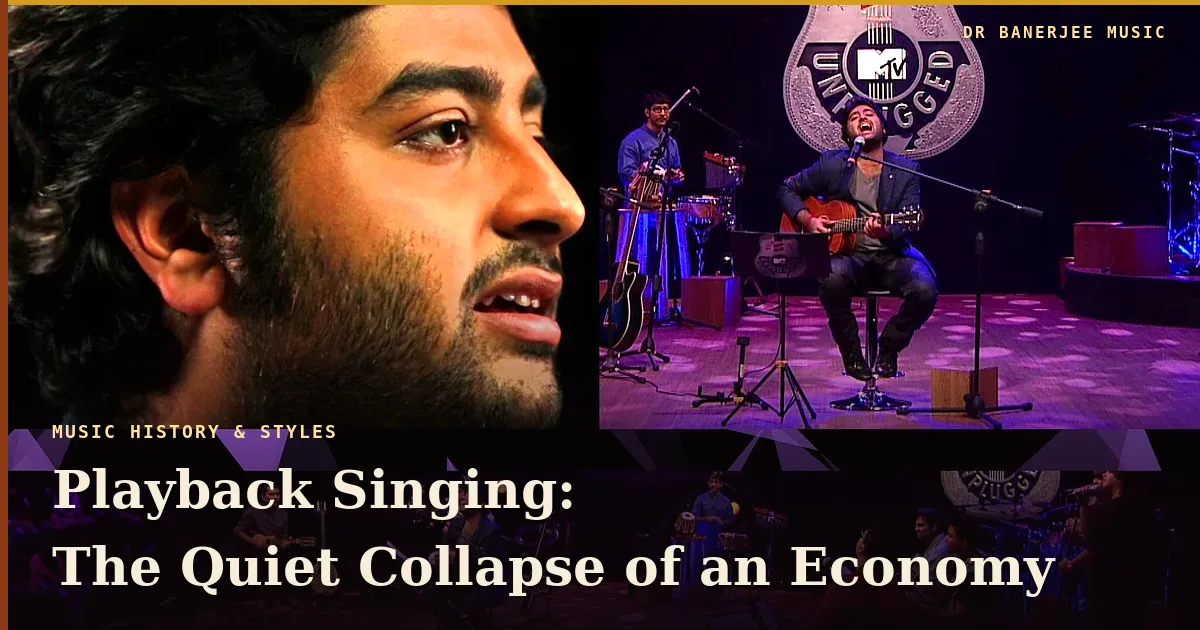
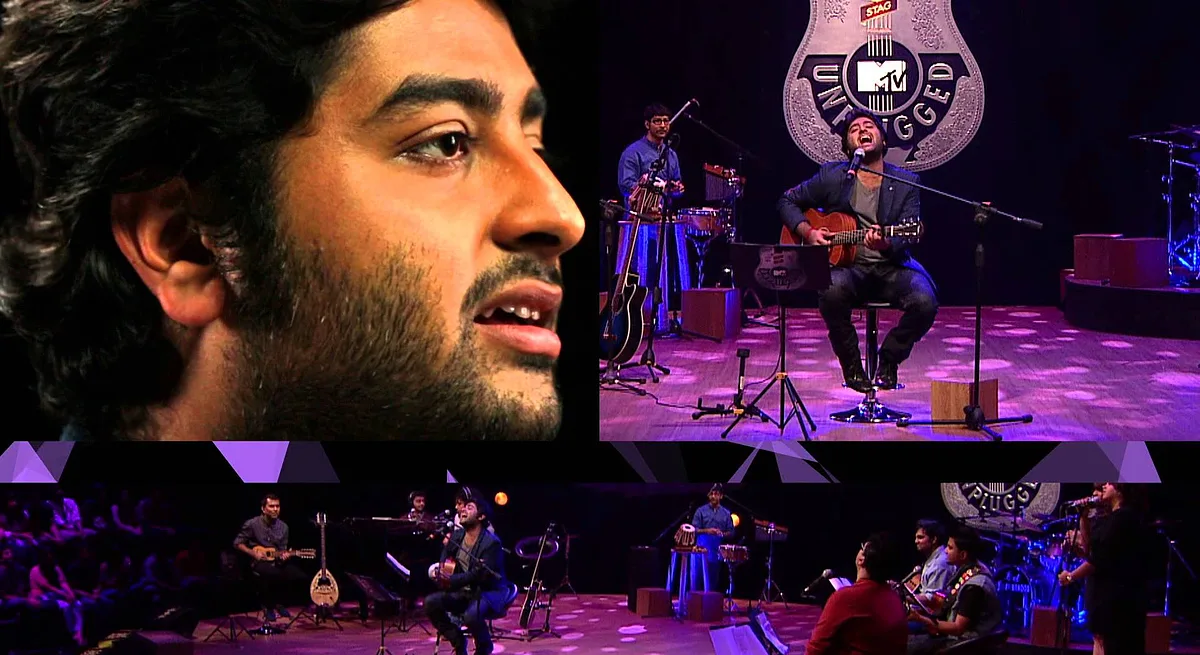
Playback singing did not collapse dramatically. There was no strike, no public reckoning, no institutional reform. What occurred instead was quieter and more revealing: the system reached a point where its most reliable musical labour no longer found the arrangement viable. The withdrawal of Arijit Singh from playback singing has been widely framed as personal fatigue or creative boredom, but such readings miss the structural truth. This was not an artist stepping away from relevance; it was an economy discovering, belatedly, that it had no mechanism to retain what it depended on most. This article does not argue for nostalgia or reform. It exists to document a failure.
Playback singing as a work system
Playback singing emerged as an industrial solution in mid-twentieth-century Indian cinema. Actors performed on screen; singers supplied voices off screen; music functioned as narrative support, emotional amplification and marketing infrastructure. Economically the system was simple: singers were paid fixed fees per song, rights were owned by producers or labels, and longevity, royalties and catalogue value were structurally irrelevant to the vocalist. The arrangement persisted because access to audiences was scarce and tightly controlled. When that scarcity ended — when streaming let artists reach listeners directly — the justification for surrendering ownership quietly disappeared, though the fee structure did not.
Discipline the accounts never recorded
Playback singing compensated output, not preparation. The decades of riyaz, breath control, tonal discipline and stylistic restraint that made a voice dependable were economically invisible. The system paid per song while quietly extracting time efficiency in studios, reduced retake risk, emotional accuracy on demand, and aesthetic credibility by association. None of this accumulated as capital for the singer within the playback economy. What the industry took for granted was not popularity but dependability — and dependability was precisely the thing it never learned to price. This is the same undervaluing of slow, unglamorous work I describe in how much weekly practice genuinely takes.
The opportunity cost nobody calculated
While one voice was repeatedly deployed to repair musical inadequacy, other possibilities were deferred or never explored. Original repertoires were postponed, long-form musical thinking was discouraged, and audiences were trained to recognise timbre rather than composition. The loss is not the absence of a single singer; it is the body of work that was never commissioned because the system chose expedience over development. Remix culture intensified the stagnation, recycling familiar melodies to reduce compositional risk while hollowing out musical research, so that vocal performance became a legitimising layer applied to pre-validated material. Meanwhile the same forces reshaping authorship elsewhere — as I argue in generative AI and the collapse of musical authorship — made ownership matter more, not less.

Why the system could not adapt
Playback singing persisted structurally unchanged even as its economic justification eroded. Fixed fees remained the norm, rights ownership stayed consolidated, and creative decisions stayed risk-averse. At no point did the system invest in long-term musical continuity; it consumed present value without provisioning for the future. This is not malice but organisational inertia — the same inertia that keeps failing models running long after their logic has expired. For practitioners the lesson is direct: film-dependent music is no longer a sustainable professional foundation, and training exclusively for playback relevance prepares musicians for a shrinking, unstable market. For educators the implication is unavoidable — teaching must prioritise technique, musicianship, production literacy and ownership awareness over cinematic aspiration, a point that echoes why so many online music courses fail.
From centralised voices to fragmented authority
The era of singular "hero voices" defining musical decades is unlikely to return. What replaces it is fragmentation: multiple artists, regional identities, independent catalogues and direct audience relationships. This redistribution does not romanticise independence — it increases responsibility, because artists now carry the burden of sustainability previously absorbed, however imperfectly, by institutions. The collapse of playback singing marks the end of delegation. Music has returned to its makers. Playback singing did not disappear because artists rebelled; it disappeared because its economic logic expired, and the system exhausted its most valuable labour without evolving a framework to retain it. This article does not mourn what is gone. It records why it could not stay.
Frequently Asked Questions
Why did Arijit Singh step back from playback singing?
This article reads it structurally rather than personally. Streaming ended the scarcity that made the fixed-fee, producer-owned model tolerable, yet the model never changed. A dependable artist eventually found the arrangement unviable, exposing an economy with no mechanism to retain the labour it relied on most.
What was wrong with the playback fee system?
It paid per song for output while ignoring preparation. Years of riyaz, breath control and tonal discipline were economically invisible, and rights stayed with producers or labels. Singers built no catalogue value or royalties, so the system extracted reliability without ever letting it accumulate as the artist's capital.
What should musicians learn from this collapse?
That visibility without control is not a career strategy. Film-dependent work is now unstable, so musicians should build technique, production literacy and ownership of their catalogues. The emerging landscape rewards self-sufficiency and direct audience relationships rather than compliance with a centralised, fixed-fee system.