Harmonium Online Lessons for Beginners (Bhajan aur Punjabi Songs)


Doctorate in World Music, University of Oxford · teaching since 1992. More about the teacher.
Few instruments sit closer to the heart of an Indian home than the harmonium. Chahe ghar ki sandhya aarti aur bhajan mandali ho, shabad kirtan ho, ya mehfil mein Punjabi lok-geet aur sufi kalaam gaana ho — the warm reed sustain of a harmonium supports the human voice like an instant companion. Starting harmonium online lessons for beginners India lets you build clean two-hand coordination right where your harmonium already rests, without carrying a heavy wooden instrument through city traffic every week.
Yet many self-taught learners hit two stubborn walls when copying fast finger-tutorial videos on YouTube: their left hand pumps the bellows in jerky bursts that chop every vocal line in half, and they memorise visual key shapes on Kali 1 without understanding swar or how to adjust the scale to their own voice. Here is how methodical online harmonium tuition builds effortless bhajan and Punjabi song accompaniment from day one.
Why Harmonium Feels Different From Electronic Keyboard
At a glance, harmonium keys look identical to a small keyboard, so beginners sometimes treat both the same way. In reality, the harmonium is a breath-driven acoustic reed instrument:
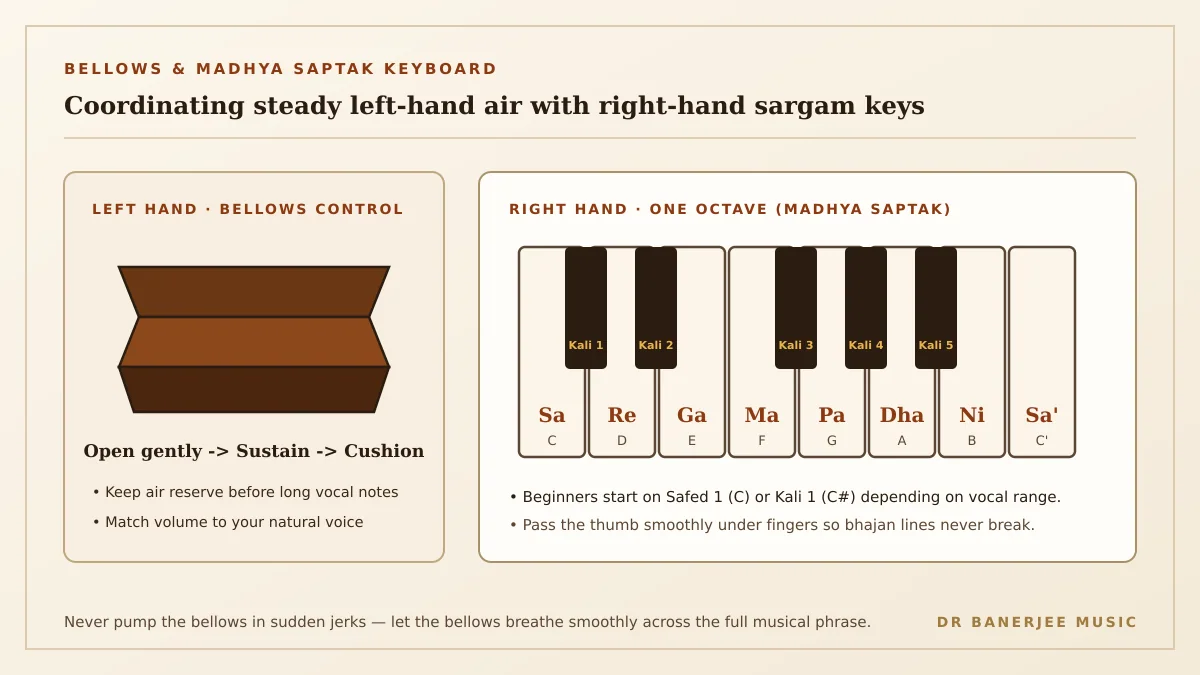
- Your left hand shapes every dynamic: pressing a plastic keyboard key harder makes it louder, whereas pressing a harmonium key harder changes nothing — all expression, warmth, and phrase tapering come from how smoothly your left hand opens and cushions the bellows (bhathi).
- Your right hand plays vocal legato: because Indian bhajans, dohas, and Punjabi folk melodies move in connected vocal curves rather than percussive staccato jumps, smooth thumb-under fingerings (
1–2–3–1–2–3–4) keep reed transitions seamless so there are no awkward silent gaps mid-word. - Stops and drones matter: knowing which main air stops (kalli) to pull — while avoiding unnecessary tremolo or out-of-tune drone knobs on budget instruments — gives you an immediate, dignified tone.
What Structured Harmonium Online Lessons for Beginners India Cover Step by Step
In live online lessons, your teacher watches both the angle of the bellows and your right-hand fingers while listening to how the reed sound blends with your singing voice:
1. Bellows breathing ("Bhathi" control)
Before racing across octaves, you learn to open the bellows softly just before pressing Sa, hold an unshakeable steady air cushion for eight slow counts, and let the bellows settle gently at the end of a line — never slamming shut mid-syllable.
2. Choosing the right home scale (Safed vs Kali)
Many internet tutorials force every single learner onto Kali 1 (C#) or Kali 4 (G#), regardless of whether that pitch strains your throat! A proper teacher tests your natural vocal range first — whether your comfortable Sa sits on Safed 1 (C), Kali 1 (C#), Safed 2 (D), Kali 4 (G#), or Safed 6 (A) — and teaches you sargam landmarks so you are never trapped in someone else's key.
3. Alankars and Thaats that unlock real songs
Practising 10 minutes of alankars in Bilawal (all shuddha swaras), Kalyan (teevra Ma), Kafi (komal Ga, komal Ni), and Bhairavi trains your fingers to find the exact roadmaps used by hundreds of traditional bhajans (like Payoji Maine Ram Ratan Dhan Payo or Shiv Ashtakam) and soulful Punjabi melodies.
4. Accompaniment skills vs solo melody playing
Playing every single vocal syllable loudly on the harmonium while singing actually drowns out your voice! Good lessons teach true sangati (accompaniment): holding a warm Sa–Pa or Sa–Ga–Pa cushion under sustained vocal words, echoing short melodic turns (antara links) in the gaps between vocal phrases, and locking rhythmically to Keherwa (8 beats) and Dadra (6 beats).

Setting Up Your Harmonium for Clear Online Classes at Home
- Sit on a folded dari/mat on the floor or at a low table: keep your spine upright and pull the harmonium close enough that your left elbow moves freely without hunching your shoulder.
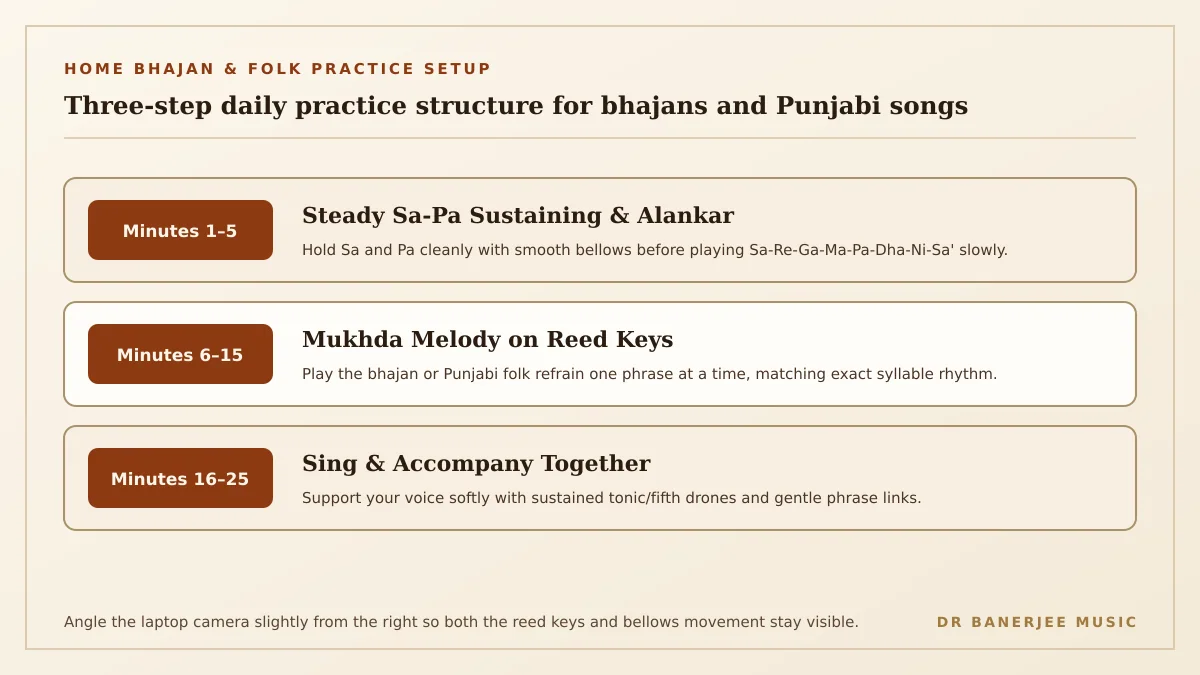
- Angle the phone or laptop slightly from the right: a diagonal side-front camera view shows both the reed keys and the top fold of your bellows in one frame.
- Turn off call noise suppression: enable original sound on Zoom or keep clean microphone spacing on Meet/WhatsApp Video so sustained harmonium reeds are not filtered out as "background hum."
- Confirm repertoire before enrolling: if your main joy is traditional Hindi bhajans, Kabir dohas, shabads, or Punjabi folk/sufi songs, confirm during your introductory chat that the teacher genuinely teaches both sargam foundations and those song traditions.
Buying or Checking Your First Harmonium
If you already have an older family harmonium at home, do not rush to buy a new one before your intro call — minor air leaks or sticky keys can often be assessed in two minutes on camera. If you are buying fresh, a dependable standard 3.25-to-3.5-octave, 2-reed (Bass–Male or Male–Female) portable or Amritsari/Kolkata-style folding/box harmonium tuned near A=440 Hz is plenty for years of home learning.
Trying a Free 15–30-Minute Online Intro with Dr Banerjee Music
Dr Banerjee teaches harmonium, devotional/bhajan accompaniment, Punjabi and Hindi song phrasing, sargam, and Hindustani vocal live online across India through monthly one-to-one and group options. Before any enrolment or payment, online students meet Dr Banerjee in a free 15–30-minute one-to-one introductory session — we check your harmonium (or guide you before buying one), find your comfortable vocal scale, discuss the bhajans or Punjabi songs you wish to learn, and agree weekly timings; normal enrolment and monthly payment follow only if you choose to start.
Check current plan structures on the fees page, read how the free demo class works, or message through the contact page to confirm current India fees and open slots directly. Reach out on WhatsApp (+91 62800 75157) or email drbnrj@gmail.com (for learners under 18, a parent or legal guardian shares guardian details, written permission, and the student's date of birth for age-based pacing).
Frequently Asked Questions
Do I need prior singing training to start harmonium lessons?
No. Beginners can learn harmonium purely as a melodic instrument or combine gentle humming and vocal sargam alongside the keys — in fact, the harmonium's visual layout helps beginners hear pitch relationships much faster.
Can children learn harmonium online comfortably?
Yes, usually from around ages 7–8 onwards once their left arm can open a light smoothly-bellowed harmonium without shoulder strain. Parents share the child's date of birth for age-appropriate sizing and stay nearby for younger learners.
Should I learn harmonium in sargam (Sa Re Ga) or Western notes (C D E)?
For bhajans, kirtan, ghazals, and Punjabi folk songs, Indian sargam (Sa Re Ga Ma Pa Dha Ni) is far more natural because songs move easily to match any singer's personal scale, though knowing how Safed 1 = C maps across keys is simple to learn alongside it.
How much daily practice is needed to play my first two bhajans smoothly?
Twenty to twenty-five calm minutes a day beats long irregular sessions. Most beginners play steady alankars and their first simple bhajan or folk refrain cleanly within four to six weeks of guided practice.
Questions about this guide? WhatsApp 62800-75157 or drbnrj@gmail.com.