Dilruba Dilnasheen Chords for Guitar, Ukulele & Piano


Doctorate in World Music, University of Oxford · teaching since 1992. More about the teacher.
Dilruba Dilnasheen chords in the supplied sheet are D#, Cm, G# and A#. I read the same sounding harmony as Eb, Cm, Ab and Bb, which makes the piano notes and harmonic relationships easier to explain. For guitar, a capo at fret 3 lets you use C, Am, F and G shapes. On a standard G–C–E–A ukulele or on piano, you can play the sounding chords directly.
This is my practical lesson for the song by Rito Riba, with lyrics by Siddhant Kaushal. I keep the supplied lyric spelling and chord placements intact below, then explain how to use that chart on three instruments. It is a teaching accompaniment, not a claim to transcribe every instrumental layer of the recording. The chart does not specify an exact tempo, strumming pattern or complete rhythmic notation, so I do not invent those details.
Song credits and official video
- Song: Dilruba Dilnasheen, from Dilfek
- Singer and composer: Rito Riba
- Lyrics: Siddhant Kaushal
- Music production: Tongs Kichu
- Published by: Play DMF; presented by Anshul Garg
- Official-video upload date: 16 October 2026
- This lesson published: 28 November 2026
Credits and the video date are checked against the Play DMF video supplied for this lesson. The featured image uses that video's promotional artwork, not an invented photograph or a new song cover. The diagrams further down are my teaching illustrations, separate from the official artwork.
If the embedded player is unavailable, open the song on YouTube. I recommend listening to the entry of each phrase before adding a busy accompaniment; recognising a chord name and recognising where that chord belongs are different skills.
The chord map: D# or Eb?
D# and Eb are the same sounding pitch on an equal-tempered guitar, ukulele or piano. The supplied chart mixes the sharp spellings D#, G# and A# with Cm. I preserve those labels in the lyric sheet, but use Eb–Cm–Ab–Bb when discussing the harmony. In an Eb-major framework, that is I–vi–IV–V: the home chord, its relative minor, the fourth-degree chord and the fifth-degree chord.
That four-chord loop is a useful overview, not an instruction to force every line into four equal bars. The opening moves between D# and A#, with G# appearing along the way. The title section also returns to D# at particular lyric points. Near the end, the supplied bridge alternates G# and A# before resolving to D#. Follow those written changes rather than cycling the overview mechanically through every section.
A bracket inside a word marks a mid-word change. Hold the current chord until the next bracket; do not move simply because the text wraps onto a new screen line. The notation below is horizontally scrollable on smaller screens so the chord-and-word relationship is not mistaken for a new musical phrase.
Guitar: use capo 3 or play the sounding chords
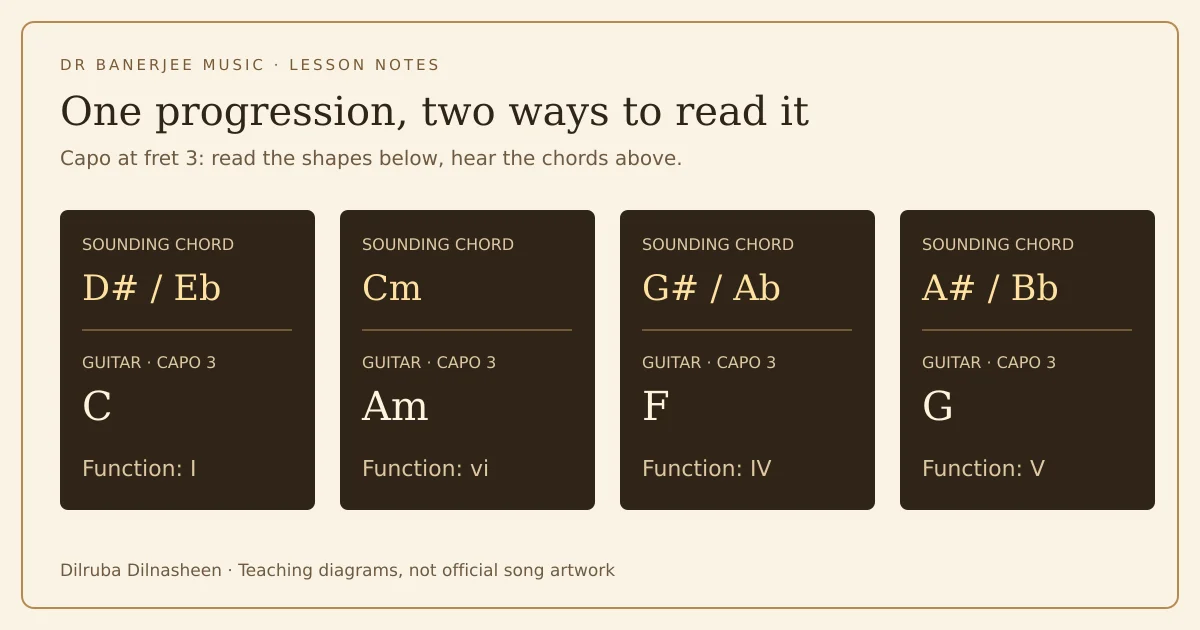
For the capo route, place the capo immediately behind the third fret and check the tuning again. Read every D# as a C shape, every Cm as Am, every G# as F, and every A# as G. Fret numbers for these shapes are measured from the capo, not from the nut. The capo raises the sounding pitch by three semitones; it does not change where the lyric asks you to move.
I start with single gentle strokes while the fretting hand learns the changes. The C-to-Am move is usually a good place to establish a relaxed hand, but the F shape may require more attention. A smaller F voicing on the upper four strings can be played as 3–2–1–1, reading from the D string towards the high E, relative to the capo. Keep the two lowest strings silent. That contains the notes of the F shape and sounds as Ab with capo 3.
If you do not use a capo, play Eb, Cm, Ab and Bb voicings directly. Avoid substituting open C for Eb while leaving the other chords unchanged: that is neither the supplied harmony nor a consistent transposition. If the vocal key needs to change, move the entire progression by the same interval. I can help choose a workable key and fingering in guitar lessons.
Ukulele: four shapes in standard tuning
On a soprano, concert or tenor ukulele in G–C–E–A tuning, try the following no-capo voicings. Read each four-digit group in string order G, C, E, A; zero means an open string. These are fret numbers, not finger numbers:
- Eb / D#: 0–3–3–1
- Cm: 0–3–3–3
- Ab / G#: 1–3–4–3
- Bb / A#: 3–2–1–1
The Eb voicing includes G on the open fourth string; every string does not have to begin on the chord's root. The same shapes work with high-G or low-G tuning, though the bass register changes. They are not instructions for a baritone ukulele tuned D–G–B–E. Check the tuning before applying a fingering chart from another instrument.
I would isolate Ab to Bb first if that change interrupts the pulse. Sound one string at a time and check whether a finger is muting its neighbour. Pressing harder across the whole hand is not a reliable solution. Once the notes are clear, add the next chord without stopping the count. The ukulele course explains how I check this movement in a live lesson.
Piano: build the triads, then connect them
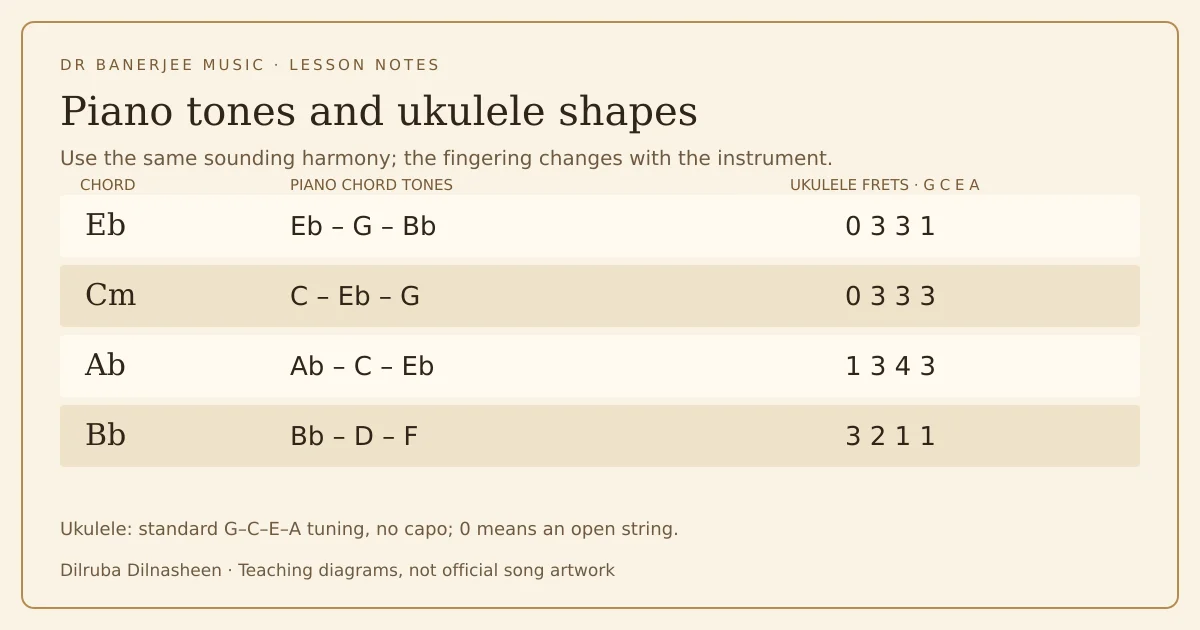
The piano triads are Eb–G–Bb, C–Eb–G, Ab–C–Eb, and Bb–D–F. Begin with the right hand alone, using a comfortable register. Add a single root in the left hand only when the changes are reliable. A quiet, clear block chord is enough to learn the lyric placements; a flowing accompaniment can come later.
To reduce movement, try Eb–G–Bb → Eb–G–C → Eb–Ab–C → D–F–Bb in the right hand. These are inversions of the same chords, not extra harmonies. Notice that Eb and G can remain while Bb moves to C between the first two shapes. The aim is to hear connected movement instead of jumping the entire hand back to root position at every change.
Leave the sustaining pedal out while checking the notes. If you later add it, clear the previous harmony when the chord changes so the notes do not blur together. The title line needs room for the voice; keyboard activity should support it rather than compete with it. For coordination and reading support, see piano and keyboard lessons.
Dilruba Dilnasheen chord-and-lyric sheet
The supplied sheet is reproduced below with its spelling, repetitions and chord placements preserved. Use the conversion above if you are reading guitar capo shapes or the flat spellings for piano.
D# Cm G# A#

(D#)Qaabil-e-(A#)taareef (D#)tu
(D#)apsara'on (A#)jaisi huu-ba-(D#)huu
Dikhe (D#)nigaahon ko (A#)tu ku-ba-(G#)ku (A#)
tera (D#)asar har(A#)dam ru-ba-(D#)ru

Meh(D#)booba main deevaana
I just (Cm)wanna tell you jaana
(G#)Teri ada'on ke qatre
shabna(A#)mi

(D#)Dilruba dil-nasheen
(Cm)ba-khuda tu haseen
(G#)tere jaisi hoor na ko(D#)i
(D#)Tum mile gul khile
(Cm)Gul khile jo tum mile
(G#)gulzar zinda(A#)gi yeh ho ga(D#)yi

(D#)Dilruba mere dil-nasheeen
(Cm)Dilruba mere dil-nasheeen
(G#)Dilruba mere dil-nasheeen
(D#)Dilruba mere dil-nasheeen

D# Cm G# A#

(D#)Main bhoolne laga hoon
(Cm)Kaam-kaaj sab kyun
(G#)kyunki tuney hai zehan ko (A#)qaid kar liya
(D#)Khalbali machi hai
(Cm)Akl na bachi hai
(G#)dakhl tuney zindagi mein (A#)iss qadar diya
Bana main (D#)Majnu mastaana
(Cm)Aashiq puraana
(G#)Sun le dil-phenk hoon (A#)nahin

Meh(D#)booba main deevaana
I just (Cm)wanna tell you jaana
(G#)Teri ada'on ke qatre
shabna(A#)mi

(D#)Dilruba dil-nasheen
(Cm)ba-khuda tu haseen
(G#)tere jaisi hoor na ko(D#)i
(D#)Tum mile gul khile
(Cm)Gul khile jo tum mile
(G#)gulzar zinda(A#)gi yeh ho ga(D#)yi

(D#)Dilruba mere dil-nasheeen
(Cm)Dilruba mere dil-nasheeen
(G#)Dilruba mere dil-nasheeen
(D#)Dilruba mere dil-nasheeen

D# Cm G# A#

Kya (G#)cheez hai tu
Kya (A#)cheez hai
Kya (G#)cheez hai
O (A#)meri dilruba
Yeh tera (G#)noor hai
Ya (A#)suroor hai
(G#)Fitoor tera chadh chu(A#)ka hai dilru(D#)ba
Put the sections together without losing the voice
I practise the opening separately from the recurring four-chord loop. First speak its words and point to each bracket. Then play only the chord attacks. Finally sing the line while keeping the accompaniment light. If the chord movement makes you swallow a syllable or rush a breath, reduce the task to the transition around that word rather than repeating the whole song.
For the title section, practise the move from Cm through G# and back towards D# exactly where the sheet places it. A learner who has memorised only D#–Cm–G#–A# may insert an A# automatically even where the chart returns directly to D#. That is a memory shortcut to correct, not a reason to rewrite the supplied sheet.
At the bridge, isolate G#–A# and its eventual D# arrival. Count through the sustained chord instead of shortening it because nothing new is happening in the fretting hand. When that works, join the preceding phrase to the bridge so that the new section has an entry, not just a shape you can play from silence.
The chart does not certify a particular strum or BPM. I use a slow practice pulse that leaves enough time for a clean change; the free metronome can help check whether that pulse continues between chords. It cannot tell you whether the singer's range is comfortable or whether a chord is muffled. Those details need listening and, when necessary, individual correction.
Related song lessons
For another supplied-chart lesson with chord changes inside the words, read Jaiye Sajana chords. For a different minor-key route and a specific Bm voicing, try Gehra Hua guitar chords. The Hindi song-chord collection gathers the lessons without treating every song as the same exercise.
Frequently Asked Questions
What are the Dilruba Dilnasheen chords in this lesson?
The supplied chart uses D#, Cm, G# and A#, equivalent in sound to Eb, Cm, Ab and Bb. I keep the supplied labels in the lyric sheet. The four-chord overview does not replace the individual changes written inside the verses, title section and bridge.
Can I play Dilruba Dilnasheen with easy guitar shapes?
Yes: put a capo at fret 3 and use C, Am, F and G shapes for D#, Cm, G# and A# respectively. Move at the same lyric points. F still needs clean fretting; a capo simplifies the shapes but does not automatically solve every hand-position problem.
Which tuning do the ukulele chord numbers assume?
The numbers assume standard G–C–E–A tuning, without a capo, and are read from the G string to the A string. They work for high-G and low-G setups, with a different bass register. Do not apply them unchanged to a D–G–B–E baritone ukulele.
Is the piano version a different chord progression?
No. Piano uses the same sounding chords: Eb, Cm, Ab and Bb. Inversions change which note is lowest in a voicing, not the chord identity. I start with clear triads and simple left-hand roots before adding a more continuous accompaniment under the sung line.
Does this lesson give the exact recorded strumming pattern?
No. The supplied sheet gives chord names and lyric placements, not a complete rhythmic transcription or verified tempo. I explain a way to learn the changes without claiming one fixed studio strum. Use the linked video as your listening reference and keep your first accompaniment simple.
Questions about this lesson? WhatsApp 62800-75157 or drbnrj@gmail.com.